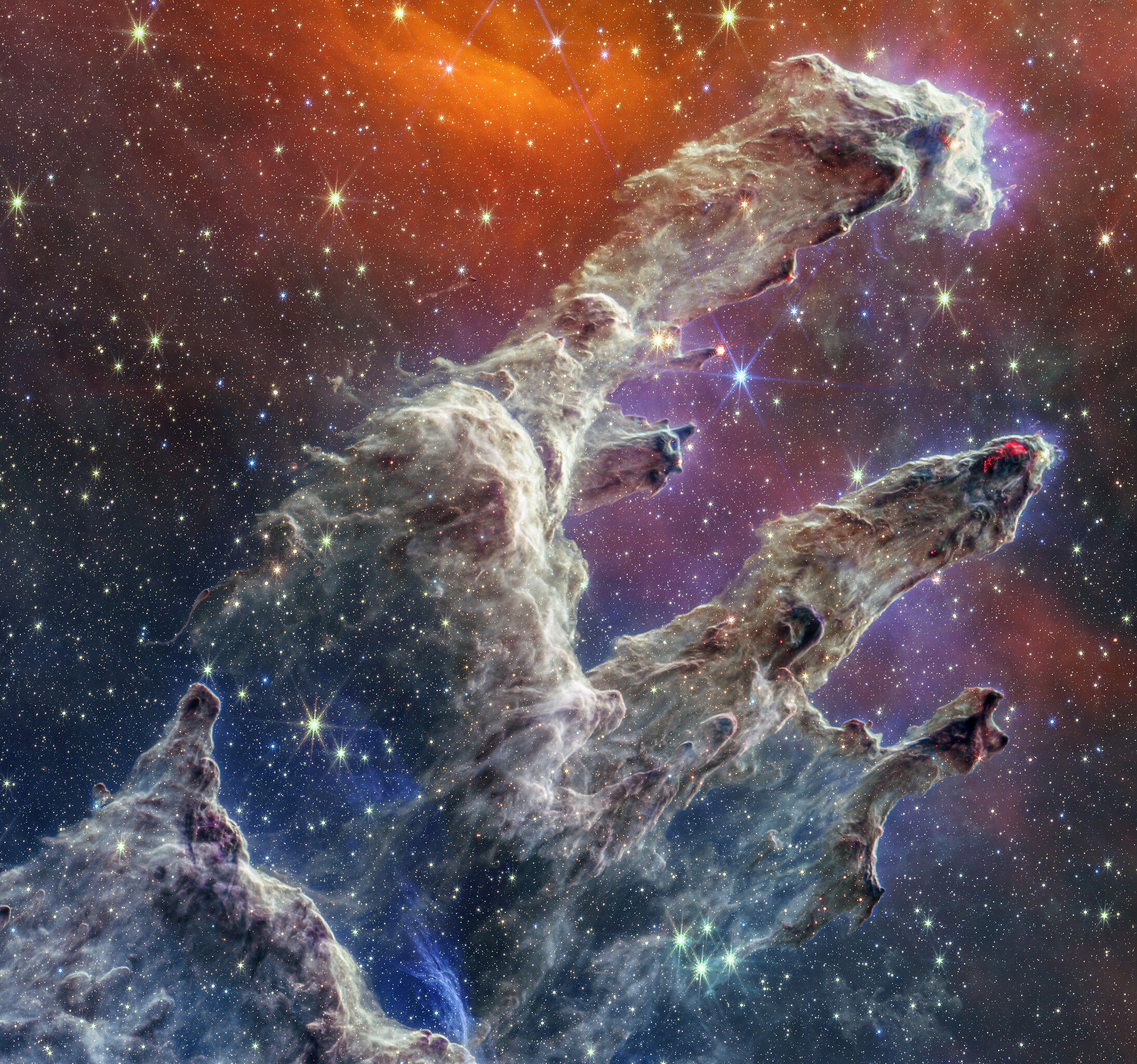

The “Pillars of Creation” are immense columns of cold gas and dust sculpted by the intense radiation and winds from nearby massive stars. In visible light, the pillars appear opaque, hiding the action within. Infrared light, however, penetrates the dust, exposing the structures where stars are actively forming. This composite merges data from Webb’s Near‑Infrared Camera (NIRCam) and Mid‑Infrared Instrument (MIRI) to highlight different physical components: near‑infrared wavelengths emphasize stars, while mid‑infrared wavelengths trace the thermal glow of dust grains and complex molecules that coat the pillars.
Along the edges of the columns, you can spot telltale signs of stellar birth. Bright, compact points mark protostars still accreting material. In several places, wispy, “lava‑like” streaks betray jets—high‑speed outflows launched from nascent stars’ poles as gas spirals onto them via disks. When these jets slam into surrounding material, they carve cavities and generate shock fronts that compress nearby gas, potentially triggering a second generation of stars.
The pillars themselves are shaped by a balance of competing processes. Ultraviolet radiation and stellar winds from hot, massive neighbors erode their surfaces, photo‑evaporating the gas and sculpting finger‑like forms that point back toward the energy sources. At the same time, gravity within the densest clumps resists dispersal, allowing cores to collapse and heat until fusion ignites. Over time, the pillars will be whittled away, leaving clusters of young stars where dusty cocoons once stood.
Color assignments in this image translate invisible infrared wavelengths into visible hues, making physical differences legible: stars stand out in the near‑infrared, while dust and complex organics glow in the mid‑infrared. Together they provide a layered view of how the interstellar medium seeds, shields, and ultimately reveals newborn suns.


Leave a Reply