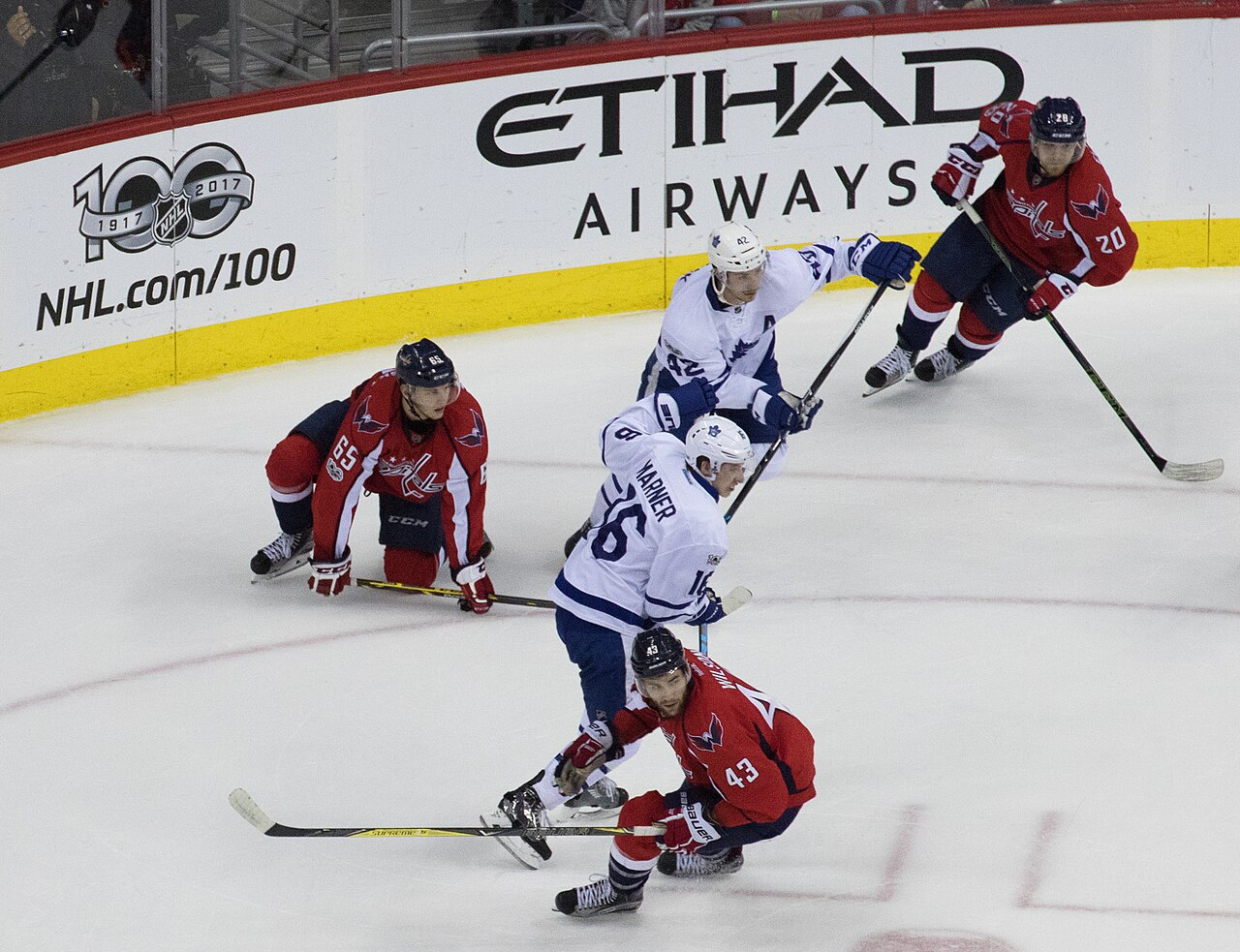
I was tired of hearing about playoff experience when I was about twelve. It’s a trope that exists in every sport with a postseason, but it exerts terrifying explanatory power in a tournament as random as the Stanley Cup Playoffs. The playoffs, players and coaches will attest, are a different animal. A young team, even a talented one, struggles to match the intensity dialed to eleven.
When my Toronto Maple Leafs were young and cute, they arrived in the postseason ahead of schedule for an ill-fated bout with the President’s Trophy-winning 2016–17 Washington Capitals. The vibes were immaculate. Comment sections exuded grandfatherly patience, not the current sunglassed-uncle rage. The Leafs earned grizzled grit points for going 2–1 up off a tricky overtime goal created by veteran Brian Boyle on a classic veteran play.
There was this certainty that wonderful things were coming. That this lovable bunch of wunderkinds would mature into Boylian fundamentals.
Of course, the Leafs didn’t win that series. They never went all-in while their young core overperformed on entry-level contracts. As their playoff game totals piled up over this dire decade, the experience narrative gave way to one of chokers and losers.

Fast forward seven years. My graduating sport media class was allowed to write a literature review on anything we wanted. Some tackled noble causes—gender dynamics in sports coverage, concussion stats, the Rooney Rule. I decided to interrogate my longstanding pet peeve.
On Floundering Literature Reviews
To my delight, a surprising amount of scholarly work exists purely to interrogate pet peeves—though researchers never admit it outright. They insist their studies will help gamblers. Or GMs who still renew their JSTOR subscriptions.
But literature devoted to postseason experience is surprisingly thin. Early research often lacks a clear framework and reaches for analogies about workplace performance.
That doesn’t really work. Postseason experience isn’t about older players being better than younger ones. It’s about players used to elevated intensity performing better under pressure. Experience in high-pressure environments—not experience for its own sake.
What the Data Says
Dr. N. David Pifer is one of the few researchers to build a whole study around playoff experience. His 2019 article in the Journal of Sports Analytics analyzed March Madness brackets over a ten-year span. I interviewed him for this piece.
To my frustration, his findings showed a small but statistically significant trend. Class rank didn’t predict success—but from the Sweet 16 onward, minutes of prior tournament experience among starters did. A 27-minute edge translated to roughly a one-point advantage per game. That may sound small—until you realize those games are often decided by ten points or fewer.
Unlike earlier work, Pifer’s study considers psychological theory. He cites Hans Eysenck’s inoculation hypothesis: exposure to stressful scenarios can build resilience to future stressors.
“Once you’re exposed to something—inoculated to it—in theory, that should make you immune to the stresses that follow,” Pifer explained.
I found a similar concept in Roy Baumeister’s 1984 Journal of Personality and Social Psychology paper on Explicit Monitoring Theory. It’s about choking under pressure. Do something 100 times, and you’re confident. But in front of an audience, you fixate on each step. That self-consciousness impairs performance. Like inoculation, repeated exposure may help.
Many EMT studies come from sports—and they’re a blast to read. McEwan et al. (2012) split university students into three putting groups: one told it was casual, one competitive, and one for a cash prize. Everyone performed similarly at first. But when told a “tiebreaker” would determine the winner, the high-pressure group sank nearly twice as many final putts.
It seemed to support the theory. And a 2019 replication of Pifer’s study in the women’s bracket found an even stronger experience-performance link.
The Pro Sports Problem
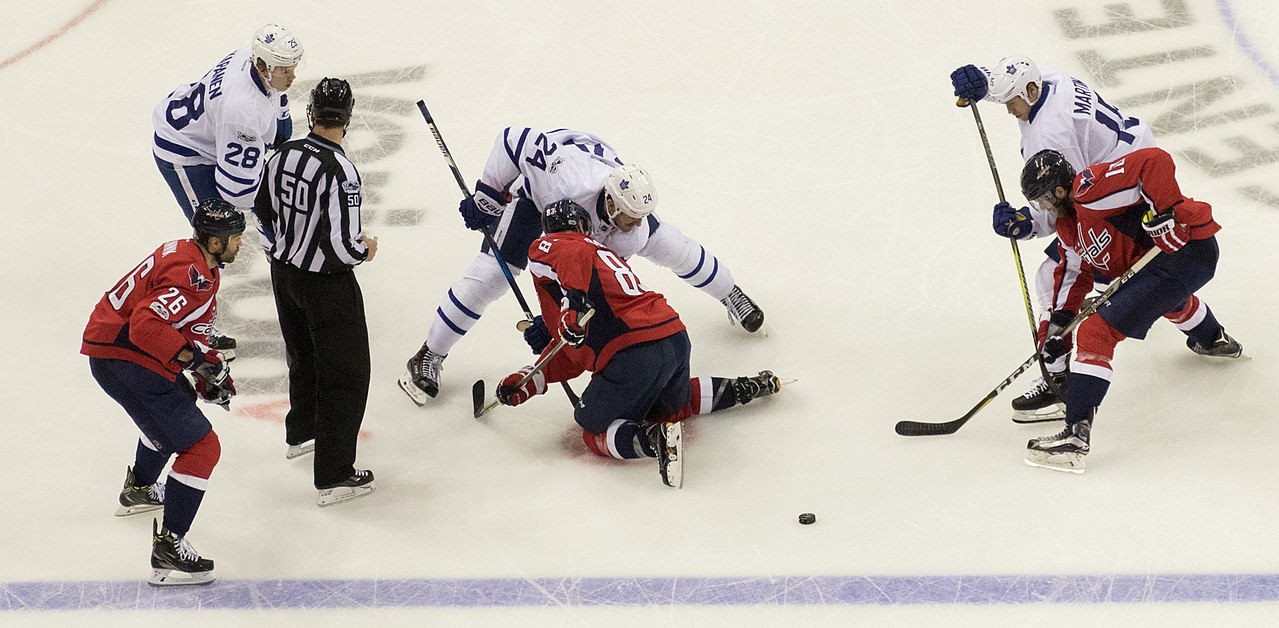
But here’s where things break down. Studies of professional sports mostly don’t find any correlation at all. There’s the basketball one. The football one. The soccer one. A handful of baseball ones. I plan to write the hockey one—if no one beats me to it.
So what gives? Why would experience matter in college sports but not at the pro level?
That became the central question of my undergrad paper. And my best guess circles back to Baumeister.
Professional athletes have already faced their share of pressure. As Dr. Joshua Pitts notes, “Many of these players may have participated in high school state championships, college bowl games, and NFL regular season games where their teams had a lot at stake.”
If inoculation works, it might carry over into pro play. The “rookie under pressure” isn’t a stranger to pressure after all.
Still, it’s not a tidy answer. Pitts’ NFL study found that quarterbacks playing their first season with a new team were 12–15% less likely to win. That suggests continuity matters. The NBA study showed playoff-experienced coaches had a slight edge. EMT may apply to isolated skills like putting or free throws—but it’s unclear how well it scales to full games or playoff series.
“It’s easy to look at [experience] in those contexts,” Pifer told me. “But when you get into the full measure of a basketball game, there’s a lot more going on than a free throw.”
Then there’s the team quality issue. Better teams make longer playoff runs. Better teams generate more playoff experience. How do you untangle causality?
“There’s no perfect control for talent differences,” Pitts said. “You just do the best you can do.”
Still Waiting
So I’ve become cautiously patient. Debunking clichés is harder than I thought. I wanted a neat little story. I wanted to explain away a painful playoff decade. I wanted a reason to believe the Leafs could’ve turned out different if they were just a little different.
Maybe I’ll still get that story. I’ll just have to wait a little longer.
WORDS: Kieran Gorsky.




Leave a Reply