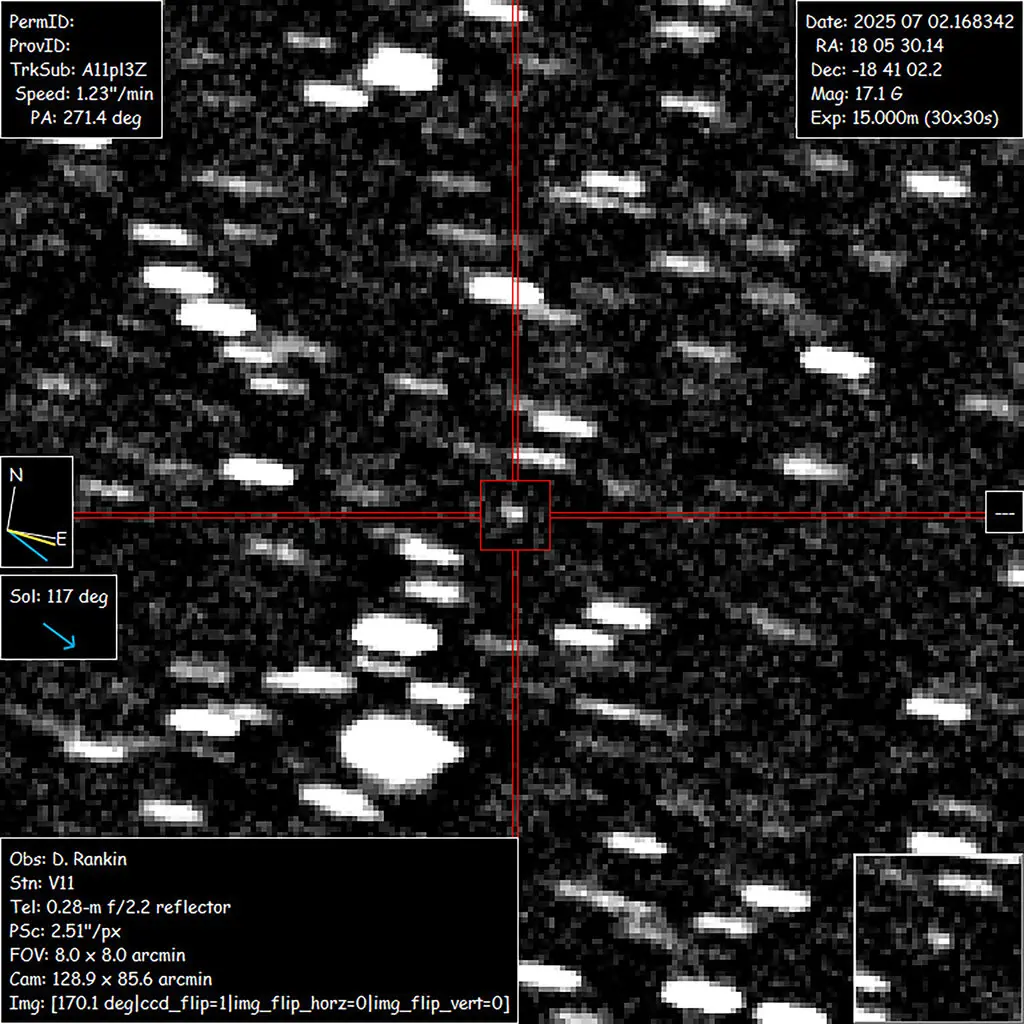
New Interstellar Visitor Detected in Our Solar System
Astronomers have confirmed the discovery of a third known interstellar object—now officially named 3I/ATLAS—traveling through our solar system. Initially spotted by a telescope in Chile and tracked by NASA’s ATLAS system, the object is moving too fast to have originated here. Currently located between Jupiter and the asteroid belt, 3I/ATLAS will pass closest to the Sun in October and come no nearer than 160 million miles from Earth. Brightness readings suggest it’s a comet with a glowing coma of gas and dust, though its exact size remains unknown. Unlike Oumuamua, this visitor will be observable for months, allowing for deeper analysis, including potential studies with the James Webb Space Telescope. Future surveys like Chile’s Rubin Observatory are expected to spot more of these cosmic interlopers. (New York Times)
AI model simulates human mind met with skepticism
A team has unveiled an AI architecture that it claims replicates human cognitive processes, with layers modeling perception, memory, and decision-making to mirror mind-like behaviors. Designers suggest it could usher in a new era of AI that thinks more like humans. However, cognitive scientists remain cautious. Critics argue that the system’s outputs—while impressive—lack genuine understanding, often filled with errors or superficial reasoning. They note it’s hard to prove the model truly embodies human-like mental representations rather than sophisticated pattern matching. Concerns also include its transparency and reliability: without clear insight into how it arrives at conclusions, evaluating its claims is tricky. The debate highlights the broader tension in AI: balancing ambitious cognitive emulation with rigorous skepticism about true consciousness. (Science)
Google inks landmark fusion‑energy deal with MIT spin‑out
Google has signed a pioneering agreement to purchase 200 MW of fusion-generated power from MIT spin‑out Commonwealth Fusion Systems (CFS), backed by Bill Gates’s Breakthrough Energy. Scheduled to come online in the 2030s, the ARC fusion plant in Virginia will initially supply roughly half its capacity to Google, with an option for future expansions. Fusion energy promises near‑limitless, low‑waste clean power—long hailed as the holy grail of energy innovation. The deal follows Microsoft’s smaller agreement with Helion Energy and signals a growing appetite among tech giants for sustainable, scalable energy solutions to fuel AI and data centers. Having raised over US $2 billion, CFS aims to prove commercial fusion is no longer science fiction. (WSJ)
China’s LHAASO crafts a galactic “treasure map”
China’s LHAASO observatory has unveiled a groundbreaking ultrahigh‑energy gamma‑ray sky survey—described as a galactic treasure map. The comprehensive catalogue reveals previously unseen gamma‑ray sources and structures, opening a new window into extreme astrophysics. These findings challenge current models of cosmic‑ray acceleration, hinting at powerful phenomena like pulsar wind nebulae and supernova remnants at work. Analysis across the Milky Way and beyond may transform our understanding of high‑energy astrophysics, and potential dark‑matter signatures lurk within. As LHAASO continues observing, astronomers anticipate even deeper insight into the Universe’s most violent processes. (SciTech Daily)
Scientists simulate fault‑tolerant quantum code using classical computers
A multinational collaboration has achieved a major breakthrough by accurately simulating fault‑tolerant quantum circuits built on the Gottesman–Kitaev–Preskill (GKP) bosonic error‑correction code—a feat previously deemed impossible on classical hardware. Employing a novel algorithm and mathematical tool, researchers from Chalmers University (Sweden), Milan, Granada, and Tokyo demonstrated how conventional computers can mimic error‑corrected quantum computations, significantly advancing validation methods for quantum devices. This advance tackles a primary challenge in quantum computing—the high susceptibility of qubits to noise and decoherence—by enabling reliable testing of error‑resilient quantum circuits. It unlocks new avenues for verifying hardware performance and accelerating development of robust, scalable quantum systems. The findings, published in Physical Review Letters, mark a pivotal step toward practical quantum computing applications across medicine, AI, encryption, logistics, and more. (Science Daily)
NASA studies last year’s record geomagnetic storm
One year after the Gannon Storm—the strongest geomagnetic event in 20 years—NASA scientists continue analyzing its aftereffects. The storm disrupted communications, power grids, and satellite systems, but also produced spectacular auroras. Using data from satellites and ground sensors, researchers are refining models of how extreme solar activity interacts with Earth’s magnetosphere. Their findings improve forecasting accuracy and help utility and aerospace sectors anticipate and mitigate future solar‑induced disruptions. As solar maximum approaches, studying last year’s storm becomes crucial for protecting infrastructure and preparing governments and industries for a solar tempest sequel. (NASA)
Vantablack 310 slashes satellite light pollution
University of Surrey researchers have unveiled Vantablack 310, an ultrablack carbon-nanotube coating designed to reduce satellite reflectivity and mitigate light pollution for astronomers. The coating absorbs nearly all visible light, cutting satellite brightness without compromising durability in harsh space environments. It is also easy to apply during satellite manufacturing. As satellite constellations proliferate, glare reduction is critical for ground-based observations. Vantablack 310 offers a practical solution that balances industry growth with protection of astronomical discovery, ensuring both technological advancement and skywatcher-friendly night skies. (TS2)
Oxford quantum team sets unprecedented error rate
Oxford University’s quantum computing researchers have achieved a record-breaking qubit precision: just one error in 6.7 million operations. This leap, achieved through improved qubit control and error suppression algorithms, significantly boosts computational reliability—crucial for scaling quantum machines. Quantum error rates remain a central challenge; this breakthrough narrows the gap between experimental qubits and practical quantum advantage. With such error milestones, larger and more complex quantum algorithms become viable. The result revitalizes confidence in the quantum roadmap and energizes both academic and industrial efforts to build scalable, fault‑tolerant quantum computers. (SciTech Daily)
UK commits £500m+ to bolster quantum computing
To strengthen its position in the international quantum race, the UK government has pledged over £500 million in quantum computing funding across the next four years (totaling £670 m over a decade). The investment supports the National Quantum Computing Centre, research hubs, and commercial partnerships, aiming to enhance national security and economic resilience. Experts highlight quantum’s transformative potential—insecure communications, advanced medical imaging, materials discovery—and stress the investment as essential to stay ahead. The announcement also counters growing foreign acquisition of UK quantum firms. This bold funding push positions the UK as a major player in global quantum science and innovation. (FT)
Ancient Egyptian mummy genome fully sequenced
For the first time, scientists have fully sequenced a 4,800‑year‑old human genome from ancient Egypt, using DNA extracted from a single tooth. This milestone builds on earlier fragmented studies and offers unprecedented insight into ancient population genetics, migrations, and health. By comparing the genome to modern and prehistoric data, researchers aim to trace lineage continuity, genetic adaptations, and disease prevalence across millennia. The achievement showcases improved ancient DNA recovery and sequencing methods, opening the door for deeper exploration into human history through genomics. (Nature)
AI “co‑scientist” teams assist scientific research
Research published by Nature explores the rise of AI “co‑scientists”—chatbot-based teams that mimic lab group deliberations and perform tasks like literature review, hypothesis generation, and experimental planning. These systems integrate multiple AI agents to emulate different lab roles (e.g., data analyst, methodologist), enhancing productivity and creativity. Early deployments show promise in accelerating project timelines and surfacing overlooked insights—but raise questions over transparency, reliability, and the human‑AI divide in scientific judgment. The study highlights the growing role of AI as collaborative partners, heralding a shift in how research is conducted and how work is credited in science. (Nature)
IMAGE CREDIT: David Rankin/Saguaro Observatory


Leave a Reply