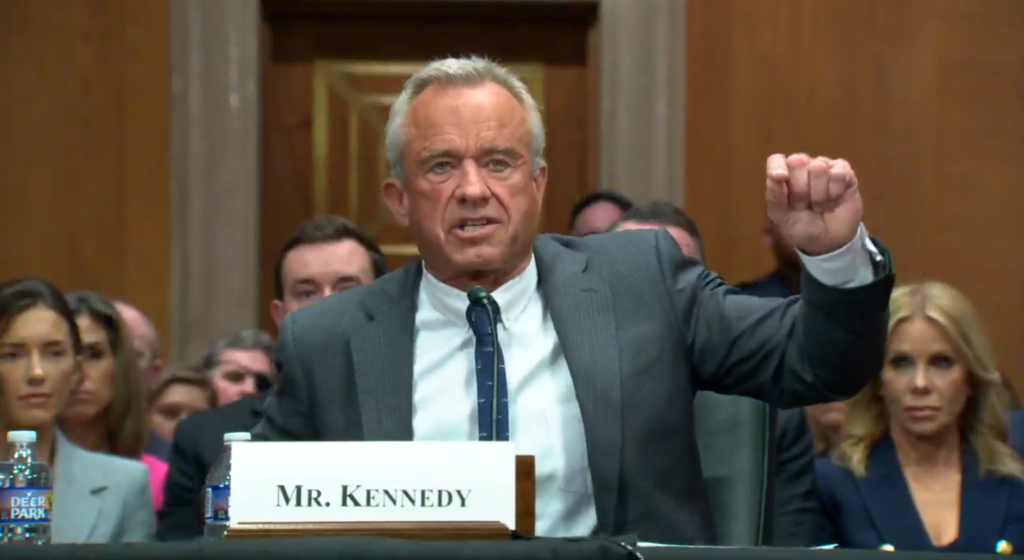
RFK Jr. Installs Anti-Vaccine Activists on CDC Advisory Panel
Robert F. Kennedy Jr., an independent presidential candidate known for his anti-vaccine rhetoric, has appointed two prominent vaccine skeptics to a panel advising the CDC on vaccine policy. Kim Witczak and Brian Hooker, both critical of pharmaceutical companies and vaccine safety, will serve on the Advisory Committee on Immunization Practices (ACIP) if Kennedy is elected. The move has alarmed public health experts who warn that it could further undermine trust in vaccines. Kennedy’s campaign insists the appointments are part of efforts to reform regulatory capture in health institutions. Critics argue it’s a dangerous politicization of public health and science. (Ars Technica)
UK Science Budget Frozen for Four Years Amid Inflation Pressure
The UK government announced that public funding for science will remain flat in real terms through 2028. The decision, part of a broader spending review, disappoints scientists who argue that stagnant funding during inflation effectively amounts to cuts. Though the government maintains that its long-term commitment to research remains intact, leaders of scientific organizations warn this stagnation could harm competitiveness and delay crucial discoveries. The freeze applies to research councils, innovation programs, and block grants, even as the government promotes its ambition to be a “science superpower.” (Science)
UK’s Major Research Bodies Struggle to Meet Inclusion Goals
A major review of diversity efforts in the UK’s research funding agencies reveals they are falling short in promoting equity and inclusion. The report, commissioned by UK Research and Innovation (UKRI), finds that while initiatives exist, they often lack coordination, measurable goals, and follow-through. The underrepresentation of marginalized groups persists across disciplines, especially in leadership and grant awarding. It criticizes the inconsistent collection of demographic data and calls for systemic change. UKRI has pledged to respond with concrete action. (Nature)
COVID Recovery Often Takes Nine Months to Regain Well-being
A large study published in JAMA Network Open suggests that many people with COVID-19 took up to nine months to return to their baseline physical and mental well-being. Analyzing data from nearly 10,000 patients across 16 U.S. health systems, researchers found that recovery times varied widely by age, race, and preexisting conditions. Common lingering symptoms included fatigue, pain, and cognitive issues. The findings add to growing evidence about long COVID’s extensive impact and support the need for sustained follow-up care and resources. (CIDRAP)

Forced Hysterectomies Continue Among India’s Sugar Cane Workers
Reports from Maharashtra, India, reveal that poor female sugar cane workers are still being pressured into undergoing hysterectomies to increase labor productivity. The practice, meant to prevent menstruation-related work absences, has sparked outrage among rights groups. Women say they are often misled or coerced by contractors and have little access to post-surgical care. Though a 2019 inquiry led to increased regulation, enforcement remains weak. Critics accuse local governments of failing to protect vulnerable laborers, who are mostly Dalit and Adivasi women. (The Guardian)
“Dragon Prince” Dinosaur May Fill Evolutionary Gap Before T. Rex
A newly discovered dinosaur fossil from China may help explain the evolutionary path from smaller tyrannosaurs to the massive T. rex. Named the “dragon prince,” this mid-Cretaceous predator is smaller and more lightly built than its infamous descendant but shares key skull and limb features. The fossil, found in Inner Mongolia, is about 90 million years old. Scientists suggest it represents a missing link, bridging the gap between early tyrannosaurs and the apex predators that later dominated North America. (Science)
James Webb Telescope Spots Smallest ‘Failed Stars’ Ever Seen
NASA’s James Webb Space Telescope has identified the smallest brown dwarfs—or “failed stars”—ever observed. These objects, each only about three to eight times the mass of Jupiter, lie within the Orion Nebula and are too small to sustain nuclear fusion. Scientists say the discovery challenges previous assumptions about how small a brown dwarf can be, raising new questions about star and planet formation. The objects blur the line between planets and stars and could help scientists understand rogue planetary systems. (space.com)
Uranus’ Moons Show Unexpected Dust Trails, Baffling Scientists
NASA’s James Webb Space Telescope has detected strange dust patterns trailing Uranus’ moons, puzzling planetary scientists. The patterns, discovered during infrared mapping of the Uranian system, don’t align with known models of how moon dust should behave. Scientists suspect unknown forces or interactions between moons and Uranus’ magnetic field may be at play. The surprising results emphasize how little is still understood about the distant ice giant and its natural satellites. More targeted missions may be needed to fully explain the anomalies. (Space Daily)
Solar Orbiter Offers First Glimpse of Sun’s Mysterious South Pole
The European Space Agency’s Solar Orbiter mission has delivered humanity’s first close-up views of the Sun’s elusive south pole. The images, captured during the orbiter’s tilted trajectory, reveal complex magnetic structures and activity not fully understood. Scientists hope studying the Sun’s poles will improve space weather predictions and solar cycle forecasting. This milestone marks a new era in solar observation, as the spacecraft continues collecting high-resolution data en route to a steeper orbit for even better views in coming years. (New York Times)
Pentagon Quietly Cultivated UFO Belief for Decades, Report Finds
A new report reveals the Pentagon has covertly shaped American belief in UFOs over decades through media manipulation, planted stories, and selective disclosure. The strategy allegedly aimed to maintain military secrecy about experimental technology while diverting public attention. Key figures in the UFO movement were unknowingly used to propagate misleading narratives. The report, drawing from declassified documents and whistleblower accounts, challenges assumptions about the transparency of recent UAP disclosures and raises ethical questions about psychological operations targeting civilians. (Gizmodo)
Thanks for reading. Let’s be careful out there.
WORDS: The Biology Guy.


Leave a Reply