Introduction: Denise and the First Hello Kitty
The first time Denise walked into the Miniso store in SoHo, she wasn’t looking for anything in particular—just shelter from the heat and maybe a charger cable. She left with a canvas tote printed with a sleepy pink bear and a feeling she didn’t quite expect.
“I remember holding it in the checkout line and thinking, why does this make me feel… calm?” she recalls, smiling. “It wasn’t just the design. It was like something clicked inside me, like being around this little bear made my brain quiet for a second.”
Denise is 27, works in editorial production for a lifestyle website, and lives in a shared apartment in Brooklyn. She had never thought of herself as someone who collected plushies or pastel pens. But that first bear led to a spiral: a cinnamon roll-shaped pillow, a Sanrio pencil pouch, an entire shelf of small figurines arranged beside her bed.
“I’d get home after a long day, and it was like… these things were waiting for me. They didn’t ask for anything. They just existed.”
Kawaii wasn’t a word Denise used at first. It arrived unannounced—soft, round, pink-edged—and stayed. What she didn’t know then was that her reaction wasn’t just personal or aesthetic. It was biological. And it had been waiting in her nervous system all along.
I. Hello Kitty the Icon
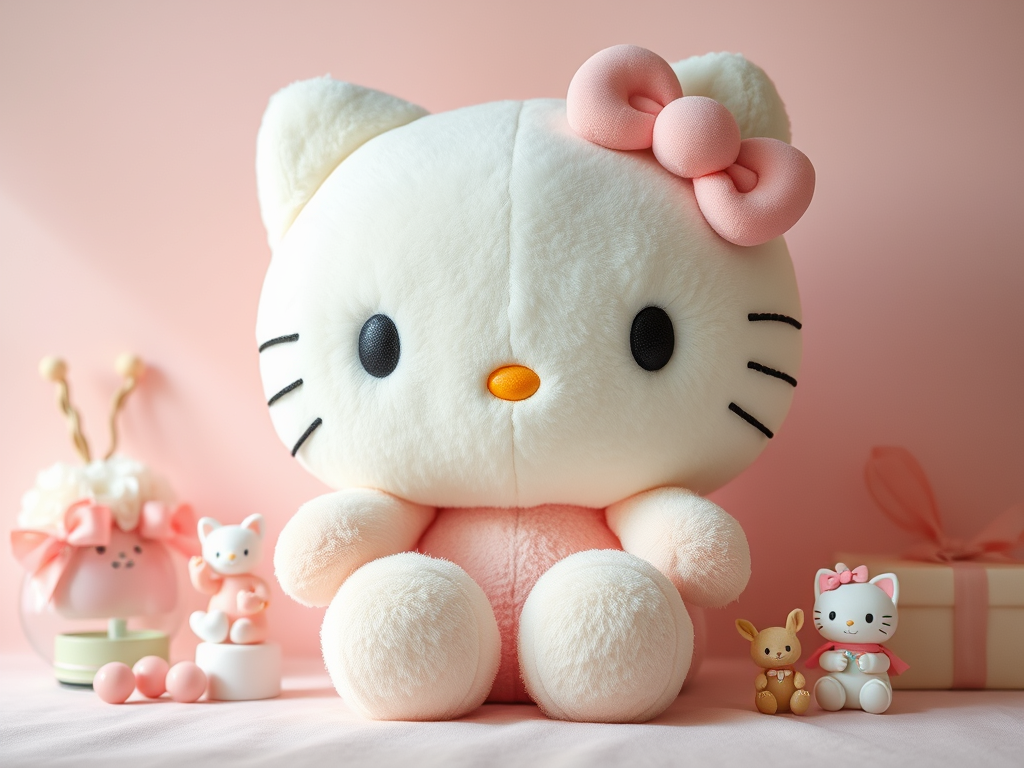
Her eyes are wide and unblinking. Her head is oversized, round like an apple, and her limbs are stumpy and soft. She has no mouth, no expression to betray a specific mood, only a small yellow nose and a bow perched neatly above her left ear. This is Hello Kitty—neither cat nor child, frozen in a state of perpetual innocence. Created in 1974 by the Japanese company Sanrio, Hello Kitty isn’t just a character. She’s an icon, a blank slate upon which people project affection, nostalgia, or comfort.
Walk through a convenience store in Tokyo—or browse a themed cafe, smartphone case, or TikTok filter—and you’ll be immersed in a universe of softness. Big-eyed animals with disproportionate heads, round-faced mascots wearing panda suits, bubble letters, and pale rainbows—this is the world of Kawaii, the Japanese aesthetic of “cuteness.” But Kawaii is more than a style. It is a feeling, a behavior, a mode of communication. And its power is not just cultural or social—it is biological.
Why does Kawaii resonate so deeply? Why do so many people, across ages and cultures, instinctively react with affection or protectiveness when they encounter round, soft, childish figures? The answer lies in our evolutionary past. This essay explores how Kawaii culture taps into primal caregiving circuits shaped by evolution, especially through what scientists call Kindchenschema—baby schema. Far from being a superficial trend, Kawaii represents a deeply rooted interface between biology, aesthetics, and society.

II. Baby Schema and the Evolutionary Roots of Cute
The power of Kawaii begins in the nursery of evolution. In 1943, ethologist Konrad Lorenz introduced the concept of Kindchenschema, or “baby schema”—a set of physical traits such as large eyes, round cheeks, a small nose, and a disproportionately large head that reliably trigger caregiving responses in adult humans. These features act as visual superstimuli, biologically priming us to nurture and protect the vulnerable. Evolution favored individuals who responded to these cues with affection, vigilance, and attentiveness. Over millennia, these instincts became hardwired.
Modern science has confirmed and expanded Lorenz’s theory. Neuroimaging studies show that baby-like faces activate regions of the brain associated with reward and empathy, including the orbitofrontal cortex, nucleus accumbens, and amygdala. A widely cited fMRI study by Glocker et al. (2009) found that digitally enhancing infant features led to increased activity in these areas, corresponding with stronger caretaking impulses. Similar responses have been observed across cultures and even species.
But Kawaii extends beyond baby schema alone. Professor Hiroshi Nittono explains that “The traditional baby schema is just one example of a trigger of kawaii, or cuteness-related positive affect. Other examples include perceived social relationships. Entities that interact with each other are perceived as cuter.” This expansion beyond morphology to interaction and behavior underscores a broader biological principle: cuteness can emerge from the perception of social bonding, not just physical traits.
This broader sensitivity likely evolved in the context of alloparenting—caregiving by individuals other than the biological parents. In ancestral human societies, survival often depended on group members responding to vulnerability, even when it wasn’t genetically theirs. The brain evolved to be responsive not only to infant cues but to a generalized pattern of softness, smallness, and social dependence.
Nittono notes that the emotional profile of Kawaii is distinctive: “The core characteristics of the kawaii emotion are positive and unthreatened, moderately aroused, approach-motivated, and socially oriented.” Unlike fear or lust, which activate high-arousal behavioral systems, Kawaii fosters gentler, sustained engagement. Studies demonstrate that viewing Kawaii imagery enhances attentional focus and fine motor performance—likely a byproduct of evolutionary mechanisms that helped early humans attend carefully to fragile infants.
The Kawaii aesthetic leverages these inherited sensitivities. Characters like Hello Kitty and Rilakkuma exaggerate Kindchenschema traits: oversized heads, minimal facial detail, and stubby limbs. These designs bypass the rational mind and activate deep-seated affective responses rooted in evolutionary caregiving circuits. They don’t need to resemble real babies to function as stimuli; rather, they serve as neuroaffective shortcuts that evoke care, empathy, and sometimes protective possessiveness.
Kawaii doesn’t just look cute—it feels neurologically urgent. The emotion it evokes may have been forged in prehistory, but today it shapes design, commerce, and our digital interactions.

III. Alloparenting and the Broader Social Brain
The evolutionary mechanisms behind Kawaii extend beyond the bond between mother and infant. In human societies, caregiving has rarely been an individual task. Instead, it is deeply embedded in a social structure characterized by alloparenting—a cooperative breeding system in which individuals other than the biological parents contribute to the care of offspring. This system, unique among primates in its scale and complexity, helped Homo sapiens thrive. It also rewired our brains to be exquisitely sensitive to vulnerability and social dependency—not just in our own kin, but in others.
In this context, cuteness becomes more than a reproductive tool—it becomes social glue. By promoting care-based emotional responses toward others, including unrelated individuals, Kindchenschema triggers support the cohesion of broader communities. Anthropologist Sarah Hrdy argues that emotional responsiveness to infants—including non-kin—is a hallmark of our species’ evolutionary success. This biological wiring is why we are moved not only by babies, but by baby animals, animated creatures, and even inanimate objects designed to mimic vulnerability.
Kawaii culture exploits these tendencies. The emotional response it elicits—marked by attentiveness, protectiveness, and mild arousal—mirrors the neural architecture shaped by alloparental care. This precise emotional configuration is what evolution favored in individuals responsible for safeguarding fragile life. Kawaii aesthetics repackage these evolutionary triggers for modern life, offering a simulated caregiving experience.
Research on nonverbal cues reinforces this idea. Simple images of interaction—two small creatures nestled together or one figure leaning gently into another—can evoke stronger Kawaii responses than a single static image. It is not merely the roundness of a head or the size of eyes that invokes care—it is also the appearance of bonding, interdependence, and vulnerability.
This helps explain why Kawaii characters often appear in pairs or small groups, engaged in acts of affection or cooperation. These subtle cues mimic the communal caregiving scenarios found in ancestral environments, activating the same neural machinery once used to ensure group survival. In doing so, Kawaii transforms an evolutionary adaptation into an aesthetic experience—one that feels intimate, endearing, and socially connective.

IV. Kawaii and the Evolved Brain
If the aesthetics of Kawaii evolved to exploit ancient caregiving circuits, then the effects of Kawaii stimuli should be visible in the brain and body—and they are. A growing body of psychophysiological research has begun to map how exposure to cute imagery affects cognition, motor control, and emotional state. These findings suggest that Kawaii doesn’t just charm us visually—it changes how we think, feel, and behave.
Neuroimaging studies have consistently shown that cute stimuli activate brain regions linked to reward, social emotion, and caregiving. This includes the orbitofrontal cortex, which evaluates reward; the nucleus accumbens, part of the brain’s dopamine system; and the amygdala, associated with emotional salience. This activation pattern reflects the evolved purpose of Kindchenschema: to capture attention and elicit nurturing behavior.
But more fine-grained experiments reveal a second layer of effects—one tied to attention and motor control. In a landmark study led by Professor Hiroshi Nittono (2012), participants who viewed Kawaii images—such as baby animals or cartoon characters—demonstrated improved fine motor accuracy and attentional focus on subsequent tasks. The mechanism is a narrowing of attentional focus typical of approach-motivated states—similar to how a hungry person focuses intensely on food.
Additional physiological responses support this. Kawaii stimuli modulate arousal without inducing stress. Unlike stimuli that provoke fear or lust—both of which also trigger intense approach motivation—Kawaii induces moderate arousal in a non-threatening context. This allows for sustained attention, often accompanied by slower, more deliberate movements. In effect, the body shifts into a caregiving mode: alert, careful, but not alarmed.
Professor Michiko Ohkura, whose work in Kawaii Engineering applies biometric measurements to emotional response, offers further insight. Using tools like EEG and eye-tracking, her research has shown that “relaxing kawaii stimuli can increase the ratio of alpha waves and exciting kawaii stimuli can decrease it.” This pattern aligns with a balance between attention and relaxation, suggesting that Kawaii imagery uniquely blends alertness and calm—a rare combination in affective neuroscience.
Together, these insights show that Kawaii culture is not simply emotional—it is neurofunctional. It affects how we direct our attention, how we prepare to act, and how we interpret the social world around us. Kawaii is an evolutionary interface—linking past survival mechanisms to present-day media, design, and interaction.

V. Cultural Amplification: From Instinct to Industry
Kawaii may originate in biology, but it thrives through culture. What begins as an instinctive neural response to baby-like features has been carefully curated, amplified, and deployed across every facet of contemporary Japanese life—and, increasingly, the global marketplace. In Japan, Kawaii is not just an aesthetic; it is a cultural mode—woven into consumer products, urban infrastructure, advertising, communication styles, and even political messaging.
Sanrio industrialized Kawaii by refining visual elements that tap into Kindchenschema and affective vulnerability. But its success opened the door to a much larger cultural movement. Corporations, governments, and individuals alike began to wield cuteness as a tool of emotional persuasion and social softening. Banks issue cards adorned with pastel characters. Police stations and construction sites feature smiling mascots. Even the Japan Self-Defense Forces have a mascot character, aiming to soften their public image.
This widespread adoption reveals how biologically effective visual cues can be harnessed for cultural engineering. The evolutionarily programmed response to soft, non-threatening stimuli becomes a foundation upon which trust, identification, and consumer loyalty are built. In marketing terms, Kawaii acts as an emotional adhesive—forming affective bonds between people and products, between citizens and institutions. In evolutionary terms, it’s a repurposing of caregiving circuits for market and identity formation.
What makes this amplification effective is that it operates below the threshold of reason. People do not rationally evaluate Kawaii characters; they feel their way toward them. Kawaii functions in this precognitive space, exploiting evolved responses to elicit warmth, nostalgia, and even submission. The result is an aesthetic that feels safe—and by extension, makes everything it touches seem safe too.
However, this process relies on design principles that exaggerate the triggers of care: softness, symmetry, minimalism, and implied vulnerability. Professor Michiko Ohkura has formalized this process through Kawaii Engineering, applying methodologies from human-computer interaction to measure and refine affective responses. Through techniques like EEG analysis and eye-tracking, researchers identify which stimuli generate the strongest Kawaii reactions—and then tweak visual and behavioral elements accordingly.
This engineered cuteness is increasingly present in emerging technologies. Japanese and Chinese service robots are deliberately designed to appear childlike, gentle, and non-threatening, easing interactions between humans and machines. The robotic seal Paro, used in eldercare, was specifically built with Kindchenschema features to trigger soothing responses in patients with dementia. In this sense, Kawaii is not just a cultural style—it is a human interface strategy.

VI. Digital Cuteness and Neuroadaptation
In the age of algorithmically optimized aesthetics, Kawaii has entered a new phase—one in which its evolutionary power is being amplified, intensified, and possibly overused. As digital platforms flood our visual fields with hyper-cute emojis, avatars, filters, and stickers, a question arises: Can we become desensitized to cuteness? And if so, what does that mean for an emotion that was once tied to survival?
Neuroscience offers a concept known as neuroadaptation—the brain’s tendency to recalibrate its baseline sensitivity to stimuli after repeated exposure. Just as our sensory systems adapt to background noise or fragrance, they can also adjust to visual and emotional saturation. In this context, the omnipresence of Kawaii, particularly in its digitally enhanced forms, risks raising the perceptual threshold for what we find emotionally engaging.
This process is most visible in social media environments, where Kawaii has evolved into hyperstimuli. Filters on TikTok and Instagram enlarge eyes, smooth facial textures, and add floating hearts or blushing cheeks—pushing Kindchenschema to its extreme limits. These digital augmentations often go far beyond natural infant features, producing a cartoonishly cute aesthetic that is more potent—and more numbing—than its analog predecessors.
The concern is not just emotional fatigue but also cognitive distortion. Studies suggest that hyperstimuli can lead to unrealistic expectations and altered perception of real-world stimuli. In the case of Kawaii, this may mean that natural cuteness—like that of a real infant or animal—might register as less compelling after prolonged exposure to high-intensity digital cuteness.
Yet some designers and artists are beginning to push back, experimenting with anti-Kawaii or emotionally ambivalent aesthetics. Characters like Gudetama, who appears exhausted and unwilling to participate in life, reflect this new ambivalence. These figures still trigger care, but through emotional contrast rather than visual perfection. They represent a kind of evolved Kawaii—one that acknowledges overstimulation and leans into it.
Ultimately, the question is not whether Kawaii will lose its power, but how it will adapt to a digital world that accelerates and saturates everything it touches. Like all emotional technologies, Kawaii must evolve to remain effective.

VII. Gender, Vulnerability, and Power in Kawaii
Kawaii is often associated with softness, innocence, and vulnerability—qualities that, while seemingly neutral, are deeply entangled with gendered expectations. The aesthetic of cuteness frequently reinforces a particular version of girlhood—one that is passive, non-threatening, and emotionally open.
Cultural critics such as Sharon Kinsella and Laura Miller have argued that Kawaii in Japan became a form of resistance and compliance at once. In the 1970s and ’80s, young women began embracing cute handwriting, speech patterns, and fashion as a rebellion against rigid postwar norms. Yet even as it created space for playful self-expression, it also re-entrenched ideas of feminine infantilization. In this dual role, Kawaii simultaneously empowers and disempowers—creating a culturally acceptable outlet for deviance that ultimately neutralizes its political threat by framing it as childlike and unserious.
However, vulnerability itself can be reframed as a form of agency. Kawaii aesthetics create a space in which emotional sensitivity is visible and valuable—a counterpoint to cultures that prize stoicism and control. This shift can be especially meaningful in male-dominated fields like tech, where Kawaii interfaces and mascots soften intimidating systems and make them more approachable.
The aesthetic remains contested. While some embrace Kawaii as a celebration of emotional openness and aesthetic joy, others view it as a commercial packaging of docility. The tension lies in how Kawaii continues to hover at the edge of childhood and adulthood, passivity and agency, critique and complicity. It is precisely this ambiguity that gives Kawaii its staying power—and makes it a lens through which larger cultural questions about gender, power, and expression can be explored.

VIII. The Future of Cute: Globalization and Mutation
What began as a uniquely Japanese aesthetic has become a global vernacular of emotion. From Seoul to São Paulo, Helsinki to Harlem, the language of Kawaii—big eyes, soft colors, round forms, gentle voices—has migrated, morphed, and embedded itself in products, media, and identities far beyond its cultural origin. But as Kawaii culture circulates, it does not remain unchanged. Instead, it evolves—sometimes subtly, sometimes radically—reflecting the desires, anxieties, and infrastructures of each new context it inhabits.
This global spread has revealed both the universal pull of cuteness and the local forces that reshape it. In South Korea, the parallel aesthetic of aegyo blends Kawaii visual tropes with performative cuteness in language and behavior. In China, domestic tech companies have embraced Kawaii mascots for interface design, blending them with hyper-efficient AI systems to humanize digital tools. In the West, Kawaii has taken on ironic, nostalgic, or even subversive tones.
This cultural mutation underscores a central paradox: while Kawaii’s emotional impact is rooted in biology, its forms are infinitely plastic. The neural circuitry that responds to cuteness is stable, but the signals that trigger it are subject to manipulation. Digital artists, game designers, and algorithm-trained marketers continuously experiment with new combinations of roundness, softness, and vulnerability to elicit ever more refined emotional responses.
Meanwhile, Kawaii is infiltrating emerging technologies—AI companions, robotic pets, virtual influencers—where its non-threatening aesthetic plays a crucial functional role. Cuteness becomes the emotional lubricant that allows for smoother interaction between humans and intelligent machines.
Yet as Kawaii moves into these new digital and synthetic territories, it raises ethical and philosophical questions. Can emotional responses that evolved for caregiving be ethically reappropriated for user engagement, marketing, or machine-human bonding? Will the hyperreal cuteness of the future dull our sensitivity to real-world vulnerability?
Still, Kawaii remains adaptable. Its ability to merge the biological with the cultural, the intimate with the commercial, makes it one of the most resilient aesthetic systems in the global emotional economy. Whether through characters, robots, emojis, or avatars, Kawaii continues to evolve—not by abandoning its evolutionary roots, but by reinterpreting them for each new era of human feeling.

IX. Conclusion: Designed to Care
Cuteness is easy to dismiss. It’s soft, small, quiet—an aesthetic we associate with childhood, whimsy, or emotional indulgence. But Kawaii culture shows us that cuteness is far more than decoration. It is a biological interface, forged in our evolutionary past to promote care, social bonding, and survival. And it is a cultural technology, engineered, refined, and globalized to modulate emotion, encourage trust, and shape behavior in ways both subtle and profound.
By tracing Kawaii through the lens of Kindchenschema, alloparenting, neuroscience, and design, we begin to see it not as trivial or regressive, but as a powerful expression of how the brain responds to vulnerability—whether in infants, icons, or intelligent machines. The success of Kawaii lies in its ability to convert this response into language, media, and interaction. It speaks directly to the caregiving circuits within us and, increasingly, to the algorithms that structure our digital lives.
But like all evolved traits repurposed for modernity, Kawaii is not static. It mutates. It overexposes. It questions itself. From Sanrio’s perfectly polished Hello Kitty to the emotionally drained Gudetama, Kawaii culture has stretched the boundaries of cuteness to include irony, fatigue, and even passive resistance. And in doing so, it reveals not just the power of design—but the elasticity of the human capacity to care.
In a world where attention is fragmented and empathy is increasingly mediated by screens, the enduring influence of Kawaii reminds us of something fundamental: we are wired to notice the small, to feel for the soft, to reach out to what seems helpless. Whether that impulse is directed at a child, a character, or a companion robot, it remains rooted in the same neural soil. Kawaii doesn’t just ask for our attention—it asks for our affection, our gentleness, and perhaps most of all, our recognition of shared vulnerability.
That may be its most radical quality of all.
Epilogue: Denise, Three Years Later
Three years after that first Miniso visit, Denise’s apartment is a hybrid of adult functionality and emotional softness. Her bookshelf is flanked by twin plush characters, her coffee mug features a frowning dumpling, and her AI assistant speaks in a voice she customized to sound “more squishable.” Her friends used to tease her about it—until the pandemic, the burnout, the layoffs. Now they ask her for Kawaii recommendations.
“It’s not just about looking cute,” she says. “I think I collect these things because they give me permission to feel something small and warm in a world that’s always shouting.”
For Denise, Kawaii has become a language—a way of recognizing that care doesn’t always have to be loud or complicated. “Sometimes,” she says, “a tiny bear doing nothing is enough to remind you that you’re allowed to just… be.”
Her story echoes the real logic of Kawaii. In its soft silence, its gentle pull, it offers something surprisingly radical: a space for vulnerability, tenderness, and neurobiological rest. Denise didn’t know the term Kindchenschema or that her brain’s orbitofrontal cortex was lighting up the first time she met that sleepy pink bear. But her body did.
And in a city that never sleeps, a sleepy bear might be the most powerful thing of all.



Leave a Reply