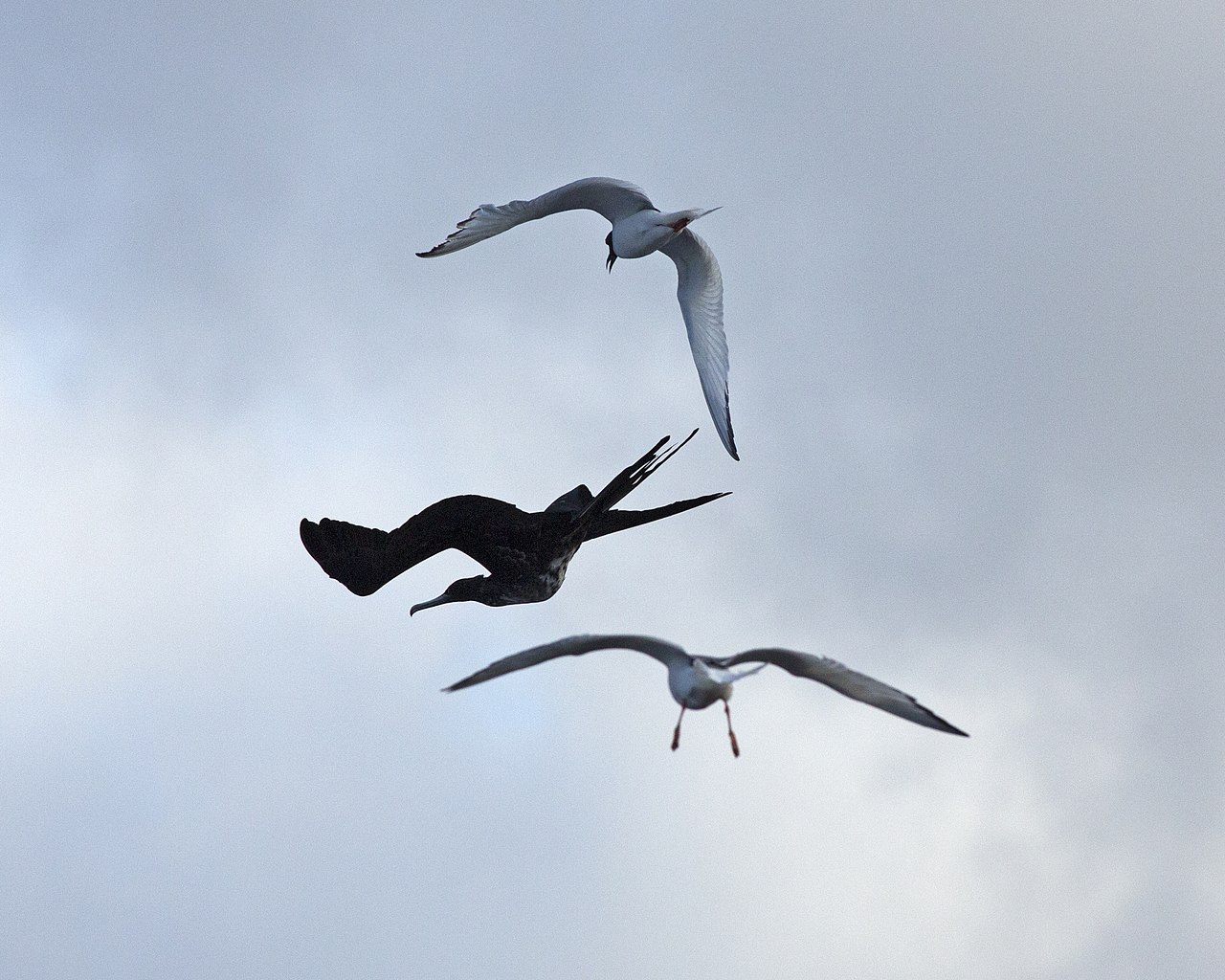

In this captivating moment frozen against the slate-gray sky, two swallow-tailed gulls clash with a much larger adversary—a frigate bird—in an aerial ballet of survival and cunning. The image, taken in the Galápagos Islands, shows the gulls defending their territory and, quite possibly, their meal, from one of nature’s most notorious kleptoparasites. The frigate bird, dark and formidable in silhouette, is not simply flying—it is on the hunt for opportunity, scanning the ocean surface for other birds with fish in their beaks.
Frigate birds, especially the magnificent frigatebird (Fregata magnificens), are icons of piracy in the avian world. Unlike many seabirds, frigate birds lack the oil-secreting glands that waterproof feathers, and their legs are too short and weak for proper diving or swimming. Yet evolution has compensated for these apparent disadvantages with one of the most extraordinary flight adaptations among seabirds. Their wings are immense—long, narrow, and deeply forked—giving them a wingspan of over seven feet. These aerodynamic marvels allow them to soar effortlessly for hours, even days, with minimal energy expenditure. In fact, they have the highest ratio of wing area to body mass of any bird species.
This unique flight biology has pushed frigate birds to adopt an equally unique lifestyle. Since diving into the sea is a dangerous or impossible proposition, they’ve become masters of aerial theft. With speed and dexterity, they harass gulls, boobies, and other seabirds until the victim drops its hard-earned catch. Sometimes, the frigate bird will even snatch the fish mid-air before it hits the water. This behavior—known as kleptoparasitism—isn’t just opportunistic, it’s strategic. Frigate birds know when and how to apply pressure, targeting exhausted or distracted birds returning from a successful fishing trip.
In the photograph, the white and grey swallow-tailed gulls (Creagrus furcatus), the only fully nocturnal gull species in the world, mount a midair defense against the encroaching frigate. Their elegant, crescent-shaped wings and crimson feet are blurred in motion as they spiral and swoop. Unlike the frigate, these gulls are capable fishers, using their excellent night vision to catch squid and small fish near the surface under moonlight. Their efforts are constantly at risk of being undone by a shadow in the sky—the silhouette of a frigatebird riding the wind, waiting for its moment.


Leave a Reply