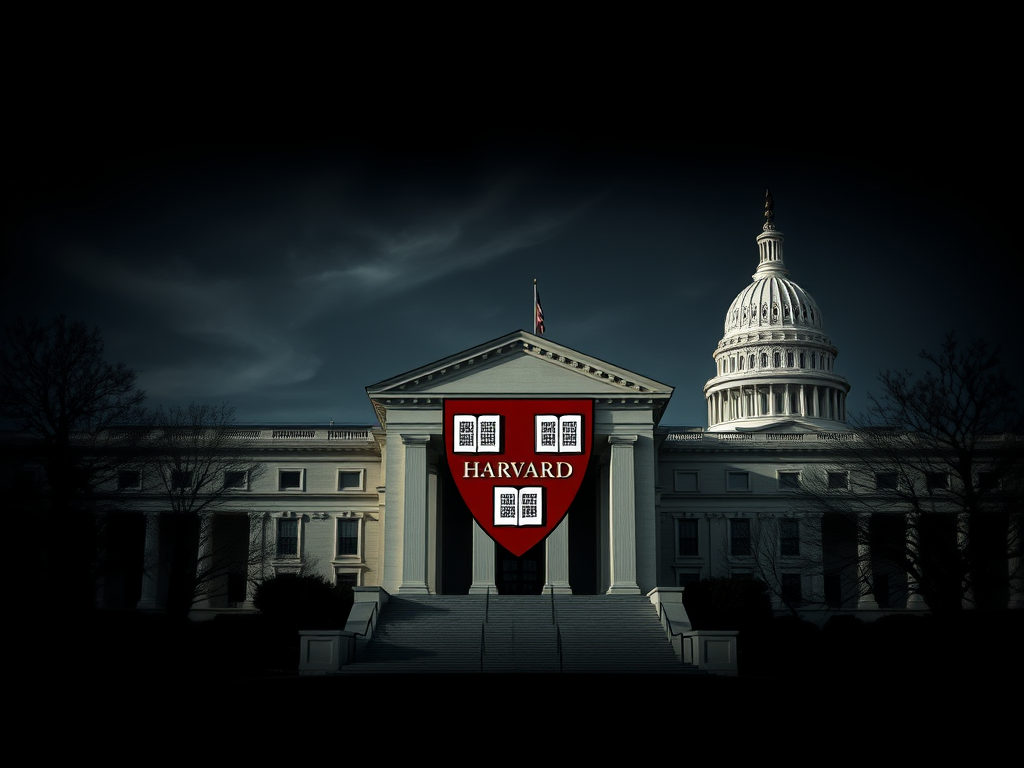
TRUMP ADMINISTRATION THREATENS HARVARD WITH GRANT CESSATION OVER ANTISEMITISM
The Trump administration has threatened Harvard University with the cessation of federal grants, citing concerns over antisemitism, racial policies, and a lack of “academic excellence.” This move follows Harvard’s lawsuit challenging the government’s funding cuts after the university opposed intrusive oversight. Education Secretary Linda McMahon’s letter accused Harvard of mismanagement, racism, and undermining higher education, and emphasized the school’s reliance on federal funding for research. Harvard rejected the allegations, asserting the government’s actions violate the law and stifle innovation. The university’s endowment, though large, is restricted, and a prolonged freeze on grants could financially harm Harvard. The administration’s stance represents an ongoing conflict with elite universities, especially Harvard, which has resisted pressure to audit professors and ensure ideological diversity. The university has vowed to defend its autonomy and continue combating antisemitism, while challenging what it sees as government overreach. (New York Times)
EU LAUNCHES INITIATIVE TO ATTRACT SCIENTISTS AMID U.S. FUNDING CUTS
The European Union launched a new initiative on Monday to attract scientists and researchers to Europe, offering grants and new policies in response to the U.S. government’s freeze on funding linked to diversity, equity, and inclusion (DEI) initiatives. French President Emmanuel Macron criticized the U.S. for canceling research programs based on DEI, calling it unimaginable a few years ago. At the “Choose Europe for Science” event in Paris, European Commission President Ursula von der Leyen announced a €500 million super grant program from 2025-2027, aimed at making Europe a research hub. The EU also plans to enshrine scientific freedom into law, highlighting Europe’s commitment to open research. In contrast, the White House dismissed DEI as “inherently discriminatory” and stated that the U.S. would continue to lead in scientific innovation. The EU’s efforts come as U.S. research projects in DEI and misinformation studies face funding cuts under Trump’s orders. (AP)
JAYANTA BHATTACHARYA DEFENDS NIH LEADERSHIP AMIDST POLITICAL SCRUTINY
When Jayanta Bhattacharya took charge of the NIH on April 1, the agency was facing turmoil, with layoffs and leadership changes following President Trump’s policies. Bhattacharya’s first weeks included handling contentious issues like a new policy on foreign research funding, preparations for a universal flu vaccine, and a proposed 40% budget cut. In an interview, Bhattacharya defended his leadership amid criticisms of NIH’s recent grant cancellations, particularly in diversity, equity, and inclusion (DEI) research. He criticized DEI-focused science as politically motivated and irrelevant to American health. Bhattacharya also commented on NIH’s foreign collaboration policies, dismissing rumors of a freeze and calling for transparency in funding. He expressed frustration with media reports and emphasized that NIH should prioritize health research over political ideologies. Despite his confrontational stance, Bhattacharya aimed to turn around the agency’s morale and ensure its scientific focus, while navigating challenges posed by both political and public scrutiny. (Science)
MUSK’S DOGE RELIES ON AI DESPITE LIMITATIONS IN GOVERNMENT FUNCTIONS
Elon Musk’s Department of Government Efficiency (DOGE) aims to run the U.S. government like a startup, often introducing AI to streamline operations. While AI has useful applications, DOGE’s approach seems overly simplistic, relying heavily on the technology without fully understanding its limitations. One example of this is at the Department of Housing and Urban Development (HUD), where an AI system is tasked with identifying areas where regulations exceed the strict interpretation of laws. Although AI is capable of processing large volumes of information, its lack of true understanding means it can generate inaccurate recommendations, potentially leading to flawed decision-making. Additionally, DOGE is pushing for the use of AI to replace tens of thousands of government jobs, an approach that raises concerns given AI’s current limitations. While AI can be useful in certain administrative tasks, DOGE’s reliance on it for broader governmental functions may risk undermining essential services and result in harmful consequences. (Wired)

GENETIC MUTATION FOUND THAT ALLOWS PEOPLE TO SLEEP LESS
A rare genetic condition allows some people to function with as little as three hours of sleep per night. In a study published in Proceedings of the National Academy of Sciences, scientists identified a genetic mutation that may contribute to this trait in naturally short sleepers. These individuals, who sleep for only three to six hours without negative effects, may hold the key to understanding sleep disorders. Researchers, led by Ying-Hui Fu from the University of California, San Francisco, discovered a mutation in the SIK3 gene, which regulates the circadian rhythm, in a naturally short sleeper. They also found that genetically modified mice with the mutation needed 31 minutes less sleep per day. This suggests that the mutation might support brain homeostasis, a theory that sleep resets the brain. The discovery of more mutations could help scientists better understand how sleep is regulated and potentially lead to treatments for sleep disorders. (Nature)
JAPAN’S CHILD POPULATION HITS RECORD LOW AMID DECLINE
As of April 1, 2025, Japan’s population of children under 15 years old has fallen to a record low of 13.66 million, marking a decline of 350,000 from the previous year. This represents the 44th consecutive year of decrease and is the first time the number has fallen below 14 million since 1950. The ratio of children to the total population is now 11.1%, continuing a 51-year downward trend. The number of children has decreased to just 46% of its 1950 level of 29.43 million. The largest group of children is aged 12-14, with 3.14 million, while only 2.22 million are between 0-2 years old. All 47 of Japan’s prefectures reported a decline in the number of children in 2024. Okinawa had the highest percentage of children at 15.8%, while Akita had the lowest at 8.8%. Japan’s child population is now the second-lowest globally, after South Korea. (Asahi Shinbun)
WHITE HOUSE PROPOSES 25% CUT TO NASA’S BUDGET FOR 2026
The White House’s proposal to cut NASA’s budget by nearly 25%, reducing it to \$18.8 billion for fiscal year 2026, has sparked strong criticism from industry leaders, lawmakers, and international partners. The plan includes cancelling key programs such as the lunar Gateway, Space Launch System, Orion, and Mars Sample Return missions. The proposal also suggests significant cuts to space technology and the International Space Station. Lawmakers, including Rep. Grace Meng and Sen. Chris Van Hollen, argue that the cuts would undermine U.S. leadership in space and science. Industry groups, such as the Coalition for Deep Space Exploration, warned that the budget would jeopardize U.S. space capabilities, risking global leadership, particularly to China. The European Space Agency and Canadian Space Agency expressed concerns, as NASA’s international collaborations could be affected. While some groups, like the Commercial Space Federation, support the budget’s focus on commercial partnerships, they criticize the deep reductions in other areas. (Space News)
Thanks for reading. Let’s be careful out there.
WORDS: The Biology Guy.




Leave a Reply