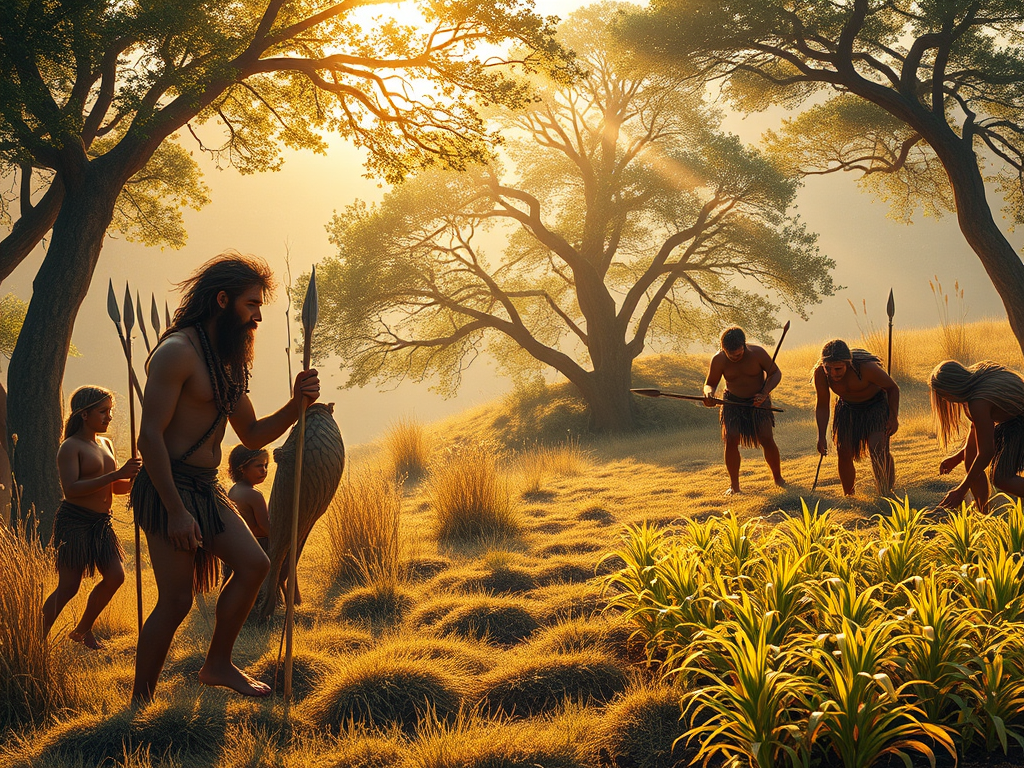
A new study published in Proceedings of the National Academy of Sciences (PNAS) has turned traditional thinking on its head by highlighting the role of human interactions during the shift from hunting and gathering to farming – one of the biggest changes in human history – rather than earlier ideas that focused on environmental factors.
The transition from a hunter-gatherer foraging lifestyle, which humanity had followed for hundreds of thousands of years, to a settled farming one about 12,000 years ago has been widely discussed in popular books like Sapiens: A Brief History of Humankind by Yuval Noah Harari.
Researchers from the University of Bath, the Max Planck Institute for Evolutionary Anthropology in Germany, the University of Cambridge, UCL, and others have developed a new mathematical model that challenges the traditional view that this major transition was driven by external factors, such as climate warming, increased rainfall, or the development of fertile river valleys.
This research shows that humans were not just passive participants in this process; they played an active and crucial role in the transition. Factors such as varying population growth rates and mortality rates—driven by competition between hunter-gatherers and farmers—shaped the agricultural development of these regions.
Using a model originally designed to study predator-prey interactions, the researchers examined how early farmers and hunter-gatherers may have influenced each other. The results suggest that early farming societies spread through migration, competition, and cultural exchange, reshaping how hunter-gatherers lived and interacted with their environment.
Sign up for the Daily Dose Newsletter and get every morning’s best science news from around the web delivered straight to your inbox? It’s easy like Sunday morning.
Dr Javier Rivas, from the Department of Economics at the University of Bath, said:
“Our study provides a new perspective on prehistoric societies. By statistically fitting our theoretical predator-prey model to observed population dynamics inferred from radiocarbon dates, we explored how population growth shaped history and uncovered interesting patterns—such as how the spread of farming, whether by land or sea, influenced interactions between different groups. More importantly, our model also highlights the role of migration and cultural mixing in the rise of farming.”
The team plans to build on this model by adding more details and testing it in larger regions.
Dr Javier Rivas added:
“We hope the methods we’ve developed will eventually become a standard tool for understanding how populations interacted in the past, offering fresh insight into other key moments in history, not just the shift to farming.”



Leave a Reply