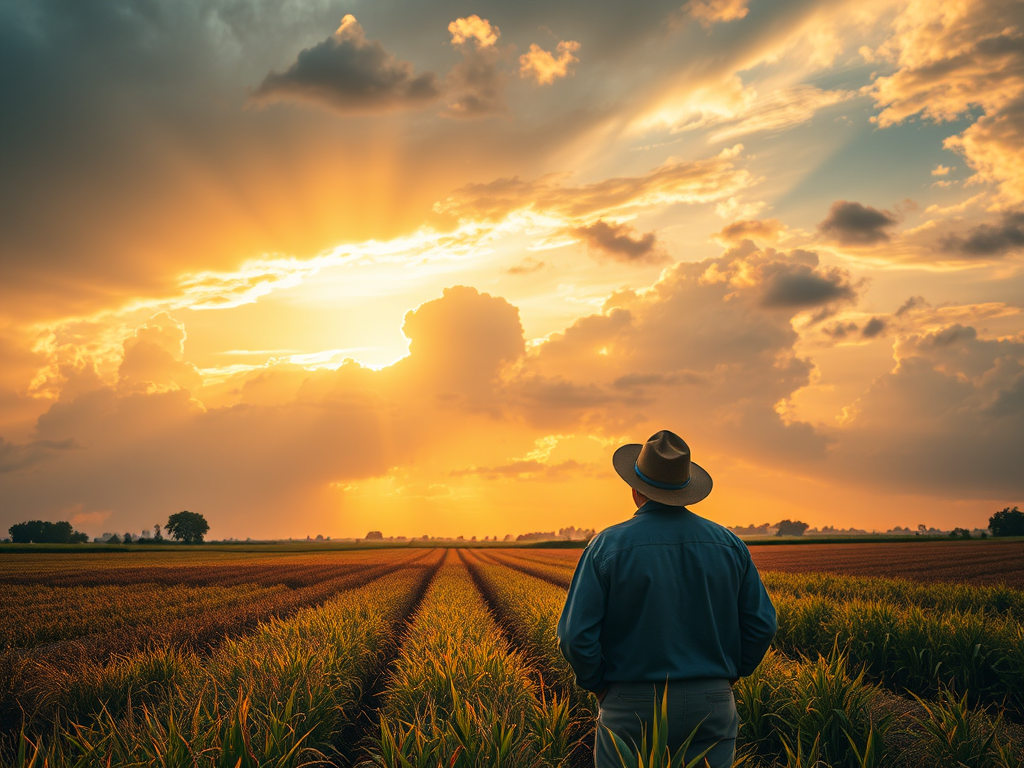
Climate change and flagging investment in research and development has U.S. agriculture facing its first productivity slowdown in decades. A new study estimates the public sector investment needed to reverse course.
In the paper, published in the Proceedings of the National Academy of Sciences, researchers model both the dampening effects of climate change on U.S. agriculture and the accelerating effects of publicly funded research and development (R&D) – and use the estimates to quantify the investment in research required to maintain agricultural productivity through 2050.
They find that a 5% to 8% per year growth in research investment is needed – an investment comparable to those made following the two world wars. Alternatively, they find that a fixed $2.2 billion to $3.8 billion per year in additional investment would also offset the climate-induced slowdown.
“What we find is that we need a very steep growth rate – but it’s not unprecedented. We’ve seen the U.S. step up in the past. We can do this, but the time is now,” said senior author Ariel Ortiz-Bobea, associate professor at Cornell and an applied economist with expertise in agricultural, environmental and energy policy.
The urgency stems from the imminent effects of climate change and because publicly funded R&D in agriculture – which is carried out at universities and research centers – takes time to impact productivity.
“It’s not like an iPhone that can be designed in California, manufactured in China and used in Ithaca,” Ortiz-Bobea said. “The research has to be done in close proximity to the people using it, and then it needs to be adopted by farmers. So, it takes time, and the longer we wait, the longer we stay on a path where we’re less productive, while other nations like China and Brazil are investing heavily in R&D.”
Sign up for the Daily Dose Newsletter and get every morning’s best science news from around the web delivered straight to your inbox? It’s easy like Sunday morning.
The current public sector investment in R&D is approximately $5 billion, with spending growing only .5% per year from 1970 to 2000 before stagnating. Ortiz-Bobea favors the more incremental investment scenario that adds 5% to 8% funding every year, for a total investment of $208 billion to $434 billion by 2050.
“The current environment is one where any public spending is seen as a waste, and obviously any use of taxpayer dollars should be assessed in a systematic way,” Ortiz-Bobea said. “But decades of research shows that agricultural research has a very high return on investment for the country.”
The alternative, Ortiz-Bobea said, is declining productivity, more government bailouts and increased reliance on other countries, as well as more environmental degradation: as farmers would need to use more land and more chemicals to increase production.

Leave a Reply