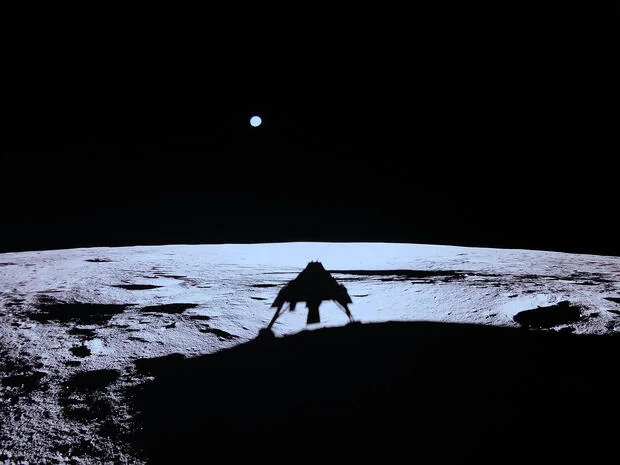
FIREFLY AEROSPACE BLUE GHOST SUCCESSFULLY LANDS ON THE MOON
On March 2, Firefly Aerospace’s Blue Ghost became the first commercial spacecraft to successfully land on the Moon, marking a major achievement for lunar exploration. The lander, located in the Mare Crisium region, is set to conduct science experiments for NASA over the next two weeks. Blue Ghost’s successful landing follows several failed attempts by other companies, including a recent crash by Intuitive Machines’ Odysseus spacecraft. Blue Ghost, launched on January 15, executed complex autonomous maneuvers to land upright and has already sent back images of the lunar surface and Earth. This success is a key milestone for NASA’s Commercial Payload Services Program, which began in 2018 to partner with aerospace companies for lunar research. Blue Ghost’s science payload includes experiments on lunar dust, electric fields, and a camera capturing a total eclipse and lunar sunset in mid-March, before its operations end as the lunar night begins. (Nature)
KENNEDY URGES PARENTS TO CONSULT PROVIDERS AMID TEXAS MEASLES OUTBREAK
As a measles outbreak in Texas nears 150 cases, U.S. Health and Human Services Secretary Robert F. Kennedy Jr. urged parents to consult healthcare providers about the MMR vaccine, though he did not explicitly recommend it. Kennedy emphasized that vaccination is a personal decision but highlighted its role in protecting both individuals and communities, especially those unable to vaccinate due to medical reasons. He also called for accurate information on vaccine safety and accessibility. The Texas outbreak, largely affecting unvaccinated individuals, has led to 20 hospitalizations and one death. Despite declining vaccination rates, the CDC and local health officials continue to advocate for the MMR vaccine, noting that measles cases have increased due to reduced coverage. This outbreak is the largest in Texas in 30 years and marks the first measles death in the U.S. since 2015. (CNN)
MYSTERY OUTBREAK IN DRC SPARKS FEARS OF NEW PATHOGEN
A recent outbreak in the Democratic Republic of the Congo (DRC) has sparked fears of a deadly new infectious pathogen, reminiscent of past Ebola outbreaks. The illness, which has affected 1,096 people and caused 60 deaths in Equateur province, shares symptoms with several viral infections, including fever, headache, vomiting, and diarrhea. Initially linked to the consumption of bat meat, it now appears that this connection was coincidental. The World Health Organization (WHO) has ruled out Ebola and Marburg viruses, which typically take longer to cause death. Researchers suggest the outbreak may be due to a poisoning event, possibly from contaminated water, which could be easier to contain. Other theories include mosquito-borne arboviruses like dengue or chikungunya, or bacterial infections. Although a new pathogen is considered the least likely cause, researchers are continuing to investigate. The DRC has faced similar mystery outbreaks in recent years. (Science)
TRUMP ROLLS BACK CLIMATE POLICIES BOOSTING FOSSIL FUEL INDUSTRY
In just a few weeks, President Trump has dramatically reshaped U.S. climate policy, rolling back environmental regulations and bolstering the fossil fuel industry. His administration’s actions include withdrawing from the Paris climate agreement, freezing clean energy project funding, and dismantling key climate programs. By gutting climate efforts, firing federal workers, and weakening pollution controls, Trump has accelerated fossil fuel production and undermined renewable energy initiatives. His administration has also moved to remove California’s authority to set emissions standards and revoked approvals for projects promoting clean energy. These changes have prompted legal challenges, with some funds frozen and projects delayed. The administration’s actions have long-lasting implications for climate progress, potentially stalling efforts to reduce greenhouse gas emissions and limit environmental damage. Critics argue that Trump’s disregard for environmental laws is a direct attack on climate regulation, with severe consequences for public health and the environment. (New York Times)

TRUMP CUTS FOREIGN AID THREATENING GLOBAL HIV/AIDS RESPONSE
The Trump administration’s decision to cut most U.S. foreign aid programs has severely impacted the global HIV/AIDS response, with South Africa’s program, the largest in the world, facing significant disruptions. Key programs like the President’s Emergency Plan for AIDS Relief (PEPFAR), which funds HIV efforts in over 50 countries, have been slashed, endangering treatment and prevention in nations like South Africa, Zimbabwe, and Zambia. Experts warn of a potential rise in new infections and deaths, particularly in South Africa, where an additional 565,000 HIV cases and 601,000 deaths could occur by 2034 without funding. UNAIDS, which coordinates global efforts, also faces a loss of U.S. support, jeopardizing its $200 million budget and workforce. The cuts threaten the intertwined HIV and tuberculosis programs, with severe consequences for monitoring, treatment, and drug resistance. Global health experts describe the cuts as a humanitarian crisis, with dire consequences for millions of people living with HIV/AIDS. (Science)
“MAN WITH THE GOLDEN ARM” JAMES HARRISON PASSES AWAY
James Harrison, known as the “man with the golden arm,” passed away on February 17 at the age of 88. Harrison’s rare blood plasma, containing the Anti-D antibody, saved over 2 million babies by preventing a deadly blood disorder in unborn children. His blood helped create medication for pregnant women at risk of haemolytic disease of the fetus and newborn (HDFN), which can lead to severe complications or death. Harrison began donating blood at age 18, continuing every two weeks until he was 81. His remarkable contributions earned him a world record for plasma donations, a title he held until 2022. Harrison’s daughter, Tracey Mellowship, shared that he was proud of saving lives and was happy to see families, like hers, thrive because of his donations. The Australian Red Cross Blood Service plans to replicate his antibodies in labs to develop treatments for pregnant women globally. (BBC)
MAKING OF JACOB APPELBAUM DOCUMENTARY MARKED BY SECRECY
The making of *Nobody Wants to Talk About Jacob Appelbaum* was marked by unprecedented precautions due to the sensitive nature of its subject: Appelbaum, an internet security expert and former Wikileaks associate. The documentary filmmaker faced tight security protocols, including motion-sensing cameras, locked edit suites, and air-gapped computers to prevent surveillance and hacking. Appelbaum, suspicious and cautious, imposed strict conditions for filming, including encrypted backups and forbidding the footage from entering the U.S. Despite his distrust, the filmmaker was drawn into Appelbaum’s world, where conversations about surveillance and privacy were constantly laced with tension. The project reflected the rise and fall of a movement, encapsulating Appelbaum’s complex persona. His warnings about the dangers of making the film, given the powerful forces at play, left the filmmaker questioning whether he was being brave or reckless. As the film is released, both men will learn the true costs of this daring undertaking. (CBC)
MASS TOURISM FLOODS ANTARCTICA THREATENING FRAGILE ECOSYSTEM
Mass tourism has reached Antarctica, with cruise ships flooding the continent, bringing tourists to remote locations like Deception Island. Despite its status as a nature reserve, the influx of visitors is having detrimental effects on the pristine environment. Tourists, drawn by social media platforms like TikTok, engage in inappropriate behaviors such as bathing in hot springs, contributing to pollution, and potentially harming local ecosystems. The rise in tourism has increased by 16% in just one year, and the Antarctic Treaty, which regulates activities on the continent, has yet to impose strict controls on tourism. Experts are warning about the impact of human presence, including the release of harmful substances like sunscreen into the ocean, which threatens marine life such as krill. There have even been instances of vandalism, including graffiti on historic sites. With tourism growing uncontrollably, scientists and officials are urging for better regulations to protect Antarctica’s fragile ecosystem. (El Pais)
RESEARCHERS DEVELOP BIOHYBRID HAND COMBINING LAB-GROWN MUSCLE AND ROBOTICS
Researchers at the University of Tokyo and Waseda University have developed a biohybrid hand, combining lab-grown muscle tissue with mechanical engineering to create a robotic hand capable of gripping and making gestures. This innovation in biohybrid science, still a nascent field, marks a significant step forward in robotics. The team grew muscle fibers in the lab and bundled them into “multiple tissue actuators” (MuMuTAs), which provide the strength needed for the hand’s movements. Remarkably, the biohybrid hand experiences fatigue like a human hand, losing force after 10 minutes of use but recovering after rest. While still a proof of concept, this breakthrough addresses challenges in scaling biohybrid devices, with potential applications in prosthetics, muscle tissue research, and drug development. The MuMuTA technology paves the way for more lifelike robotic movements and offers a glimpse into the future of advanced prosthetics and biohybrid robotics. (Fox News)
Thanks for reading. Let’s be careful out there.
WORDS: The Biology Guy.
IMAGE CREDIT: Firefly.


Leave a Reply