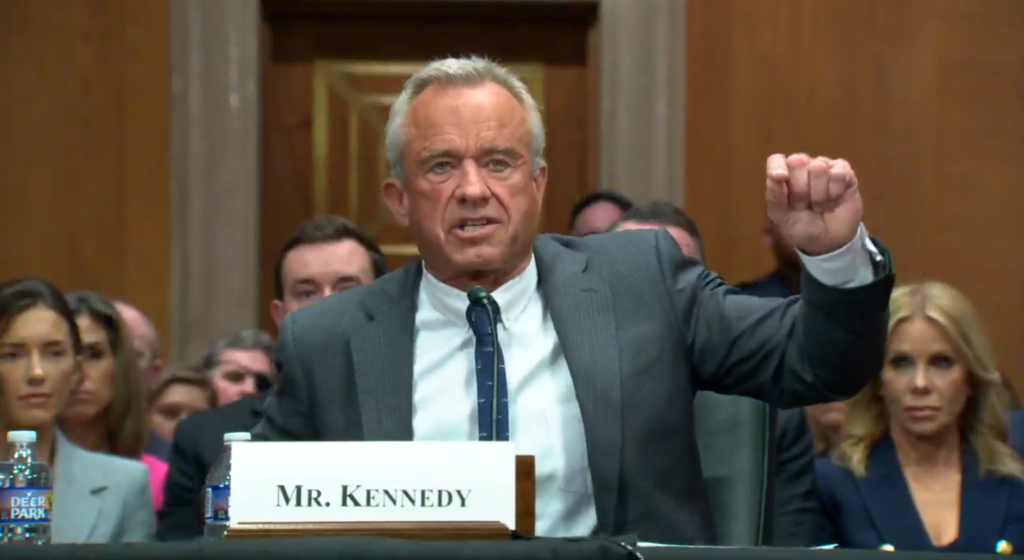
ROBERT F. KENNEDY JR. CONFIRMED AS HHS SECRETARY
Robert F. Kennedy Jr. was confirmed by the US Senate as the Secretary of the Department of Health and Human Services, with a 52-48 vote. Despite being a long-time critic of vaccines, Kennedy received support from most Republicans, except for Mitch McConnell, and opposition from Democrats and two independents. Kennedy, a lawyer and activist with no medical background, will oversee an agency with a $1.8 trillion budget and key divisions like the CDC, NIH, and FDA. While Kennedy has criticized industries such as food, agriculture, and pharmaceuticals, public health experts express concerns about his anti-vaccine stance. The Infectious Diseases Society of America warned that his views could undermine vaccine confidence and policy. Some senators, while voting in favor, remain uneasy about his vaccine stance, with assurances from Kennedy that he will base decisions on data-driven, evidence-based research. The future of his tenure raises significant concerns. (CIDRAP)
APPLE AND GOOGLE REINSTATED TIKTOK TO APP STORES
Apple and Google reinstated TikTok to their U.S. app stores on Thursday, weeks after removing the app to comply with a new law that banned it. The law, signed by President Biden, required TikTok’s parent company, ByteDance, to sell the app to a non-Chinese owner by January 19 due to national security concerns. While President Trump tried to pause enforcement through an executive order, Apple and Google awaited assurances from the Justice Department that they wouldn’t face penalties for distributing TikTok. The app’s return raised questions about executive power versus the rule of law. TikTok remains accessible to users who had already downloaded it, though some creators reported glitches. TikTok executives are optimistic that the issue will be resolved without further legal obstacles, despite concerns over U.S. user data potentially being shared with China. Trump, who has promised to save TikTok, has suggested extending the non-enforcement period. (New York Times)
TRUMP ADMINISTRATION FREEZE DISRUPTS GLOBAL TUBERCULOSIS CONTROL EFFORTS
The Trump administration’s 90-day freeze on USAID funding has severely disrupted global tuberculosis (TB) control efforts. USAID is the leading donor for TB programs, contributing $406 million in 2024, and its abrupt shutdown has left TB diagnosis, treatment, and research services in high-burden countries in limbo. Programs halted include medication distribution, sputum sample collection, and community outreach, with critical TB trials paused. Experts warn that even short disruptions can lead to severe consequences, such as the spread of drug-resistant TB. The freeze, which coincided with efforts to dismantle USAID, has drawn backlash from organizations like Stop TB Partnership, which relies heavily on USAID funds. While the Trump administration argues that the freeze is necessary for efficiency assessments, critics emphasize the threat to global health, particularly in preventing outbreaks from reaching the U.S. Lawsuits have been filed, challenging the freeze and dismantling, with the hope of restoring aid and services soon. (CIDRAP)
FEDERAL JUDGE BLOCKS TRUMP ADMINISTRATION FREEZE ON USAID AID
A federal judge issued a temporary injunction blocking the Trump administration’s freeze on USAID foreign aid, which had severely impacted health and humanitarian programs, including critical clinical trials. The freeze was part of a broader move to dismantle USAID, halting $40 billion in annual aid, including HIV research and maternal health projects. Many trials were suspended, such as a vaccine trial in Uganda and Zambia, and ongoing studies were disrupted, leaving participants without essential medical care. Researchers, facing ethical dilemmas, struggled with the consequences of halting studies, including losing trust and putting participants’ health at risk. Legal challenges are underway to reverse the freeze, but experts fear the damage may be irreparable, as the U.S. is unlikely to be replaced by other global funders. With USAID’s communication stalled, researchers are exploring alternative funding, but uncertainty remains high. Scientists hope the freeze will be lifted in time to resume vital work. (Science)

CDC STUDY REVEALS UNDETECTED H5N1 INFECTIONS AMONG VETERINARIANS
A study by the CDC revealed that three veterinarians who worked with cows tested positive for prior H5N1 bird flu infections, despite not showing symptoms or working with infected cows. The veterinarians, who were part of a study involving 150 bovine veterinarians, had antibodies against H5-type flu viruses, indicating recent infection. This discovery suggests that the virus may be spreading silently among animals and people, raising concerns about gaps in surveillance systems. The findings emphasize the need for better surveillance of H5N1 in dairy cattle, milk, and humans exposed to cattle. Although none of the veterinarians reported flu-like symptoms, one had worked with H5-positive poultry. This comes as the USDA implements a national milk testing strategy to detect bird flu in bulk milk samples, which recently helped identify a second spillover event of H5N1 from wild birds to cows in Nevada. (Ars Technica)
IEA FORECASTS 4% ANNUAL INCREASE IN GLOBAL ELECTRICITY DEMAND
The International Energy Agency (IEA) has raised its forecast for global electricity demand growth, predicting a nearly 4% increase per year until 2027, driven by rising electric transport, air conditioning, and energy-hungry data centers. This marks a shift toward what the IEA calls the “new age of electricity,” spurred by climate change, growing air conditioning use, and a transition away from fossil fuels. Governments are increasingly adopting electricity for transport, heating, and heavy industry, while the rapid growth of data centers, especially to support artificial intelligence, may strain energy supplies. China, which saw a 7% rise in demand last year, is expected to lead the growth, followed by the U.S., where demand could increase by the equivalent of California’s total consumption by 2027. While clean energy projects are growing, experts warn that without increased investment in clean power, fossil fuel generation may remain at current levels, hindering climate goals. (The Guardian)
QUERA RAISES $230 MILLION ADVANCING NEUTRAL ATOM QUANTUM COMPUTING
Neutral atom quantum computing is gaining momentum, with QuEra, an academic spin-out company, raising $230 million in funding, one of the largest investments in the quantum industry to date. Neutral atoms are stable, do not require bulky cooling systems, and can retain quantum states, making them ideal qubits. However, early challenges in controlling and configuring atoms for calculations slowed progress. Recent breakthroughs in atom manipulation have brought their accuracy close to other quantum hardware, like those used by IonQ and Google. QuEra, along with companies such as Atom Computing and Pasqal, is advancing the development of machines with hundreds of qubits, with aggressive roadmaps for scaling up. The technology’s ability to trap and move atoms using lasers offers advantages in building larger, more efficient computers. While challenges remain, including reducing atom displacement during operations, the industry is optimistic about the potential of neutral-atom quantum computers, with excitement growing around the field’s progress. (Nature)
STUDY REVEALS LIMITATIONS OF LARGE LANGUAGE MODELS IN REASONING TASKS
A study of large language models (LLMs) like ChatGPT revealed fundamental limitations in their ability to solve complex compositional reasoning tasks, such as Einstein’s famous logic puzzle. Despite their impressive performance on natural language tasks, LLMs struggle with tasks that require combining multiple pieces of information, like deducing the birthdate of Frédéric Chopin’s father based on separate facts. Researchers found that LLMs often fail to reason beyond their training data, approximating solutions that may be incorrect. This limitation stems from the architecture of transformers, the neural network type most LLMs use, which has mathematical bounds in handling compositional tasks. Although interventions like chain-of-thought prompting and model enhancements can improve performance, these do not overcome the inherent limits of transformers. These findings suggest that while LLMs are effective at pattern matching, they cannot fully grasp complex reasoning, raising questions about their future potential and whether alternative approaches should be pursued. (Quanta)
AI-DESIGNED ENZYMES REVOLUTIONIZE MULTI-STEP CHEMICAL REACTIONS
Researchers have used artificial intelligence (AI) to design new enzymes capable of completing multi-step chemical reactions, a critical feature of natural enzymes. This breakthrough, published in *Science* on February 13, marks a significant milestone in enzyme engineering. The AI-designed enzymes accelerated a four-step reaction crucial for biological and industrial processes, including plastic recycling, making them 60,000 times more efficient than previous designs. Unlike earlier efforts that focused on tweaking existing enzymes, this new approach created entirely new enzymes by combining multiple machine-learning techniques. The AI tools, RFdiffusion and PLACER, worked together to model the enzyme’s structure and optimize its active sites for each step of the reaction. While the enzymes are not yet as efficient as natural ones, the research lays the groundwork for creating more complex enzymes with potential applications, such as breaking down plastic. This success could also pave the way for designing enzymes for entirely new chemical reactions. (Nature)
Thanks for reading. Let’s be careful out there.
WORDS: The Biology Guy.
IMAGE CREDIT: U.S. Senate Senate Committee on Health, Education, Labor and Pensions.



Leave a Reply