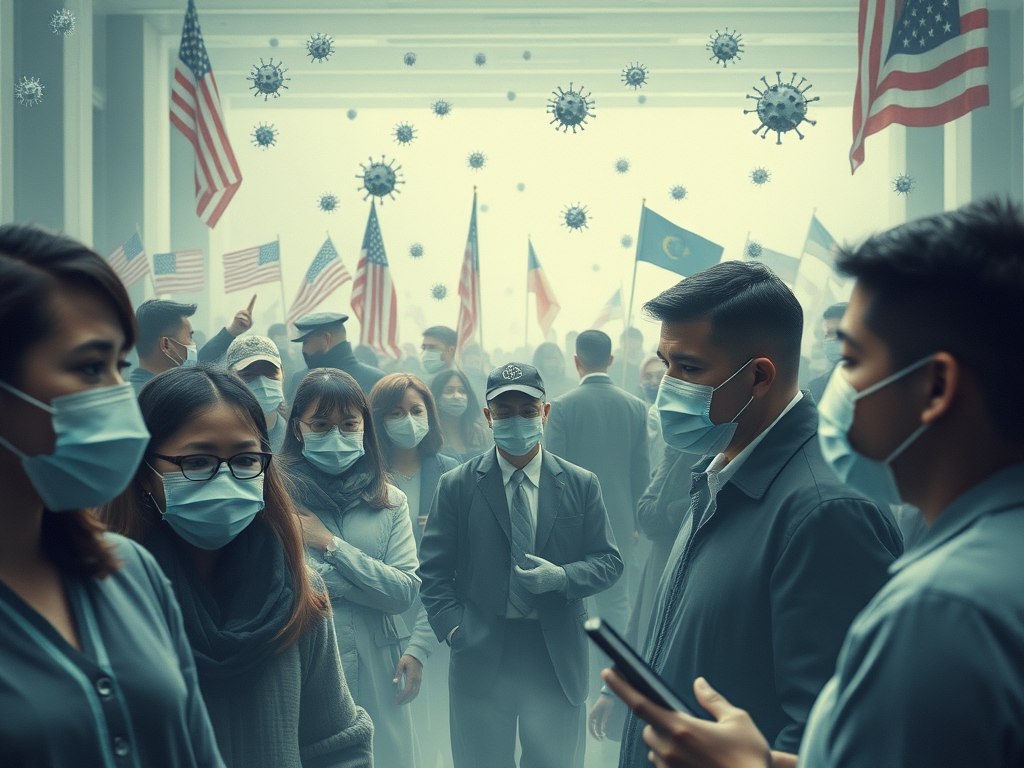
MOST AMERICANS SAY COVID-19 DIVIDED COUNTRY, REPORT FINDS
The Pew Research Center’s report, 5 Years Later: America Looks Back at the Impact of COVID-19, examines the long-term effects of the pandemic on American society. The study, based on surveys conducted in late 2024, finds that most Americans (72%) believe COVID-19 drove the country apart. The report covers four key areas: public health, workplaces, religion, and technology. Findings show that while three-quarters of Americans experienced personal tolls from COVID-19, most have since recovered. However, political divides persist regarding risk perception, vaccine uptake, and public health responses. Partisan differences also shape views on pandemic restrictions, with Republicans favoring fewer and Democrats supporting them. The pandemic reshaped work, accelerating remote jobs, while also affecting religious life and technology use. Trust in institutions declined, particularly among Republicans regarding public health authorities. Looking forward, 40% believe the U.S. would handle a future health crisis better, though many expect similar challenges. (Pew Research)
TRUMP ADMINISTRATION FREEZE THREATENS GLOBAL HIV/AIDS FIGHT
The global fight against HIV/AIDS is at risk due to the Trump administration’s freeze on foreign aid, disrupting the U.S.-led PEPFAR program, which has saved millions of lives over the past two decades. The uncertainty surrounding PEPFAR’s temporary waiver has left patients unable to access life-saving antiretroviral drugs, raising fears of a resurgence in AIDS-related deaths. Experts warn that 6.3 million people could die in the next five years if the funding gap is not addressed. HIV, which weakens the immune system, can rapidly rebound once treatment stops, leading to increased infections and drug resistance. Without medication, the disease progresses to AIDS, leaving individuals vulnerable to opportunistic infections like tuberculosis and pneumonia. The crisis is particularly dire in high-burden countries like South Africa. The disruption has already caused widespread layoffs of U.S.-funded health workers, leaving clinics unable to provide essential care. Health officials warn that unless urgent action is taken, the world could see a devastating rollback of progress in HIV/AIDS treatment and prevention. (AP)
ELON MUSK THREATENS TO WITHDRAW OPENAI BID OVER DISPUTE
Elon Musk has threatened to withdraw his $97.4 billion bid to buy OpenAI if the company maintains its nonprofit structure, arguing that its shift to a for-profit model violates its founding mission. Musk, a co-founder of OpenAI who later parted ways, has engaged in a public and legal battle with CEO Sam Altman over control of the AI company. Musk’s bid has been met with strong resistance from OpenAI, which accused him of hypocrisy—claiming in court that OpenAI must remain nonprofit, while simultaneously attempting to purchase it. OpenAI maintains that its nonprofit board has no obligation to entertain Musk’s offer. The dispute reflects deeper tensions over OpenAI’s future direction, with Musk alleging it is prioritizing profit over its stated mission of ensuring AI benefits humanity. Altman dismissed Musk’s actions as an attempt to stall OpenAI’s progress, while Musk likened the company’s shift to a conservation nonprofit turning into a lumber company. (CNN)
APPLE PARTNERS WITH ALIBABA TO BOOST AI IN CHINA
Alibaba has announced a partnership with Apple to integrate its AI technology into iPhones sold in China, boosting its stock by over 9% to a three-year high. Alibaba Chairman Joe Tsai revealed the collaboration at the World Government Summit in Dubai, emphasizing Apple’s decision to work with Alibaba after evaluating multiple Chinese AI providers. This move comes as Apple struggles in the Chinese smartphone market, facing declining sales and stiff competition from domestic brands like Huawei and Vivo. Analysts attribute Apple’s challenges to the lack of advanced AI features in its devices, a key selling point for modern smartphones. Apple’s market share in China fell to third place in 2024, with shipments declining by 17%. Meanwhile, Alibaba has gained traction as a leader in Chinese AI, with its stock up over 40% in 2025. The company’s Qwen 2.5 AI model, released in January, has been lauded for outperforming competitors in both capability and cost. (CGTN)

SCARLETT JOHANSSON DEMANDS AI REGULATION AFTER DEEPFAKE SCANDAL
Scarlett Johansson is calling for urgent legislation to regulate artificial intelligence after a deepfake video featuring her and other celebrities circulated widely on social media. The AI-generated video falsely depicted Johansson wearing a shirt with a Jewish star and Kanye West’s name, implying a response to West’s recent antisemitic remarks and merchandise. In a statement, Johansson condemned antisemitism and warned that AI-driven misinformation is an escalating threat. She criticized the U.S. government for failing to enact protective regulations, calling AI abuse a bipartisan issue that endangers society. The deepfake video, created by AI expert Ori Bejerano, also featured Adam Levine, Mila Kunis, Mark Zuckerberg, and others, set to the song “Hava Nagila”. Johansson has been a vocal critic of unauthorized AI use, previously challenging OpenAI over a synthetic voice resembling hers. Meanwhile, public figures like David Schwimmer have urged social media platforms to take stronger action against antisemitism, as West deactivated his X account following backlash. (CNN)
RUSSIA LAUNCHES DISINFORMATION CAMPAIGN TO INFLUENCE GERMAN ELECTION
Russia is conducting an extensive disinformation campaign ahead of Germany’s federal election on February 23, aiming to undermine mainstream parties and boost the far-right Alternative for Germany (AfD). The campaign spreads false claims through AI-generated videos, bot networks, and fake news websites, exploiting political and social tensions. Key players include Russian propagandist John Mark Dougan, who has created over 100 fake German news sites, and Elon Musk, who has amplified pro-AfD narratives on X. Russian bot networks have also spread Musk’s posts to further destabilize Germany’s political landscape. Tactics include deepfakes of both politicians and regular individuals, such as altered videos misrepresenting university staff and police officers. Researchers warn that these influence operations aim to delegitimize the election and erode public trust. While the full impact remains uncertain, engagement with Russian-linked content has tripled in recent weeks, highlighting the scale and sophistication of the effort to sway German voters. (New York Times)
U.S. PHARMA TURNS TO CHINA FOR FASTER DRUG DEVELOPMENT
U.S. pharmaceutical companies are increasingly turning to China for drug development, marking a major shift in the biopharma industry. Once overlooked, Chinese biotech firms are now producing innovative drugs faster and at lower costs, attracting licensing deals from major U.S. players like Merck, Gilead, and Summit Therapeutics. Chinese companies benefit from lower research costs and faster clinical trials, while U.S. firms can license already-tested molecules, reducing risk. This shift is reflected in the rise of big pharma deals with Chinese firms, which made up nearly 30% of transactions with upfront payments over $50 million in 2023, up from zero five years ago. However, concerns remain. Some fear this trend could undermine American biotech startups as large firms opt for cheaper Chinese alternatives. Others argue competition will lower drug prices. There’s also the risk of U.S. policymakers intervening, similar to AI and semiconductor restrictions, potentially reshaping global biopharma dynamics. (CNBC)
GLOBAL PHD DECLINE RAISES CONCERNS OVER SCIENTIFIC TALENT DRAIN
PhD enrolments have dropped in several countries, including Australia, Japan, Brazil, and the UK, prompting concerns about a talent drain and its impact on scientific progress. Factors such as high living costs, low stipends, and limited job prospects post-graduation are key deterrents. In Australia, the average PhD stipend is below the minimum wage, making it difficult for students, particularly those with families, to sustain themselves. Japan has seen a decline in enrolments since the early 2000s, and Brazil’s numbers were also at a decade-low in 2022, exacerbated by the economic crisis. Some countries, like Brazil and Canada, have increased funding to address these issues, leading to a slight improvement. Additionally, academic job precarity and the increasing number of PhDs, especially in China, further contribute to the challenge. Countries are attempting to diversify career options for doctoral students, but the broader perception of PhDs remains a barrier. (Nature)
BIRDS-OF-PARADISE REVEAL STUNNING BIOFLUORESCENCE IN NEW STUDY
Birds-of-paradise are even more visually striking than previously known, with new research revealing that 37 of the 45 species exhibit biofluorescence. This means their plumage and body parts absorb UV or blue light and emit it at lower frequencies, making colors appear brighter and more eye-catching. Researchers at the American Museum of Natural History studied preserved specimens under blue and UV light, finding that males of 21 species had biofluorescent plumage on their heads, necks, bellies, tails, or face wattles. Many species also displayed fluorescence inside their mouths and throats, potentially enhancing courtship displays. Females of 36 species also exhibited biofluorescence, but theirs may serve a camouflage function rather than display. The trait likely evolved in a common ancestor but was later lost in some lineages. The findings highlight how even well-studied species like birds-of-paradise continue to offer new insights into avian vision, behavior, and evolution. (The Guardian)
Thanks for reading. Let’s be careful out there.
WORDS: The Biology Guy.


Leave a Reply