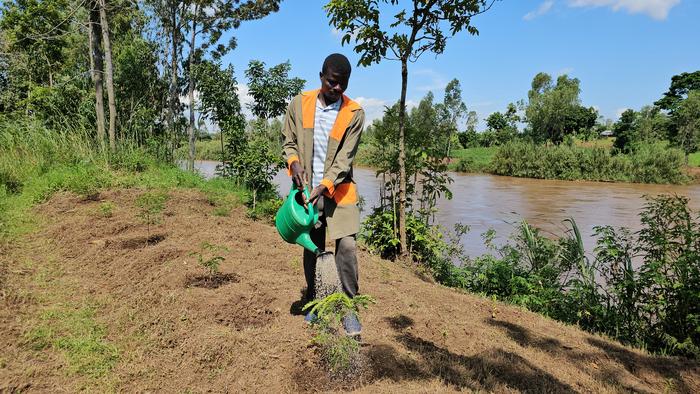
African nations have grand ambitions to green up landscapes with trees; the Kenyan government, for example, launched an initiative to plant 15 billion trees by 2032. The hope is that new trees could help fight desertification, create opportunities for livelihood diversification, support nutritional diets, restore biodiversity in highly degraded land and capture planet-heating carbon. Restoring lands using trees could empower millions whose livelihoods depend on working the land while generating multiple environmental and social benefits.
Yet tree planting projects often fall short because of a poor diversity of tree species and inadequate follow-through to nurture seedlings into mature trees.
“While many tree planting projects focus on integrating trees in agricultural landscapes, their outcomes are often constrained because they don’t consider the local context and trade-offs involved for smallholder farmers,” said Ennia Bosshard, a Ph.D. researcher at the University of Exeter. Bosshard and colleagues including Chris Kettle of the Alliance of Bioversity and CIAT recently explored the “barriers and enablers” tree-planting smallholders face in research published in People and Nature on January 28. Some may find the results surprising.
A farm in Vihiga County, Kenya, where trees are integrated into the landscape. (Photo: Ennia Bosshard for the Alliance)
Snakes and enablers
The study found that farmers’ positive past experiences with planting trees were key enablers. Farmers were also more likely to become directly involved in increasing tree diversity when they heard the experiences of their peers who said the positive results were worth the wait. Interestingly, other social pressures like those from family, elders, or media had little to no impact on decision-making.
Sign up for the Daily Dose Newsletter and get every morning’s best science news from around the web delivered straight to your inbox? It’s easy like Sunday morning.
Although farmers were broadly enthused by the benefits of increased tree diversity – better crop yields or climate resilience, for example – the study revealed some concerns about some potential consequences.
“One surprising result we found was that, in particular, the fear of increasing tree diversity attracting harmful wildlife like snakes or insects played an important role in willingness to diversify trees on farms,” Bosshard said. (In the Kenyan study area, venomous snakes are legitimately concerning.) “But overall we found very positive attitudes toward integrating native tree species on or near farms.”
Another concern was that tree planting provides its greatest benefits over time.
“Benefits take many years to appear. Farmers may have more immediate concerns and priorities,” Kettle said. “This should be a call to central planners and development organizations to listen a little more closely to the smallholders, particularly their short-term issues, when deploying massive tree-restoration plans.”
Local trees for local benefits
In addition to increasing the enablers and taming the snakes already mentioned, researchers said specific local challenges need locally designed solutions.
“Our research highlights that diversifying trees on farms is perceived as having benefits as well as costs,” Bosshard said. “More work is needed to understand how to maximize the benefits—like food security and soil fertility—while addressing farmers’ concerns, such as dealing with wildlife.”
Next steps include increased peer-to-peer learning, stronger policy designed for restoration practitioners, and targeted interventions, like increasing the quantity and quality of tree-planting material.
Alliance researchers point to two key targeted interventions that have grown considerably under the CGIAR Nature-Positive Solutions Initiative: Diversity for Restoration (D4R) and My Farm Trees (MFT). Both tools were deployed extensively by the CGIAR Nature-Positive Solutions Initiative through its RESTORE work area.
D4R increases the scientific knowledge base for the adaptive and resilient use of local tree species in forest landscape restoration, whose life histories and cultural uses have been long understudied by science. MFT helps increase the capacities of local communities to manage, monitor and verify their tree-planting activities from seed collection to nursery work and tree growth, and provides digital payments to incentivize communities who want to increase tree diversity in production areas.
“D4R and MFT draw strongly on local restoration knowledge and needs, which is critical to building tools that can help improve the track record of tree-based restoration,” Kettle said.
IMAGE CREDIT: Rachel Kibui/NATURE+, Alliance of Bioversity International and CIAT




Leave a Reply