Ōtākou Whakaihu Waka scientists have successfully analysed more than 30 years of vital data on the thickness of landfast sea ice in Antarctica’s McMurdo Sound, which will prove useful to measure future impacts of climate change.
The study, published in the Journal of Geophysical Research: Oceans, set out to discover what key influences determine the thickness of landfast sea-ice, known as fast ice, using data from 1986 to 2022.
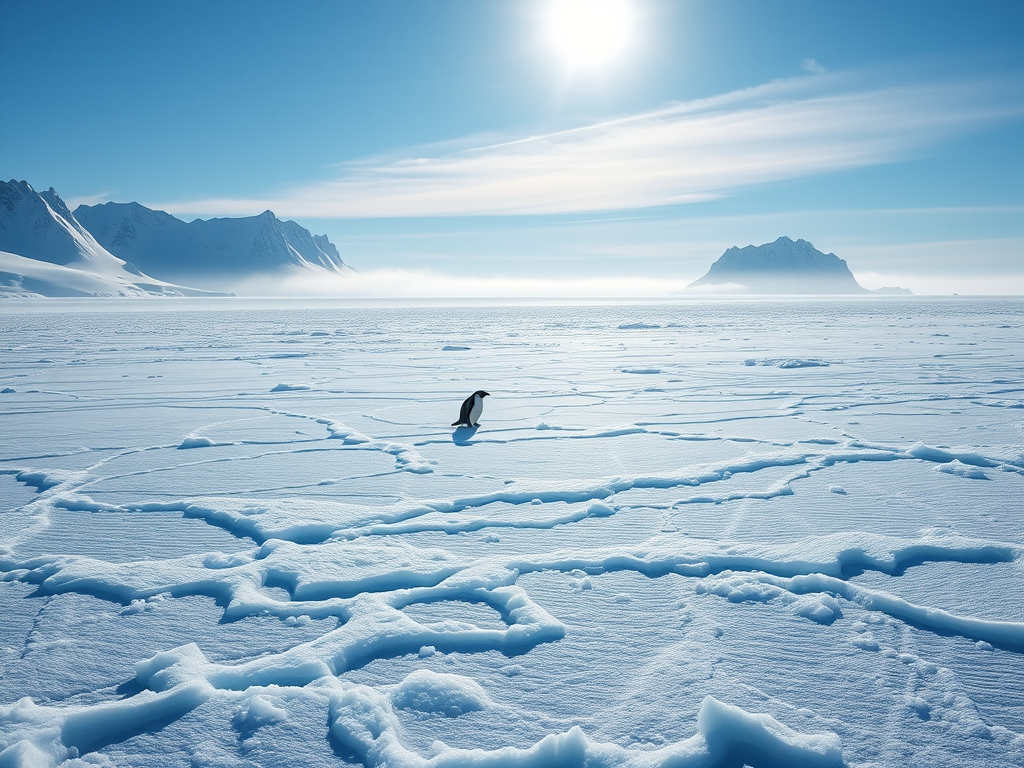
Fast ice is frozen ocean water that is attached to shorelines and persists for at least 15 days. It provides vital habitats for penguins and seals, as well as fish, krill and algae underneath the ice.
Scientists also traverse around McMurdo Sound on fast ice to perform experiments and measure the ocean underneath and the atmosphere above. The ice needs to be stable and thick enough to do this safely.
Instead of a long-term trend of increasing or declining thickness, the researchers found storm events, air temperature and winter wind speed cause fast ice thickness to vary year to year.
Lead researcher Dr Maren Richter, who completed the research as part of her PhD at Otago, says fast ice in McMurdo Sound has not (yet) seen strong effects of climate change.
“The ocean/ice/atmosphere system there seems to still be able to balance out effects of climate change.
Sign up for the Daily Dose Newsletter and get every morning’s best science news from around the web delivered straight to your inbox? It’s easy like Sunday morning.
“We see a slight increase in air temperatures over the last 10 years of our study period, but if we look at air temperature over a longer time period (from the mid-1980s to now) there is no clear trend,” she says.
The study data shows what variability is ‘normal’ for the fast ice in McMurdo Sound and this can then be used to detect when things start to change, for example if a year is unusual or if a series of years start to form a trend toward different fast ice conditions.
“The data analysed shows how important it is to monitor the Antarctic regularly and over many years. Only long time series of observations allow us to distinguish between natural variability and trends influenced by climate change.”
She hopes the new study will be useful for modellers to predict variations year to year, which would be useful for scientists planning research on the ice or to research station operators who want to know what ship to use to resupply the stations.
The study could also be used to verify and train models that look decades into the future and try to see what average fast ice conditions will be like in 100 years’ time with a lot more carbon dioxide in the atmosphere.
“Now might be the last time we can observe some systems before effects of climate change dominate over natural variability.”
Co-author and Dr Richter’s primary PhD supervisor, Associate Professor Inga Smith, of the Department of Physics, says although the total fast ice area is much smaller than the pack ice (broken up sea ice) in Antarctica, it has very important roles to play in Earth’s climate system and for the breeding success of penguins and seals.
“We know very little about how fast ice behaves over long periods of time which means we cannot currently predict future changes,” she says.
Dr Richter points out that 30 years of observations is still “quite short” when talking about trends in climate.
“There might have been changes in earlier years which we do not know about because we were not measuring fast ice thickness.
“I also want to stress that although there was no trend in fast ice thickness in McMurdo Sound, other areas around Antarctica do show trends in fast ice thickness, extent and persistence.”




Leave a Reply