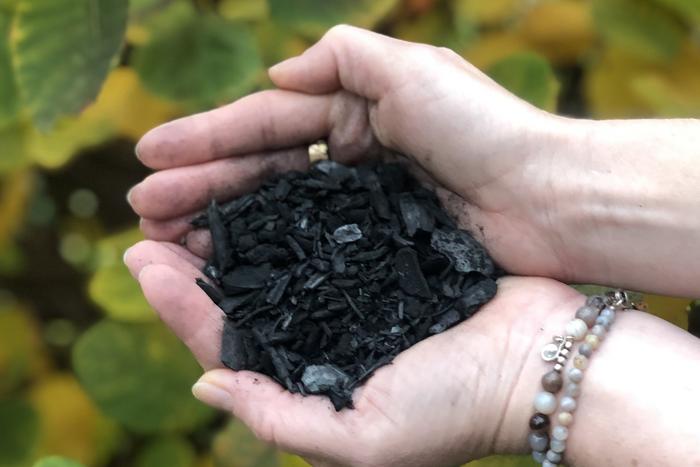
DDT soil pollution is still a major problem in many parts of the world. Researchers at Chalmers University of Technology, Sweden, have developed a new method to manage ecological risks from the toxin by binding it with biochar. When they mixed biochar into contaminated soil at a former tree nursery, DDT uptake by earthworms in the soil was halved. This method may enable the growing of certain crops on land that is currently considered unusable due to the environmental risks.
The legacy of previous generations´ use of the insecticide DDT still affects us today. During the 50s and 60s, the substance was used to control pests in forestry and agriculture, and although it has been banned for over 50 years, in Sweden alone there are thousands of sites where the soil is still DDT-contaminated. Many other countries around the world have the same problem.
The toxin has been linked to a variety of negative health effects in humans and animals, and it breaks down very slowly. It poses an ecological risk because it can be taken up by terrestrial organisms such as earthworms. When these are in turn eaten by birds and other animals, DDT begins to accumulate within the food chain, which means that the top predators are affected by the highest toxin concentrations.
For three years, researchers at Chalmers University of Technology have been testing a new method to reduce the ecological risks of the toxin, at a DDT-contaminated former tree nursery in southern Sweden.
“In our field experiment, we mixed the soil with biochar and grew different plants. We found that biochar binds DDT efficiently, so that it is not taken up by soil organisms,” says Paul Drenning, postdoctoral researcher at the Department of Architecture and Civil Engineering at Chalmers, and the first author of the study.
Cheap and environmentally friendly solution on site
Biochar – which is similar to charcoal – is an environmentally friendly product that is cheap to produce. It binds contaminants and can improve soil health when added to soil. This practice can also be useful for climate change mitigation since it can contribute to long-term storage of carbon in the soil.
The researchers found that the amount of DDT taken up by earthworms in the soil decreased by an average of 50 per cent when the soil had been mixed with biochar. This indicates that the bioavailability of DDT to soil organisms had been reduced – meaning that the soil had become less toxic, with a lower risk of DDT spread via bioaccumulation in the food chain of animals, or by leaching into water.
This reduction in environmental risks could, in turn, lead to landowners being able to start farming again on land that is currently unused, pending decisions on how to manage the contaminated soil.
Sign up for the Daily Dose Newsletter and get every morning’s best science news from around the web delivered straight to your inbox? It’s easy like Sunday morning.
“Treating contaminated soil in large volumes is costly and complicated. A common solution is to dig out the soil and then transport it to a landfill for hazardous waste, but that means destroying good quality soils and is not a reasonable solution for large contaminated areas”, says Paul Drenning.
“Treatment with biochar on site could thus make the land useful instead of being left uncultivated or degraded, and also at a significantly lower cost for both the landowner and for the environment.”
Long-term effect expected
Examples of crops that could be grown in the treated area are saplings of pine and spruce, hay for animal feed or bioenergy crops such as willow trees (salix). The treatment with biochar means that plants may take up less DDT from the soil as well, but they accumulate very little even without treatment.
“The reason why the contaminated land is left unused today is not that there would be health risks with crops, but that the landowner is obliged by regulation to address the ecological risks with DDT. While awaiting an investigation and decision on this, the land has remained unused”, says Jenny Norrman, Professor at the Department of Architecture and Civil Engineering and the leader of the research project.
Biochar decomposes very slowly in soil, and the researchers expect the effect of the treatment to last for a long time – perhaps for decades. They will continue sampling at the site for several years to follow the development. In parallel, they will explore how to scale up the experiment, to be able to mix biochar into the soil without having to dig out large volumes.
Great potential for the method
Using biochar for treatment of contaminated soil is uncommon today. As far as the researchers know, the method has not been tested before at forest nurseries in Sweden, or internationally in the same soil type and climate.
“There is a great interest in using biochar for stabilisation of both DDT and various other contaminants in soils, such as metals and polyaromatic hydrocarbons. Therefore, it is positive that we have been able to see a good effect in our experiment,” says Paul Drenning.
Soil is a valuable resource with a very slow rate of regeneration – a single centimetre of soil can take hundreds of years to form. In the European Union, 60-70 per cent of the soils are considered unhealthy due to degradation, with soil pollution being a major driver. Active work is now underway within the EU to better control soil pollution. The European Commission´s upcoming Soil Monitoring Law contains new, stricter rules for sustainable land management and remediation of contaminated areas, where consideration of soil health is expected to play a significant role.
The Chalmers researchers have also investigated several other aspects of soil health – such as different treatment effects on soil functions like nutrient cycling, water cycling and carbon storage – with positive results, in addition to the effect of biochar on DDT. Their field experiment is a demonstration of a general methodology which they have developed for evaluating the effects of gentle remediation options on soil health. It is designed to also be accessible for practitioners and decision-makers, such as landowners.
IMAGE CREDIT: Anja Enell, the Swedish Geotechnical Institute.


Leave a Reply