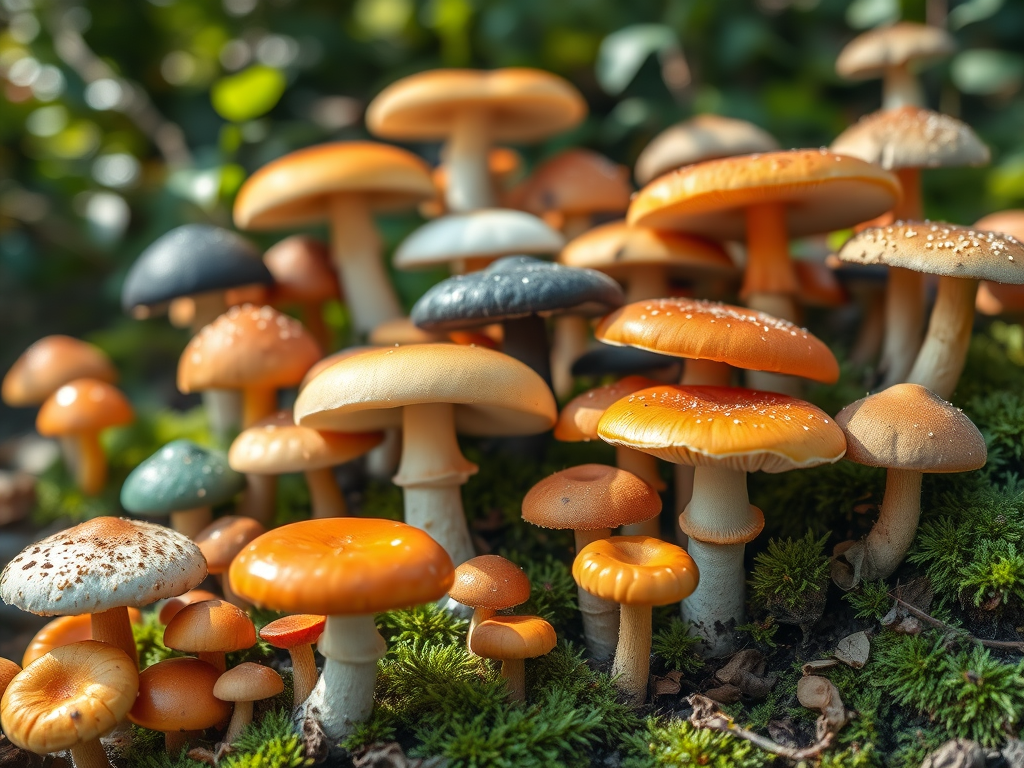
For roughly a century, ever since Alexander Fleming’s accidental discovery of penicillin in 1928, fungi have proven to be a goldmine for medicines. They’ve provided treatments for a wide range of diseases, from infections and high cholesterol to organ rejection and even cancer.
However, the process by which fungi synthesize some of their most potent compounds remains opaque. This is especially true of cyclopentachromone, a key building block in fungal products whose derivatives have shown promise in fighting cancer and reducing inflammation, among other medicinal properties.
While chemists have made progress in creating chromone derivatives in the lab, the molecule’s distinctive structure has proven difficult to precisely and reliably copy. “It’s very easy to wind up with a version where the chemical bonds aren’t in the right place, or the structure is flipped,” says Sherry Gao, Presidential Penn Compact Associate Professor in Chemical and Biomolecular Engineering (CBE) and in Bioengineering (BE).
In a new paper in Journal of the American Chemical Society, members of the Gao Lab describe how they deciphered nature’s own instructions — namely, the genes of Penicillium citrinum, a mold commonly found on citrus fruits — to discover a previously unreported enzyme that catalyzes the creation of cyclopentachromone-containing compounds.
“Nature has had billions of years to develop pathways for creating these compounds,” says Gao, the paper’s senior author. “Now we can borrow nature’s tools to develop and study these compounds further, which could potentially lead to the development of new pharmaceuticals.”
Part of what makes cyclopentachromone unique is its distinctive structure, which includes a trio of carbon rings, two with six carbons, and one with five carbons. Like the scaffold used to erect a building, this series of rings provides the structural foundation for numerous bioactive molecules.
Sign up for the Daily Dose Newsletter and get every morning’s best science news from around the web delivered straight to your inbox? It’s easy like Sunday morning.
However, one of cyclopentachromone’s known chemical precursors has an additional carbon, forming three rings of the same size. Exactly how nature changes that chemical to one with a different ring structure, when such rings are normally stable, has never been described before.
Elucidating the process required systematically turning genes on and off in P. citrinum until the pathway was disrupted, making clear which genes coded for the enzyme at work. “It was like having to test hundreds of light switches to see which one operates a particular bulb,” says Qiuyue Nie, a postdoctoral fellow in the Gao Lab and the paper’s first author.
As the researchers discovered, a different intermediary compound, 2S-remisporine A, which is produced by the newly identified enzyme, IscL, has a sulfur atom hanging off one side of the three-ring structure, like the hitch on the back of a truck.
That high degree of reactivity is the source of cyclopentachromone’s medicinal versatility: just as a truck can pull many different types of attachments, from wagons to boats, the carbon-sulfur bond in 2S-remisporine A can combine with a wide range of other groups, yielding a diverse array of molecules. “This intermediary compound is highly reactive,” says Nie. “The carbon-sulfur bond can react with different sulfur donors to produce a lot of new compounds.”
The fact that 2S-remisporine A is so reactive and will combine with various molecules, even itself, explains why this precursor has never been fully identified before. “We could never invent how to make such a reactive intermediate compound,” says Nie. “We had to learn how nature makes it, then leverage those enzymatic tools ourselves.”
The researchers hope that future work will walk this newly discovered pathway using the genetic map that guides it to further advance the use of fungal compounds in medicine. “Nature has an incredible toolbox,” says Gao. “This paper shows us how one of those tools is made.”




Leave a Reply