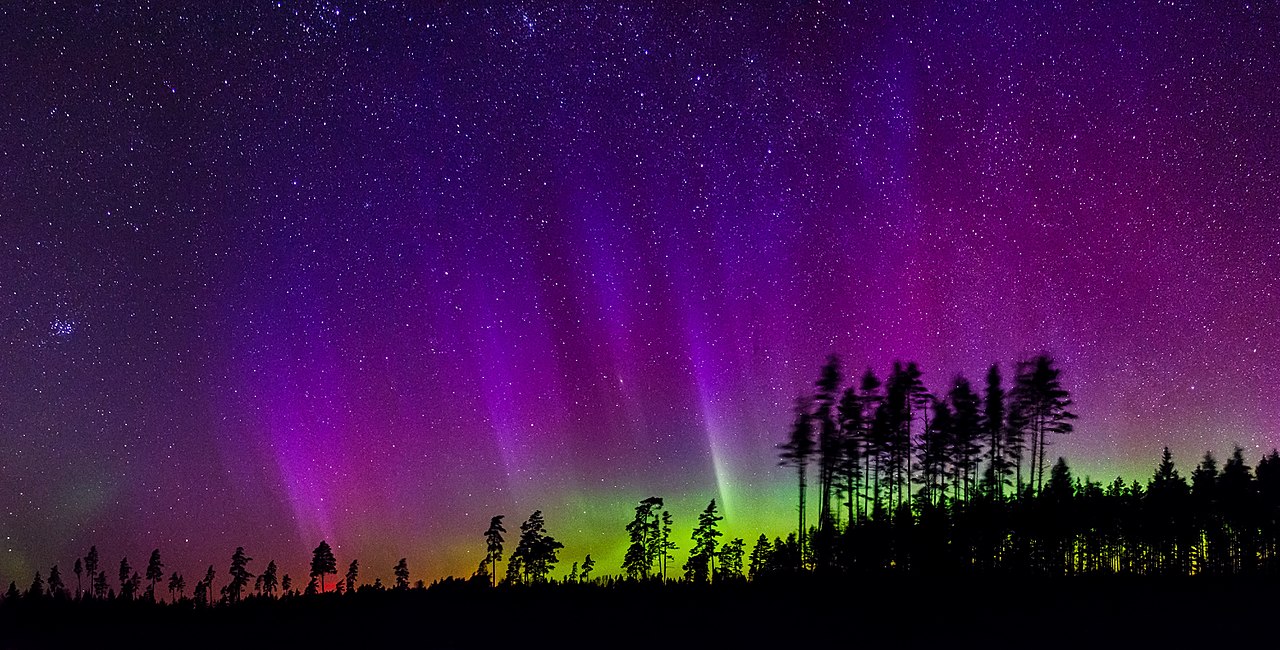

Today’s Big Picture image showcases a breathtaking display of the Northern Lights, or Aurora Borealis, a phenomenon that illuminates the sky with vibrant colors, often seen in high-latitude regions near the Arctic Circle. The science behind this mesmerizing light show lies in the interaction between charged particles from the Sun and Earth’s magnetic field.
The auroras are caused by solar wind—a stream of charged particles, primarily electrons and protons, emitted by the Sun. When these particles reach Earth, they are guided by its magnetic field toward the polar regions, where they collide with atoms and molecules in the upper atmosphere, particularly in the thermosphere and exosphere, about 80 to 500 kilometers above the Earth’s surface. The energy from these collisions excites the atoms and molecules, causing them to emit light as they return to their original energy state.
The colors in the aurora vary depending on the type of gas involved in the collision and the altitude at which it occurs. Oxygen, for example, emits green and red colors; green light typically appears at lower altitudes (around 100-300 km), while red can appear at higher altitudes. Nitrogen, on the other hand, can produce blue or purplish-red hues. The combination of these emissions creates the aurora’s iconic spectrum of greens, purples, and reds.
Solar activity, such as solar flares and coronal mass ejections, can intensify auroras. During periods of high solar activity, more charged particles are sent toward Earth, resulting in brighter, more widespread auroral displays that may even be visible in lower latitudes.
The aurora phenomenon is not just beautiful but also offers scientists valuable insights into Earth’s magnetic field, space weather, and the Sun’s activity, which impacts satellite operations and power grids.


Leave a Reply