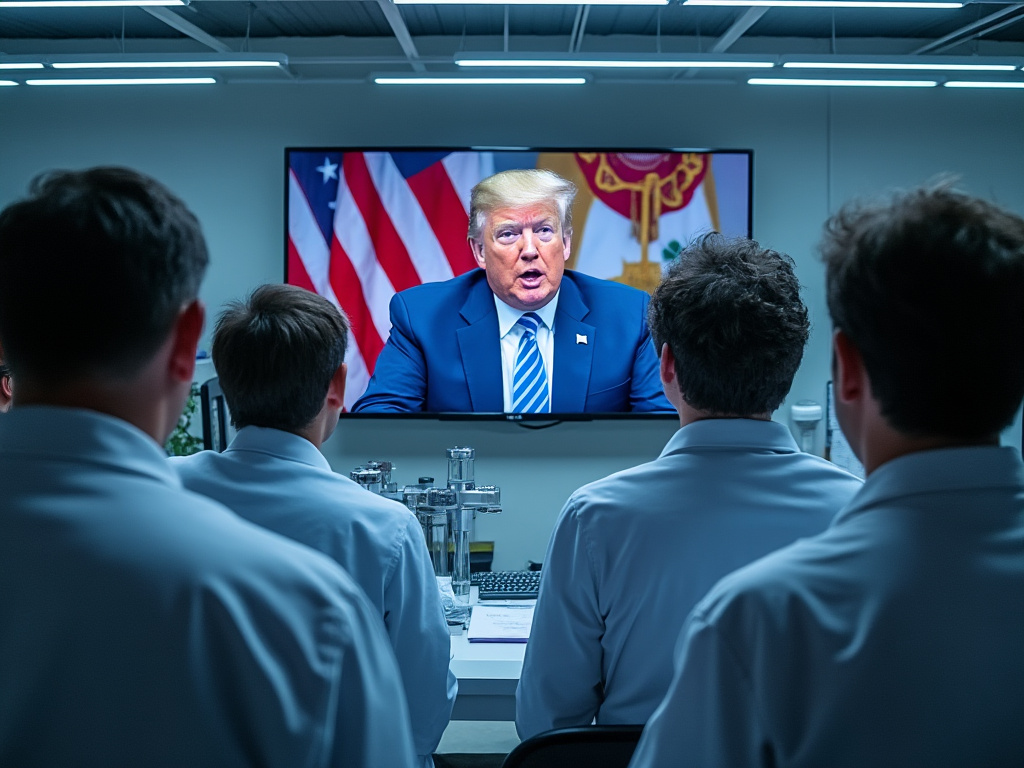
TRUMP WIN RAISES CONCERNS OVER U.S. SCIENTIFIC RESEARCH
Following Donald Trump’s victory in the 2024 U.S. presidential election, science advocates express concern over potential damage to the U.S. research enterprise. Trump’s proposed tax cuts and anti-immigration measures could lead to reduced funding for basic research and hinder the flow of foreign scientists into the country. Research funding, which increased under President Biden, may decline under a Republican-controlled Congress focused on cutting spending to address the growing deficit. Republicans may also push for policies that weaken diversity initiatives in science and downplay issues like climate change. Notably, Trump’s stance on climate could mirror his first term, including withdrawing from the Paris climate pact and repealing climate-related laws, although some analysts believe these efforts may face resistance due to the widespread impact of clean energy projects. Additionally, tensions with China could lead to reduced research collaborations, further complicating the scientific landscape. As Congress prepares for budget negotiations, the future of U.S. scientific research remains uncertain. (Science)
GLOBAL CARBON EMISSIONS SET TO REACH RECORD HIGHS IN 2024
One year after global leaders pledged to transition away from fossil fuels, countries are burning more oil, natural gas, and coal than ever before, according to the Global Carbon Project. In 2024, global carbon dioxide emissions are expected to reach a record 37.4 billion metric tons, a 0.8% increase from 2023. While emissions in the U.S. and Europe are expected to decline, and fossil fuel use in China has slowed, surging emissions in India and the rest of the world offset these declines. Despite the spread of renewable energy technologies like solar and wind, the growing demand for energy has led countries to continue relying on fossil fuels. Notably, India’s emissions are set to increase by 4.6%, making it the largest contributor to global carbon dioxide growth. While Europe and the U.S. are seeing some reductions, global emissions are still on the rise, challenging the goal of halting global warming. (New York Times)
U.S. INDICTS HACKERS FOR STEALING 50 BILLION RECORDS
The U.S. government has indicted Connor Moucka and John Binns for hacking into AT&T’s systems and stealing around 50 billion customer call and text records. In July, AT&T confirmed that hackers accessed the phone records of nearly all its customers, including data on calls and texts but not message content. The breach occurred in April, with records stolen from AT&T’s Snowflake-hosted cloud systems. The indictment, filed in connection with the hack, describes the breach of “Victim-2,” which aligns with AT&T’s public disclosure, confirming the company as the victim. Moucka and Binns, who operated under multiple online aliases, extorted victims, stealing sensitive data and demanding ransom in Bitcoin. Their hacking activities affected several other companies using Snowflake, including Santander Bank and Ticketmaster. These breaches resulted in the theft of personal and corporate data, including social security and banking information, marking them as some of the most significant cyberattacks of the year. (Tech Crunch)
EPOCH AI INTRODUCES FRONTIERMATH TO CHALLENGE ADVANCED AI MODELS
Epoch AI has introduced FrontierMath, a new benchmark designed to challenge AI models with complex, expert-level mathematics problems that most models struggle to solve. The benchmark consists of hundreds of problems across various mathematical disciplines, such as number theory and algebraic geometry, which are so difficult that even top AI models like GPT-4o, Claude 3.5, and Gemini 1.5 Pro solve less than 2% of them. Unlike other benchmarks, the FrontierMath problem set remains unpublished to prevent data contamination, ensuring that models cannot easily solve them based on prior exposure. The problems are rigorously peer-reviewed by over 60 mathematicians and are designed to require significant computational work, making them difficult for both AI and humans. The problems are “guessproof” with solutions that can be automatically verified. Epoch AI plans to release additional problems and conduct regular evaluations of AI model performance to further test their capabilities in solving advanced mathematical challenges. (Ars Technica)

CHINA UNVEILS REUSABLE HAOLONG SPACE SHUTTLE FOR TIANGONG RESUPPLY
China has revealed the design of the Haolong space shuttle, a reusable spacecraft intended to transport cargo to and from the Tiangong space station. Developed by the Chengdu Aircraft Design and Research Institute, Haolong is part of a push for low-cost, reusable cargo solutions by China’s human spaceflight agency, CMSA. Unlike the current Tianzhou spacecraft, which burns up upon reentry, Haolong can return cargo to Earth. The shuttle measures 32.8 feet long and 26.2 feet wide, weighing less than half of the Tianzhou capsule. It will launch atop a rocket and land horizontally on a runway, featuring an aerodynamic design with a large wingspan and high lift-to-drag ratio. Haolong will dock with Tiangong for cargo operations, before autonomously deorbiting, reentering the atmosphere, and landing for maintenance. The shuttle is part of China’s plans to expand Tiangong and ensure long-term resupply of food, experiments, and other cargo to the space station. (space.com)
NASA UNCOVERS NEW INSIGHTS INTO URANUS’ MAGNETIC ANOMALIES
In 1986, NASA’s Voyager 2 provided the first close-up look at Uranus, uncovering both new discoveries and puzzling anomalies. Among these was the planet’s strange magnetic field and energized particle radiation, which defied scientific understanding. For years, scientists couldn’t explain the source of these phenomena. However, recent analysis of the Voyager 2 data has shed light on this mystery. It turns out that just before the spacecraft’s flyby, Uranus experienced an unusual space weather event that compressed its magnetosphere, temporarily altering the planet’s magnetic environment. This compression likely pushed plasma out of the system, affecting the observed lack of plasma, and boosted the radiation belts by injecting electrons. The new findings offer hope that Uranus’ moons, previously thought to be inert, may actually be geologically active. This new insight, combined with ongoing research, could change our understanding of Uranus and shape future missions to explore its system more deeply. (NASA)
BRAIN-COMPUTER INTERFACE RESTORES TOUCH SENSATION IN PROSTHETICS
Scott Imbrie, paralyzed from a car accident in 1985, now uses a brain-computer interface (BCI) to control a robotic arm and feel tactile sensations through it. This breakthrough in neuroprosthetics has shifted focus from simply restoring movement to reintroducing the sensation of touch, which is crucial for functionality and mobility. Early attempts at prosthetics struggled with providing meaningful sensory feedback, but recent studies have restored tactile sensations, allowing users to feel textures and pressures. Advances in BCI and neural engineering have made these sensations more realistic, even enabling temperature sensations. However, challenges remain in mimicking the complexity of somatosensation, such as differentiating between soft touch and pain. Researchers are also working on e-skin, a synthetic material that could replicate human skin, offering a more integrated prosthetic experience. While progress is promising, ethical, access, and safety concerns persist, and further work is needed to ensure these technologies are accessible and effective in everyday life. (Nature)
MICHELANGELO MAY HAVE ENCODED MEDICAL KNOWLEDGE IN ART
Michelangelo’s anatomical mastery, demonstrated in works like the Sistine Chapel frescoes, stemmed not only from artistic talent but also from extensive dissections of corpses, a rare practice for artists at the time. A recent study by European researchers suggests that Michelangelo may have encoded medical knowledge into his art, revealing diseases such as breast cancer. In The Flood fresco, a woman is depicted with signs of breast carcinoma, such as a deformed nipple and possible lymph node involvement, which could symbolize the impermanence of life and divine punishment. This interpretation connects to the biblical flood, which Michelangelo painted as punishment for sin. Researchers suggest similar representations of disease appear in other works, like his sculptures in the Medici Chapels. While interpretations vary, the consistency of anatomical and symbolic themes points to Michelangelo’s advanced anatomical understanding, gained from his dissections, though the artist never published his anatomical treatise. (El Pais)
Thanks for reading. Let’s be careful out there.
WORDS: The Biology Guy.


Leave a Reply