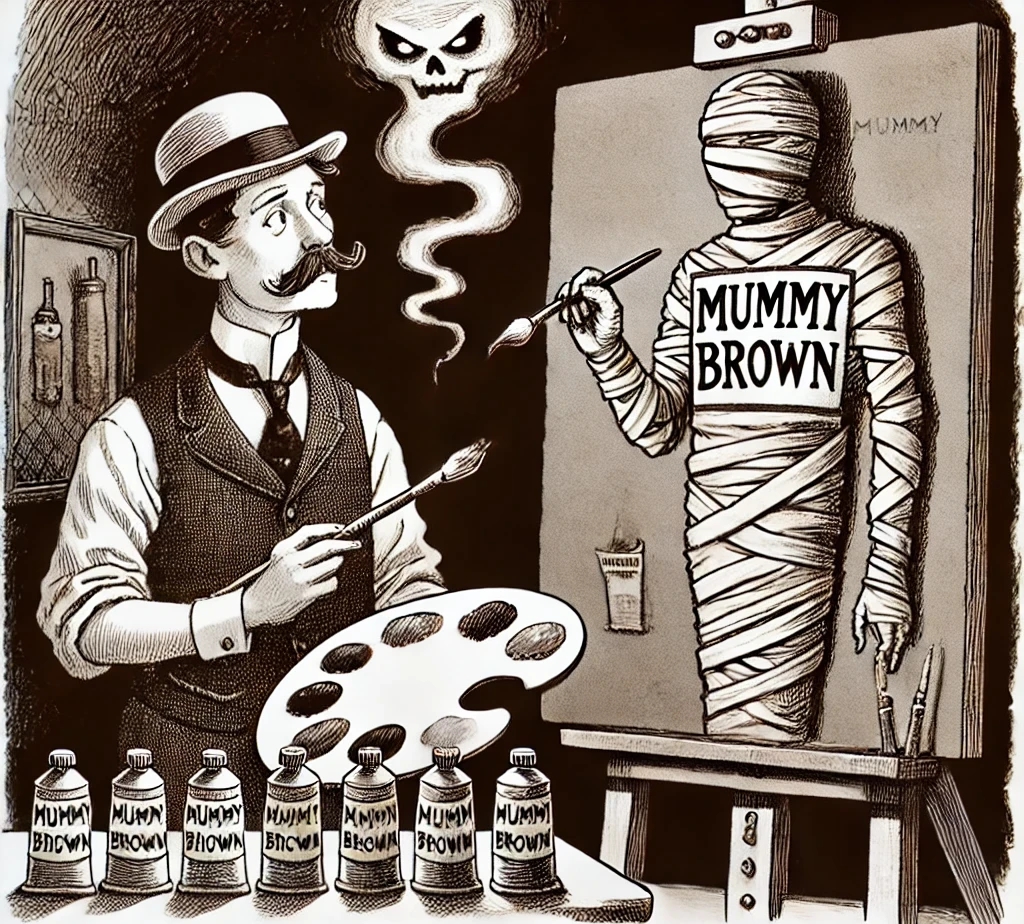
In the rich tapestry of art history, few pigments carry a story as haunting as “dead man’s head,” also known as “mummy brown.” This peculiar color, a warm, rich shade of brown with subtle undertones of gray, holds within its hue a disturbing secret: it was quite literally made from the ground remains of ancient Egyptian mummies.
The creation of this pigment began in the 16th century, when European traders began importing Egyptian mummies not for their historical or archaeological value, but as raw materials for paint. The process involved grinding mummified human remains into a fine powder, which was then mixed with white pitch and myrrh to create a transparent brown pigment prized by artists for its versatility in creating flesh tones and shadows.
Notable artists including Eugène Delacroix and Martin Drolling are believed to have used mummy brown in their works. The pigment’s popularity stemmed from its unique properties – it created warm, rich shadows and was particularly effective for glazing and flesh tones. The irony of using human remains to paint human figures seemed lost on most artists of the time.

The trade in mummy brown represents a darker chapter in the history of art, reflecting the period’s colonial attitudes and disregard for cultural heritage. Egyptian mummies, rather than being preserved as invaluable historical artifacts, were commodified and literally consumed by European art markets. Mummies were so extensively harvested that by the late 19th century, the supply began to run low.
The eventual discontinuation of mummy brown came about through a combination of factors. As the Victorian era progressed, the ethical implications of using human remains for paint became increasingly difficult to ignore. Artists began to confront the reality of their medium – the famous pre-Raphaelite painter Edward Burne-Jones reportedly gave his tube of mummy brown a ceremonial burial in his garden upon learning of its origins.

Today, “dead man’s head” serves as a reminder of art history’s complex and sometimes unsettling relationship with its materials. Modern alternatives recreate the color without its macabre origins, but the original pigment stands as a testament to how the pursuit of artistic excellence once led to practices that would be unthinkable today. The color lives on in name and appearance, but its dark origins serve as a sobering reminder of the importance of ethical considerations in art.


Leave a Reply