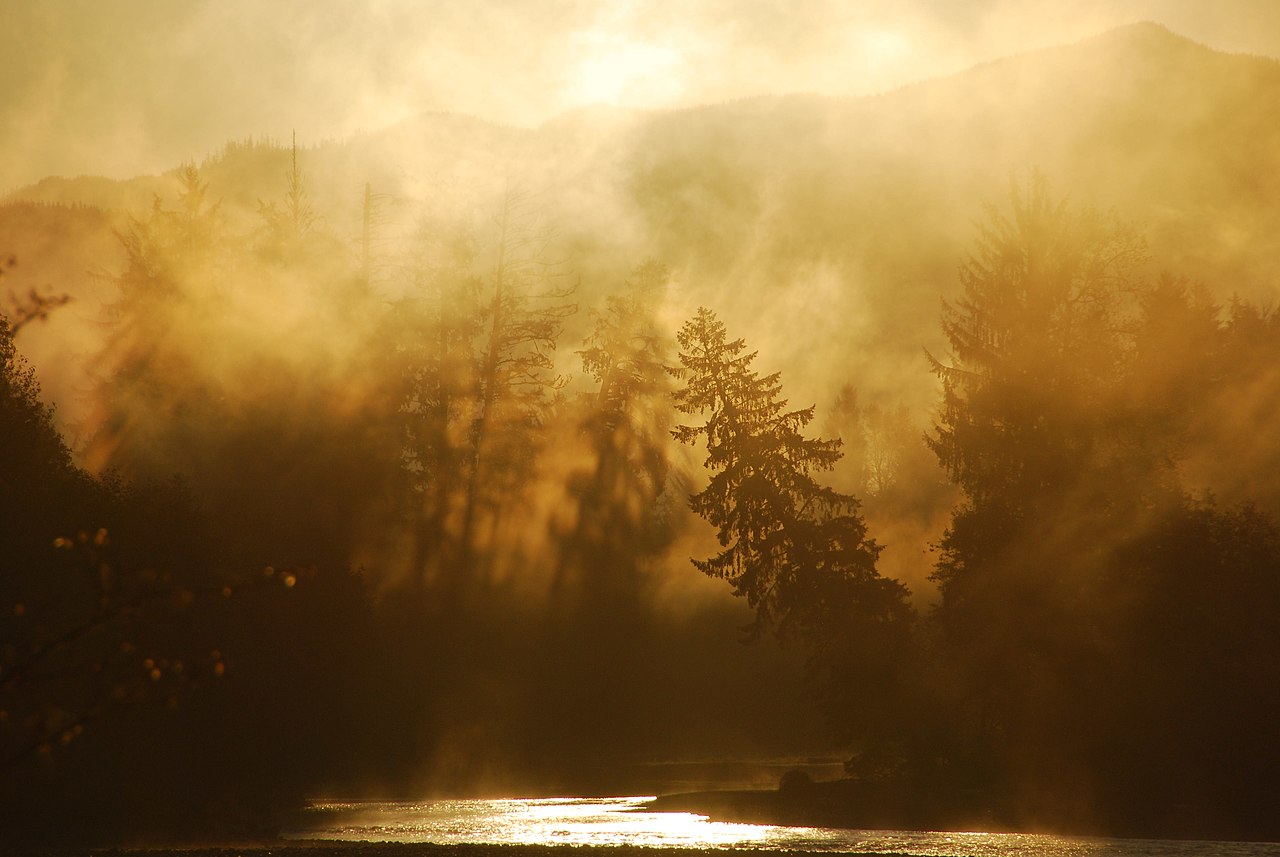

The Hoh Rainforest, located in Washington’s Olympic National Park, is a remarkable temperate rainforest ecosystem that receives 140-170 inches (355-432 cm) of precipitation annually, making it one of the wettest places in the continental United States.
The science behind this unique ecosystem begins with its geographic location. The Hoh Valley sits on the western slope of the Olympic Mountains, perfectly positioned to capture moisture-laden air masses moving inland from the Pacific Ocean. As these air masses hit the mountains, they’re forced upward in a process called orographic lift, causing them to cool and release their moisture as rain or fog – a phenomenon clearly visible in the atmospheric conditions shown in the image.
The forest’s signature mist, beautifully captured in the golden morning light of the photograph, plays a crucial role in the ecosystem. During dry summer periods, this fog can provide up to 40% of the forest’s moisture through a process called fog drip, where water condensing on tree needles and leaves drips down to hydrate understory plants and maintain soil moisture.
The dominant trees in the Hoh are Sitka spruce and western hemlock, which can grow to extraordinary heights of over 300 feet and live for several hundred years. These conifers are specifically adapted to the wet conditions, with their needles featuring tiny channels that help direct water away from their surfaces to prevent fungal growth. The image shows their distinctive silhouettes emerging through the morning mist.
The forest floor, though not visible in this sunrise shot, is equally fascinating from a scientific perspective. It contains a complex network of mycorrhizal fungi that form symbiotic relationships with trees, facilitating nutrient exchange throughout the forest. Dead trees, known as nurse logs, decay over decades while supporting new life, with young trees often growing in lines where they originally sprouted on fallen logs.
The Hoh’s unique ecosystem also supports a diverse array of wildlife, from Roosevelt elk to northern spotted owls, and hosts numerous endemic species of moss and lichen that contribute to its characteristically lush appearance. The forest’s dense canopy, partially visible in the image, creates distinct microclimates below, where temperature, humidity, and light levels remain relatively stable throughout the year.




Leave a Reply to JuliaCancel reply