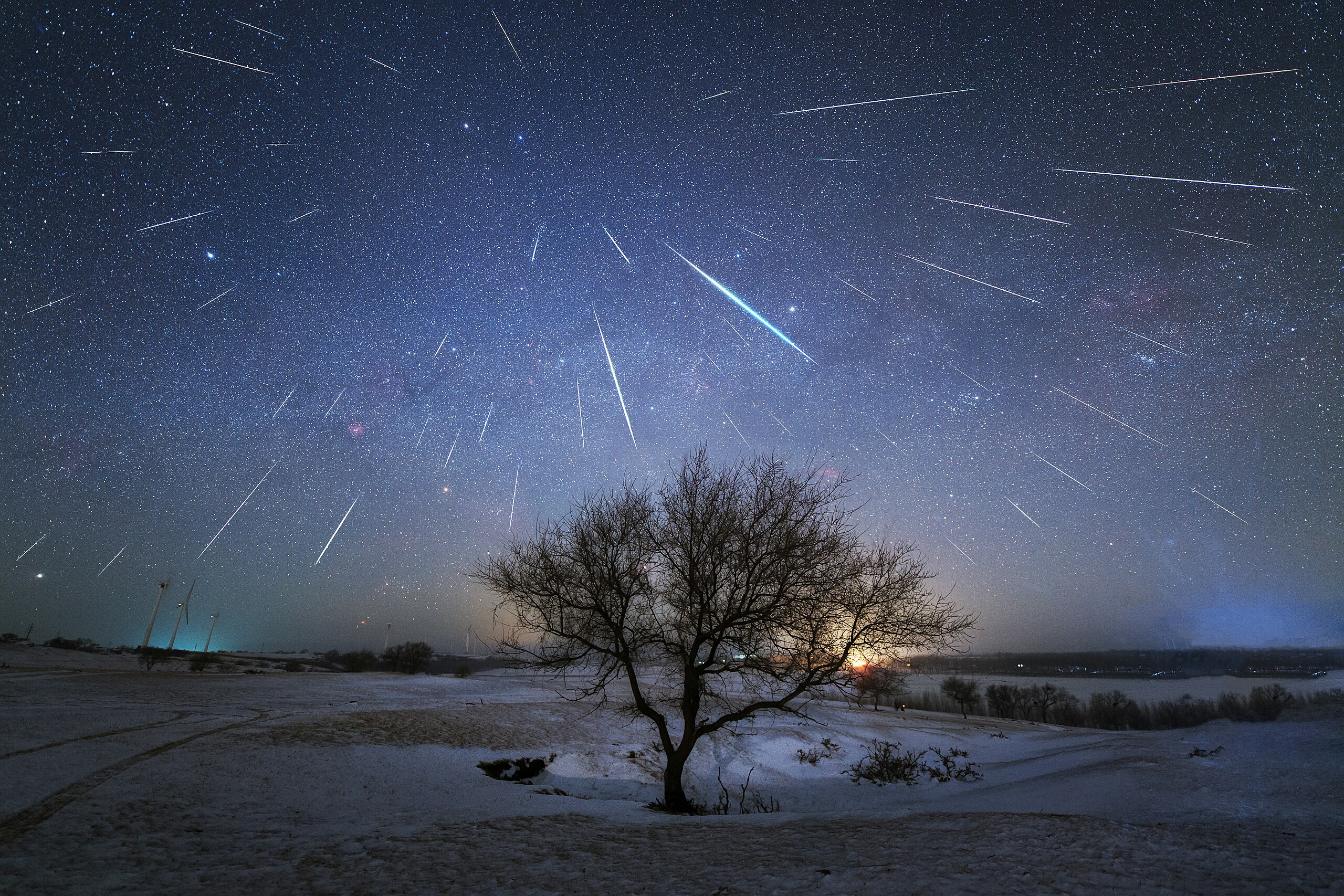

Meteor showers are spectacular celestial events that occur when numerous meteors flash across the night sky from a single point, known as the radiant. The science behind meteor showers lies in the interaction between Earth’s orbit and streams of debris left by comets or asteroids.
Meteors, often called “shooting stars,” are small particles from space that burn up upon entering Earth’s atmosphere due to friction with air molecules. These particles, called meteoroids when in space, range in size from tiny grains of sand to small pebbles. When a meteoroid enters the atmosphere and vaporizes, it creates a bright trail of light—a meteor. If any part of it survives the journey and lands on Earth, it’s called a meteorite.
Meteor showers occur when Earth passes through a trail of debris left by a comet or, less commonly, an asteroid. Comets are icy bodies that release gas and dust as they approach the Sun, forming a glowing coma and sometimes a tail. This material spreads along the comet’s orbit, creating a meteoroid stream. When Earth’s orbit intersects this stream, the particles enter our atmosphere at high speeds, resulting in increased meteor activity.
Since Earth’s orbit around the Sun is consistent, it intersects the same debris streams at the same times each year, leading to annual meteor showers. The specific dates can vary slightly due to gravitational influences from other planets and the precise nature of the debris stream.
Famous Meteor Showers
- Perseids: Originating from Comet Swift-Tuttle, the Perseids peak around mid-August each year and are known for their bright meteors.
- Leonids: Associated with Comet Tempel-Tuttle, the Leonids peak in mid-November and are famous for producing meteor storms roughly every 33 years.
- Geminids: Unusual because they originate from an asteroid-like object called 3200 Phaethon, the Geminids peak in mid-December and are one of the most prolific showers.
The radiant is the point in the sky from which meteors appear to originate, due to perspective as the parallel paths of meteoroids enter Earth’s atmosphere. This point is named after the constellation in which it lies, hence the names of meteor showers like the Perseids (Perseus) and Leonids (Leo).



Leave a Reply to Info manCancel reply