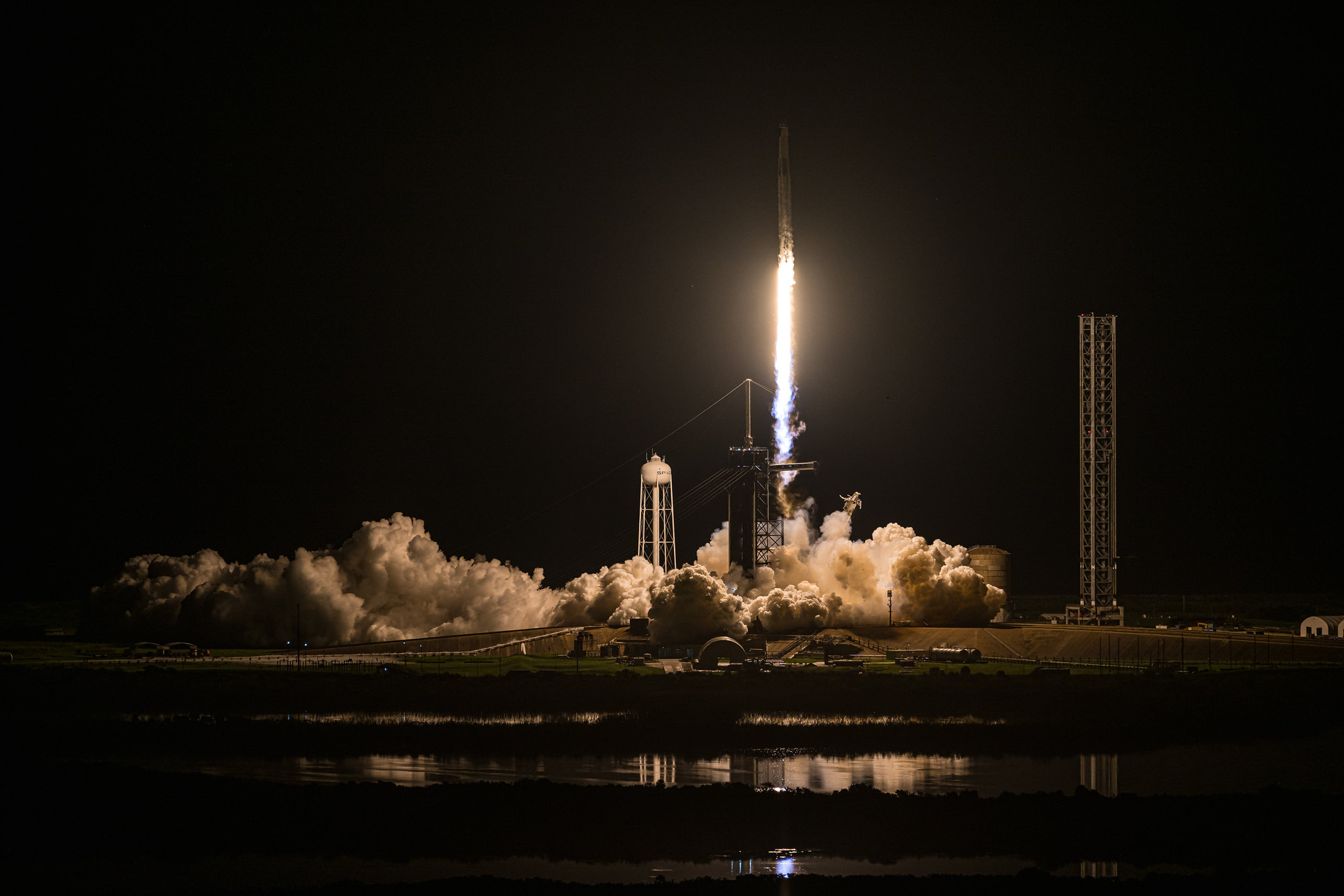
SPACEX’S POLARIS DAWN BEGINS HISTORIC MISSION WITH SPACEWALK
SpaceX’s Polaris Dawn mission launched at 5:23 a.m. ET, marking a historic journey into Earth’s Van Allen radiation belts. This mission, streamed live on X, involves a four-person civilian crew who will attempt the first commercial spacewalk. The crew, including SpaceX employees, will travel in the SpaceX Crew Dragon capsule, launched atop a Falcon 9 rocket from NASA’s Kennedy Space Center. The mission faced delays due to weather and required calm conditions for a safe return. Polaris Dawn aims to set new records, reaching higher than any previous orbit, potentially surpassing NASA’s Gemini 11 mission. The mission also plans to achieve the highest altitude for a woman in space. During the mission, the crew will attempt a dangerous spacewalk, exposing them to the vacuum of space and potential cabin re-pressurization issues. (CNN)
NEW STUDY SHOWS OLD MICE EGGS REVERSED BY YOUNG OVARIES
A new study reveals that placing immature eggs from old mice into the ovarian structures of young mice can reverse aging signs in the eggs. Conducted by cell biologists Rong Li and Wang HaiYang at the National University of Singapore, the research shows that rejuvenated eggs were nearly four times more likely to produce healthy pups compared to those matured in an old environment. Published in Nature Aging, the study provides strong evidence that young follicles can improve the quality of aging eggs, with rejuvenated oocytes showing fewer chromosomal abnormalities and better mitochondrial function. Conversely, young oocytes matured in old follicles exhibited accelerated aging. This suggests that oocyte aging is partially reversible and that the surrounding cellular environment plays a crucial role. The findings hint at potential cell therapies for improving egg quality in older individuals, though translating these results to human applications remains challenging. (Nature)
If you’re enjoying the Daily Dose, sign up for the Daily Dose Newsletter and get the morning’s best science news from around the web delivered straight to your inbox? It’s easy like Sunday morning.
OLD POLIOVIRUS SAMPLES RAISE CONCERNS ABOUT VIRUS ORIGIN
Researchers at the Pasteur Institute in Paris discovered four old poliovirus samples sent by Albert Sabin over 60 years ago. The samples were destroyed as part of a global effort to eliminate old polioviruses but were first sequenced to preserve their genetic data. A July paper in Virus Evolution raised concerns that a poliovirus strain from 2014, which infected a child in China, might have originated from a research or vaccine facility rather than natural sources. The study found that this virus, named WIV14, closely resembles an old strain used in vaccines, suggesting it may have been released accidentally. This possibility, along with the paper’s connection to the Wuhan Institute of Virology, has sparked debate and speculation, particularly among those discussing lab leaks related to COVID-19. Experts stress the importance of investigating potential leaks and ensuring rigorous safety in labs and vaccine facilities to prevent future incidents. (Science)
CHINA APPROVES FIRST MPOX VACCINE FOR CLINICAL TRIALS
China’s first mpox vaccine, developed by the Shanghai Institute of Biological Products (a Sinopharm subsidiary), has been approved for clinical trials starting September 9. Sinopharm, known for creating China’s first COVID-19 vaccine, reports that early studies show promising results with effective immunity against mpox. The vaccine is crucial for controlling the disease in China, where no approved mpox vaccines currently exist. Clinical trials typically involve three phases and can take years before market approval. This vaccine arrives as global mpox cases rise, with a recent WHO declaration of a global health emergency due to a more infectious variant. China has reported over 2,500 mpox cases and has intensified preventive measures, including comprehensive screenings for all incoming international travelers, goods, and vessels. (Channel News Asia)

HIGH-ALTITUDE AIR SAMPLES REVEAL DIVERSE MICROBES AND PATHOGENS
Researchers recently discovered a surprising range of bacteria and fungi in high-altitude air samples collected over Japan. The microbes, captured at altitudes up to 10,000 feet, had traveled more than 1,200 miles and included potential human pathogens. This study, led by Xavier Rodó from the Barcelona Institute for Global Health, suggests that airborne microbes could influence disease patterns, though direct evidence linking these high-altitude microbes to human outbreaks is lacking. Rodó’s research began with a connection he found between winds from China and surges in Kawasaki disease cases in Japan and California. His team collected air samples using a Cessna airplane, finding not only microbes but also traces of hafnium, likely from Chinese mines. The samples revealed 266 types of fungi and 305 types of bacteria, some of which are associated with soil, plants, and human infections. The study raises intriguing questions about how airborne microbes might contribute to disease spread and highlights the need for further research to understand their potential impact on human health. (New York Times)
CHINA OUTLINES PLAN FOR AMBITIOUS INTERNATIONAL LUNAR RESEARCH STATION
China has outlined a detailed plan for its International Lunar Research Station (ILRS), set to develop in two main phases. Initially, the ILRS will be constructed near the lunar south pole by around 2035. This first phase will establish a basic, robotic moon base. The second phase, expected to be completed by about 2050, will expand the base into a comprehensive lunar station network. This network will feature a central lunar orbit station and exploration nodes on the lunar equator and far side. The extended model will be powered by a combination of solar, radioisotope, and nuclear generators, and will include advanced infrastructure such as high-speed communication networks, various lunar vehicles, and both pressurized and unpressurized crewed rovers. This ambitious project is a collaborative effort between China and Russia, with China now taking the lead in the development. (space.com)
METHANE LEVELS RISE RAPIDLY, THREATEN CLIMATE GOALS
Methane concentrations are rising at an unprecedented pace, jeopardizing global climate goals, according to a Global Carbon Project study. The potent greenhouse gas, second only to carbon dioxide in its impact, has increased by 20% over the past two decades. In the past five years, methane levels have surged faster than any previous period on record. This rise is primarily due to coal mining, oil and gas production, livestock farming, and decomposing organic waste. In 2020, methane emissions reached 41.8 million tonnes, double the average of the 2010s. Despite the Global Methane Pledge—where 150 countries aimed to cut emissions by 30% by 2030—methane levels continue to climb, with notable increases in China and Southeast Asia. China, although not a signatory of the pledge, plans to host a climate summit with the U.S. later this year, raising hopes for broader climate action. (Al-Jazeera)
STUDY REVEALS VIRUS RISKS IN FUR-FARMED ANIMALS
In a study analyzing 461 fur-farmed animals that died from disease, researchers identified 125 virus species, including 36 novel ones and 39 with potential cross-species transmission risks. Notably, seven new coronavirus species were found, expanding their host range, and novel coronaviruses were transmitted from dogs to raccoon dogs and from bats to mink. Additionally, three influenza A subtypes (H1N2, H5N6, and H6N2) were detected in guinea pigs, mink, and muskrats. Zoonotic viruses like Japanese encephalitis and mammalian orthoreovirus were found in guinea pigs. Raccoon dogs and mink carried the highest number of high-risk viruses, highlighting fur farming as a significant transmission hub for viral zoonoses and potential virus spread between farmed and wild animals, and from humans to animals. (Nature)
Thanks for reading. Let’s be careful out there.
WORDS: The Biology Guy.
IMAGE CREDIT: SpaceX.



Leave a Reply