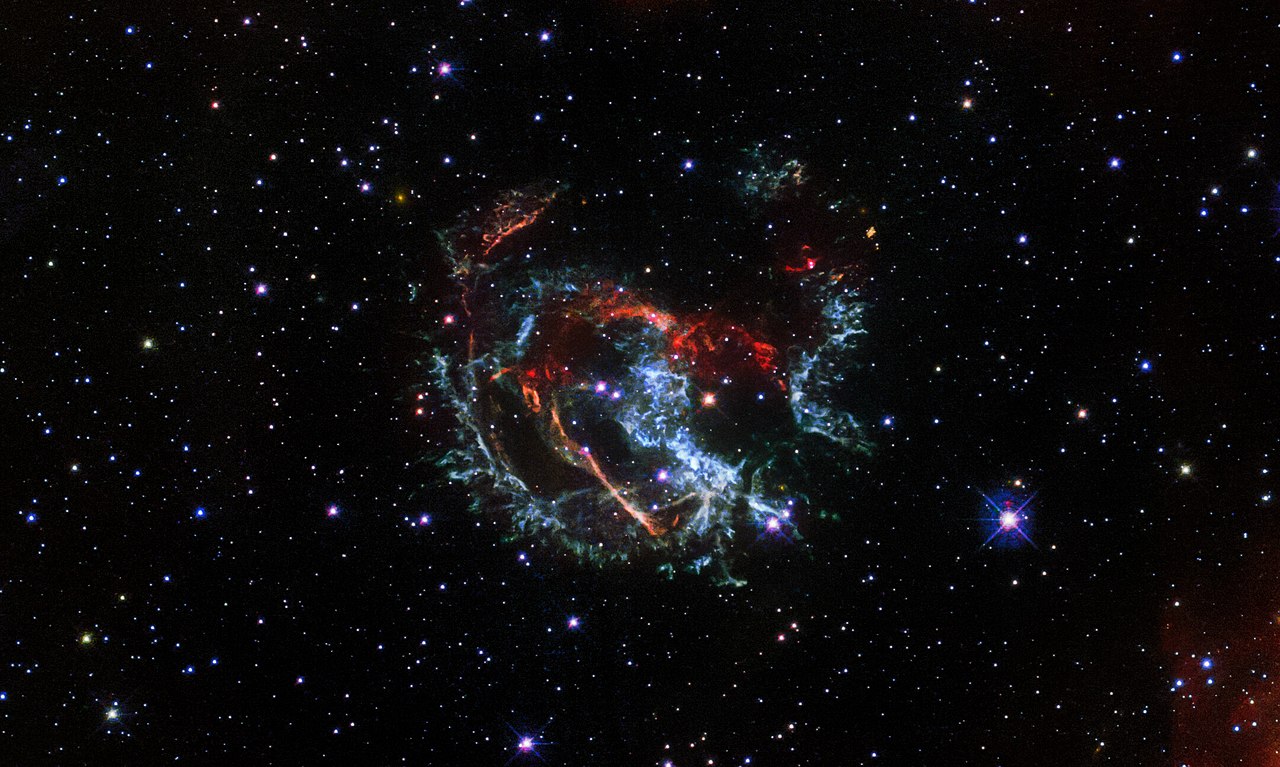

The Hubble image of the supernova remnant 1E 0102.2-7219 offers a glimpse into the dramatic aftermath of a star’s explosive death. This remnant, located in the Small Magellanic Cloud, approximately 200,000 light-years away, is the remains of a star that detonated in a cataclysmic event known as a supernova. The violent explosion ejected the star’s outer layers into space, creating a rapidly expanding shell of gas and dust.
At the heart of the science behind this image lies the Doppler effect, a principle that explains the changes in frequency and wavelength of light as objects move relative to an observer. In this context, the remnants of the supernova are moving at different velocities and directions. The colors in the Hubble image correspond to these movements: the gaseous knots moving toward Earth are shifted toward shorter wavelengths, appearing blue, while those moving away are shifted toward longer wavelengths, appearing red. This phenomenon allows astronomers to map the motion of the gas, providing critical insights into the dynamics of the explosion.
The speed at which these ribbons of gas are traveling is staggering, averaging 3.2 million kilometers per hour. To put this into perspective, if you could travel at that speed, you would be able to journey to the Moon and back in just 15 minutes. This incredible velocity is a testament to the immense energy released during the supernova, which propelled the star’s remnants across space at such extraordinary speeds.




Leave a Reply