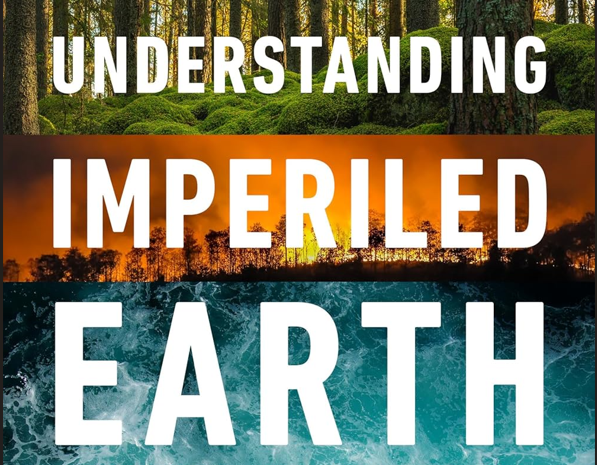
In this insightful Q&A, SCINQ sits down with Todd Braje, an accomplished archaeologist and professor known for his work in environmental archaeology and human-environment interactions. Braje’s latest book, Understanding Imperiled Earth: How Archaeology and Human History Inform a Sustainable Future, delves into the critical lessons that the study of ancient societies can offer for tackling today’s environmental challenges. With a unique blend of historical analysis and modern-day relevance, the book challenges common misconceptions about humanity’s relationship with nature and offers a roadmap for creating a more sustainable future. In this interview, Braje discusses the inspiration behind his work, the complexities of climate change, and the vital role that archaeology can play in informing global sustainability efforts.

What inspired you to write Understanding Imperiled Earth?
This has been my passion project throughout my time as an academic. It’s really why I got into archaeology. As a graduate student, I wanted to demonstrate that there was clear relevance in studying the past—not just to avoid repeating mistakes, though that’s important—but because understanding history and human cultural evolution has significant meaning for our future as a global society.
In my work, I’ve always tried to think about the lessons we can learn from the past and how those lessons are relevant for people who aren’t necessarily archaeology enthusiasts or history students. This book is the culmination of that kind of work. It’s the kind of book I’ve always wanted to write, and I finally found a way to make it relevant for a broader audience.
Okay, let’s jump into some specifics. What can archaeology teach us about sustainability?
I think when we look at the environmental challenges we’re facing as a global society—like anthropogenic climate change, declining biodiversity, landscape modifications—it’s easy to think that these are brand new issues that people in the past didn’t face. But the archaeological record tells us something different.
People have been dealing with environmental challenges, often of their own making, for thousands of years. Humans have long been ecosystem managers and have altered local, regional, and even global climates. What’s new is the massive acceleration and scale of human impacts.
But if we look to the past, we can find clear lessons and data that can help us address these problems today. Most of these issues ramped up during what geoscientists call the “Great Acceleration,” which started less than a hundred years ago with industrialization and increasing human populations. If we want to create a more sustainable future, perspectives from the past can guide us. Without them, we have no roadmap.
Your book challenges the idea that the further back in history you go, the more in harmony with nature people lived. Can you give an example of how past groups managed to live in harmony with nature and how they sometimes didn’t?
Right. There’s some truth to that myth, but it often doesn’t provide the full picture. People in the past generally lived in ways that we might view as more sustainable or resilient compared to today because they were more tied to local and regional environments.
But they also had significant impacts on those environments. They weren’t just a natural part of the landscape; they were making decisions about how to manage their surroundings, and they faced the consequences of those decisions. For example, in the Pacific Islands, some groups developed strategies to live sustainably, while others faced problems like erosion and biodiversity declines due to their choices.
In North America, there’s a misconception that Native Americans lived entirely in harmony with nature. While there were certainly practices that were sustainable, there were also instances where they engaged in large-scale hunts, like driving buffalo off cliffs in mass kill events, which weren’t entirely sustainable. So, it’s not a simple story of harmony; it’s more complex than that.

Another example you mention in the book is the collapse of complex societies like Angkor Wat. How do you interpret that, and does it bode ill for our complex societies today?
When I taught my intro to archaeology class, one of the lessons was about the collapse of complex societies. The sobering reality is that every complex society in human history has undergone some form of collapse, except for our own. That might suggest that we’re headed for a similar fate.
But “collapse” is a complicated term. It doesn’t mean that everyone perished or that an entire culture disappeared. Often, it means a decentralization of power and resources. In the case of Angkor Wat, they were pushing the limits of what their environment could sustain. When drought disrupted their carefully managed system, the society decentralized and broke into smaller entities.
This narrative provides perspective on how humans have been contending with environmental challenges for a long time. The scale of today’s challenges is different, but the past offers strategies that could help us build more sustainable and resilient systems today.
We’ve been talking about complex societies and their collapse, and it reminds me of an article I skimmed about Elon Musk’s plans to colonize Mars. He argues that we need to move while our civilization is still strong. Does that resonate with the idea that civilizations inevitably decline, and should we make the decision to colonize Mars now?
From my archaeological perspective, the idea that we need to scale up to contend with our problems is problematic. The answer isn’t necessarily to scale up, but rather to find more sustainable strategies that work long-term. If we go to Mars, aren’t we just going to eventually face the same problems there? The past shows us that there are strategies that can make us more resilient and sustainable without relying on new technology or looking for a new planet to colonize. For example, reforestation can have significant positive impacts on global climate without any new technology. If we can rethink land management and employ these kinds of strategies, we can address climate change relatively quickly.
Your answer blurred something I thought I understood from the book. You mentioned that we’ll never go back to an idealized past, and it made me wonder what you think about the rewilding movement. You seem supportive of reforestation, but where do you stand on rewilding?
Rewilding is a worthwhile idea, but I’m not comfortable with the extreme end of it—like replacing extinct species with modern analogs or bringing back extinct animals. I see that as part of the same problematic idea that technology will solve all our problems. But the idea of increasing biodiversity and restoring important ecosystem functions is something I support. For example, reintroducing beavers, which are ecosystem engineers, can increase biodiversity and help other species. I think we need to think about rewilding in ways that create resilient systems that work for both humans and non-human life.
Indigenous knowledge and practices—what role do they play in your research, especially in terms of sustainability?
Indigenous knowledge plays an important role, and its acceptance in Western science is growing. It’s important to figure out how to integrate these different ways of knowing the world. Scientists and indigenous knowledge keepers need to come to the table together and truly understand each other’s perspectives. It’s challenging, but necessary. Indigenous knowledge should be given an equal share in decision-making about how we manage landscapes, ecosystems, and biodiversity. It needs to be part of a larger data set and not seen as unscientific or unimportant.
How do you separate the wheat from the chaff? How do you discern what’s valuable in indigenous knowledge?
That’s a great point. Every culture has folk knowledge, and it’s important to recognize that. But when it comes to indigenous knowledge in areas like environmental management, it’s about bringing indigenous knowledge keepers to the table and integrating their perspectives into modern systems. It doesn’t mean we’re going back to a pre-modern world, but rather that we’re finding ways to rethink our current systems using a broader range of knowledge.
Wouldn’t that just bring us back to pre-Green Revolution days?
Not necessarily. We’re not rewinding the clock; we’re integrating indigenous knowledge into modern systems to create something new that works with today’s realities. It’s about finding other ways to think about these issues that aren’t reliant on industrial technologies alone.
How important is it to take an interdisciplinary approach to addressing today’s problems?
It’s crucial. As the world becomes more complex, solving complex problems requires a community of stakeholders and scientists. We need to bring together different perspectives to address challenges like biodiversity loss and climate change. It’s not enough for one discipline to tackle these issues alone. Interdisciplinary work is time-consuming and challenging, but it’s necessary if we want to create solutions that are sustainable and resilient.
Last question—did you worry that people might cherry-pick facts from your book to support their own views? And what do you want readers to take away from the book?
Absolutely, I worried about that throughout the writing process. It’s always a concern that people might take something out of context. But I tried to be balanced and show that this isn’t a polarized debate. We can come together on these issues. We all want a better world for our children, and that’s a place where we can find common ground. In terms of what I want readers to take away, I hope they see that it’s not too late. We can still make a difference. The past shows us that humans have faced major challenges and come out the other side. We don’t need to colonize Mars; we can build a better world here.




Leave a Reply