Among the vastly different ways of tackling a disease, controlling the genetic expression of cells is undoubtedly one of the most powerful. Over the past few decades, scientists have come up with dozens of innovative strategies that involve using messenger RNA (mRNA) to ‘force’ cells to build specific proteins. These mRNA-based therapies have recently gained prominence as vaccines against infectious diseases like COVID-19. Additionally, they hold significant potential for treating cancer and genetic disorders.
Since mRNA itself is quite unstable and easily destroyed by enzymes in the body, mRNA-based therapies rely on drug delivery techniques; the core idea is to encapsulate and protect mRNA molecules within nanostructures that can safely get them inside the target cells. Today, the most explored mRNA nanocarriers are made of amine-bearing cationic lipids or polymers, which form small protective spheres that can diffuse into cells to release their cargo. However, existing designs still face stability issues, which increases costs and leads to higher doses to get the desired effect.
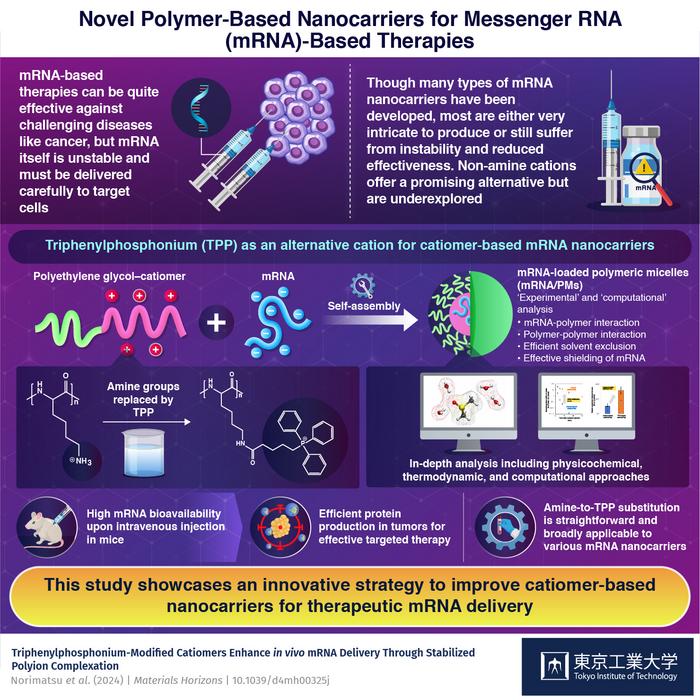
Against this backdrop, a research team from Japan explored an alternative to amine-based materials as mRNA nanocarriers. In their latest study that was published in Materials Horizons on 10 July 2024, the researchers investigated the potential of triphenyl phosphonium (TPP) as a replacement for the amine groups used as cations to form mRNA-loaded micelles.

“Phosphonium-based cations provide unique ionic properties that favor interactions with anions like mRNA, such as their charge distribution and binding force to anions, which stem from differences in electronegativity between phosphorus and nitrogen,” explains Associate Professor Yasutaka Anraku from Tokyo Institute of Technology, who led the study. “Moreover, its three phenyl moieties facilitate hydrophobic interactions, leading to stable mRNA complexation. Thus, substituting amines with TPP could increase mRNA delivery efficiency,” he adds.
To test their hypothesis, the researchers designed polymeric micelles using polyethylene glycol (PEG), TPP, and mRNA. First, they developed a highly efficient strategy to replace the amine groups in PEG-poly(L-lysine) copolymers with TPP. The resulting polymers naturally self-assemble into a core-shell structure in anion-enriched conditions due to their hydrophobicity and charge distribution. Moreover, given that mRNA contains many negatively charged phosphates, the positive TPP groups attract them to self-assemble, ensuring high and stable mRNA loading into the micelles.
Sign up for the Daily Dose Newsletter and get every morning’s best science news from around the web delivered straight to your inbox? It’s easy like Sunday morning.
Their strategy was carefully assessed and verified through a comprehensive analysis, including thermodynamic, physicochemical, and computational approaches. Moreover, they also tested the capabilities of the proposed system to deliver mRNA to tumor cells in vivo using a mouse model. “Upon intravenous injection, TPP-bearing micelles resulted in a remarkable increase in mRNA bioavailability, facilitating efficient protein production in solid tumors,” highlights Anraku. Notably, the experiments revealed that remaining intact mRNA levels in blood after 30 minutes were orders of magnitude higher when using the proposed TPP-based micelles rather than amine-based ones. Similarly, protein expression in tumor tissues was over 10 times higher when using TPP-based micelles.
Overall, it appears this innovative strategy holds much potential in the realm of mRNA therapeutics, which includes targeted drug delivery. “Given that polymeric micelles can be targeted to specific tissues by attaching ligands, TPP-bearing polymeric micelles might serve as a robust platform for mRNA delivery across various tissues,” says Anraku. With any luck, this technology will pave the way to effective treatment for humanity’s most challenging diseases.
IMAGE CREDIT: Tokyo Tech
If you enjoy the content we create and would like to support us, please consider becoming a patron on Patreon! By joining our community, you’ll gain access to exclusive perks such as early access to our latest content, behind-the-scenes updates, and the ability to submit questions and suggest topics for us to cover. Your support will enable us to continue creating high-quality content and reach a wider audience.
Join us on Patreon today and let’s work together to create more amazing content! https://www.patreon.com/ScientificInquirer



Leave a Reply