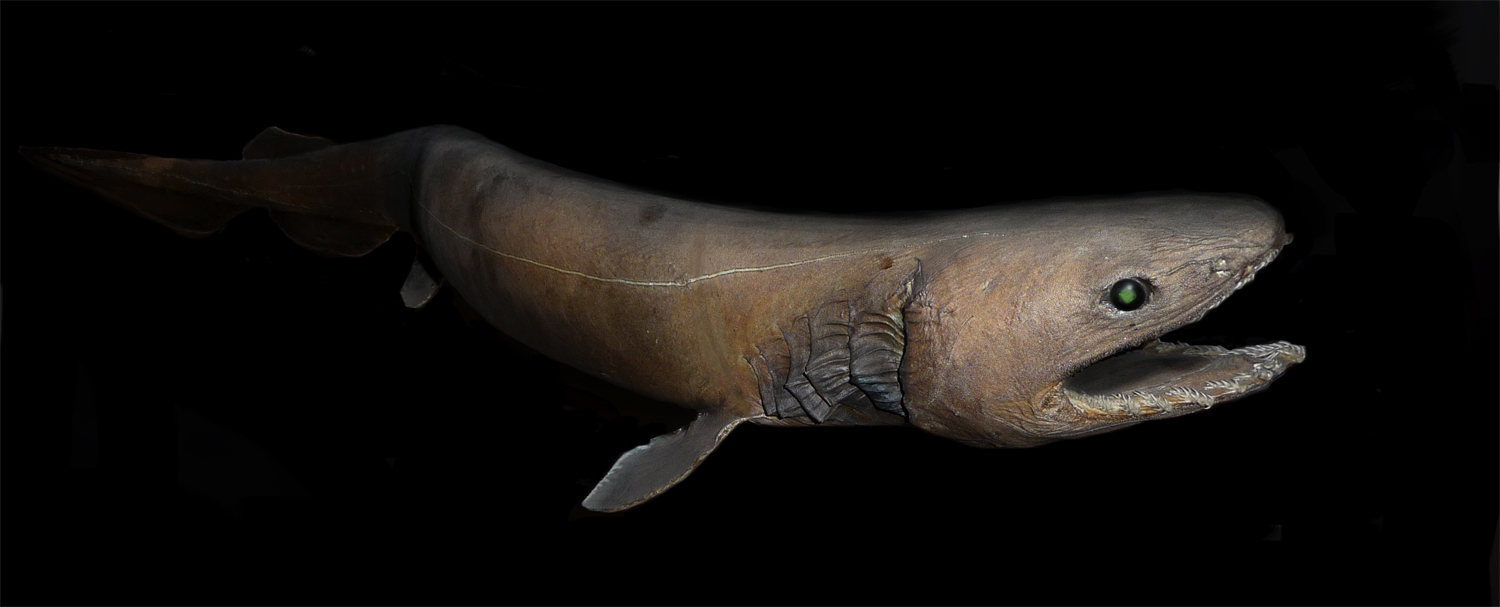

The frilled shark (Chlamydoselachus anguineus) is a fascinating deep-sea creature that has captivated scientists due to its primitive features and unique adaptations. Often referred to as a “living fossil,” the frilled shark belongs to a lineage that dates back around 80 million years, providing a window into the evolutionary history of sharks.
One of the most distinctive features of the frilled shark is its eel-like body, which can grow up to six feet long. It possesses a series of six pairs of gill slits that extend to the throat, fringed with frilly, finger-like projections, giving the shark its name. These gills are highly efficient, allowing the frilled shark to extract oxygen from the cold, low-oxygen waters of the deep sea.
The frilled shark’s elongated, flexible jaws are equipped with multiple rows of trident-shaped teeth, each with three sharp points. This dental arrangement is ideal for grasping and holding onto slippery prey such as squid, bony fish, and other small marine animals. The shark can lunge at its prey with a sudden burst of speed, using its snake-like body to strike from a coiled position.
Reproduction in frilled sharks is ovoviviparous, meaning that the embryos develop inside eggs that remain within the mother’s body until they hatch. The gestation period is thought to be unusually long, possibly up to three and a half years, one of the longest among vertebrates. This prolonged gestation, combined with their slow growth rate and deep-sea habitat, makes frilled sharks vulnerable to environmental changes and human activities such as deep-sea fishing.
IMAGE CREDIT: Citron / CC-BY-SA-3.0




Leave a Reply