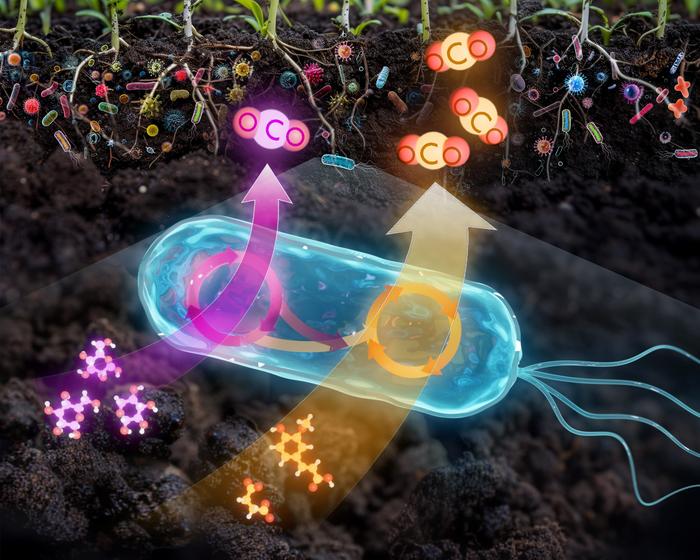
When soil microbes eat plant matter, the digested food follows one of two pathways. Either the microbe uses the food to build its own body, or it respires its meal as carbon dioxide (CO2) into the atmosphere.
Now, a Northwestern University-led research team has, for the first time, tracked the pathways of a mixture of plant waste as it moves through bacteria’s metabolism to contribute to atmospheric CO2. The researchers discovered that microbes respire three times as much CO2 from lignin carbons (non-sugar aromatic units) compared to cellulose carbons (glucose sugar units), which both add structure and support to plants’ cellular walls.
These findings help disentangle the role of microbes in soil carbon cycling — information that could help improve predictions of how carbon in soil will affect climate change.

The research will be published on Tuesday (June 11) in the journal Environmental Science & Technology.
“The carbon pool that’s stored in soil is about 10 times the amount that’s in the atmosphere,” said Northwestern University’s Ludmilla Aristilde, who led the study. “What happens to this reservoir will have an enormous impact on the planet. Because microbes can unlock this carbon and turn it into atmospheric CO2, there is a huge interest in understanding how they metabolize plant waste. As temperatures rise, more organic matter of different types will become available in soil. That will affect the amount of CO2 that is emitted from microbial activities.”
An expert in the dynamics of organics in environmental processes, Aristilde is an associate professor of civil and environmental engineering at Northwestern’s McCormick School of Engineering and is a member of the Center for Synthetic Biology and of the Paula M. Trienens Institute for Sustainability and Energy. Caroll Mendonca, a former Ph.D. candidate in Aristilde’s laboratory, is the paper’s first author. The study includes collaborators from the University of Chicago.
Sign up for the Daily Dose Newsletter and get every morning’s best science news from around the web delivered straight to your inbox? It’s easy like Sunday morning.
‘Not all pathways are created equally’
The new study builds upon ongoing work in Aristilde’s laboratory to understand how soil stores — or releases — carbon. Although previous researchers typically tracked how broken-down compounds from plant matter move individually through bacteria, Aristilde’s team instead used a mixture of these compounds to represent what bacteria are exposed to in the natural environment. Then, to track how different plant derivatives moved through a bacterium’s metabolism, the researchers tagged individual carbon atoms with isotope labels.
“Isotope labeling allowed us to track carbon atoms specific to each compound type inside the cell,” Aristilde said. “By tracking the carbon routes, we were able to capture their paths in the metabolism. That is important because not all pathways are created equally in terms of producing carbon dioxide.”
Sugar carbons in cellulose, for example, traveled through glycolytic and pentose-phosphate pathways. These pathways lead to metabolic reactions that convert digested matter into carbons to make DNA and proteins, which build the microbe’s own biomass. But aromatic, non-sugar carbons from lignin traveled a different route — through the tricarboxylic acid cycle.
“The tricarboxylic acid cycle exists in all forms of life,” Aristilde said. “It exists in plants, microbes, animals and humans. While this cycle also produces precursors for proteins, it contains several reactions that produce CO2. Most of the CO2 that gets respired from metabolism comes from this pathway.”
Expanding the findings
After tracking the routes of metabolism, Aristilde and her team performed quantitative analysis to determine the amount of CO2 produced from different types of plant matter. After consuming a mixture of plant matter, microbes respired three times as much CO2 from carbons derived from lignin compared to carbons derived from cellulose.
“Even though microbes consume these carbons at the same time, the amount of CO2 generated from each carbon type is disproportionate,” Aristilde said. “That’s because the carbon is processed via two different metabolic pathways.”
In the initial experiments, Aristilde and her team used Pseudomonas putida, a common soil bacterium with a versatile metabolism. Curious to see if their findings applied to other bacteria, the researchers studied data from previous experiments in scientific literature. They found the same relationship they discovered among plant matter, metabolism and CO2 manifested in other soil bacteria.
“We propose a new metabolism-guided perspective for thinking about how different carbon structures accessible to soil microbes are processed,” Aristilde said. “That will be key in helping us predict what will happen with the soil carbon cycle with a changing climate.”
IMAGE CREDIT: Aristilde Lab/Northwestern University
If you enjoy the content we create and would like to support us, please consider becoming a patron on Patreon! By joining our community, you’ll gain access to exclusive perks such as early access to our latest content, behind-the-scenes updates, and the ability to submit questions and suggest topics for us to cover. Your support will enable us to continue creating high-quality content and reach a wider audience.
Join us on Patreon today and let’s work together to create more amazing content! https://www.patreon.com/ScientificInquirer




Leave a Reply