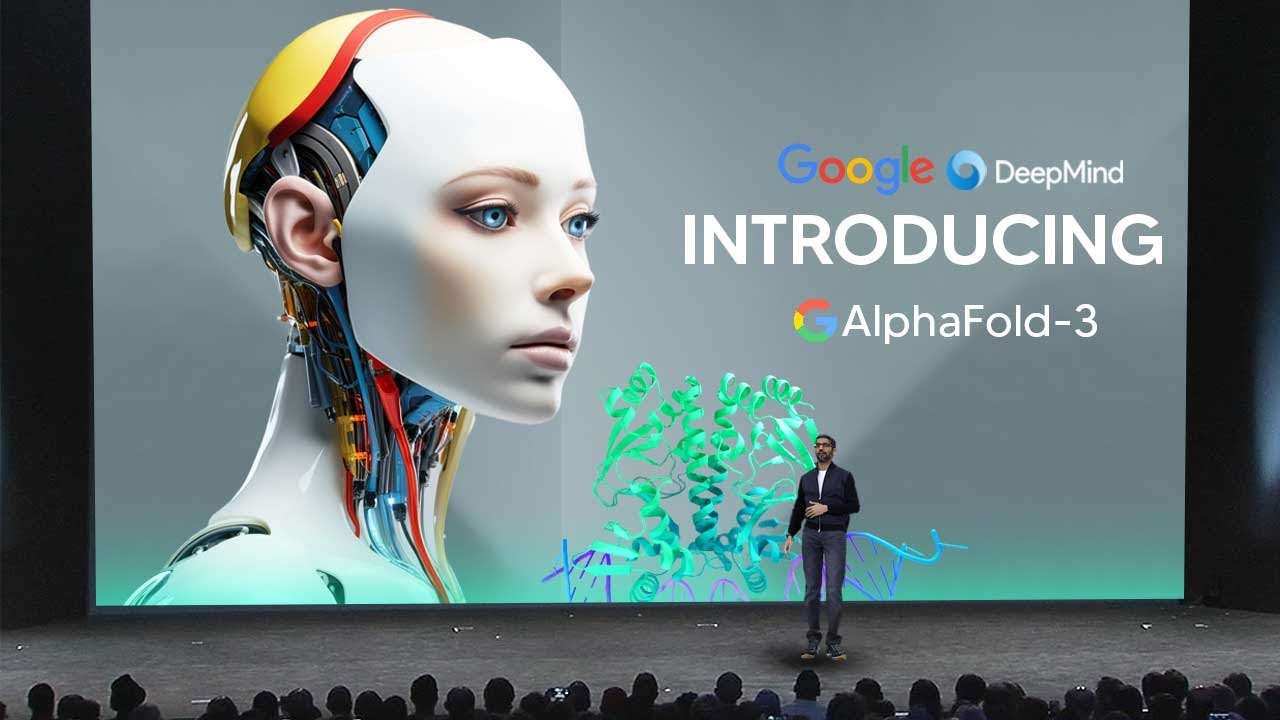
ALPHAFOLD3 TRANSFORMS DRUG DISCOVERY AND CELLULAR RESEARCH INDUSTRY.
AlphaFold2, the groundbreaking AI tool for predicting protein structures, has significantly advanced research by mapping cellular machinery and aiding drug discovery. John Jumper, leading AlphaFold’s development at Google DeepMind, aimed to expand its capabilities further with the release of AlphaFold3, offering predictions of protein structures during interactions with other crucial molecules like DNA and RNA. This latest version, revealed in May 2024, utilizes a new machine-learning model, the diffusion network, to enhance accuracy and outperform existing tools like RoseTTAFold. Despite these advancements, AlphaFold3 is restricted to non-commercial use via a server with limited daily predictions. DeepMind chose not to release the underlying code to balance accessibility with Isomorphic Labs’ commercial interests in drug discovery. Despite the limitations, researchers like Frank Uhlmann believe AlphaFold3 will revolutionize structural biology by making predictions faster and easier. Open-source alternatives are anticipated soon, promising further democratization of protein structure research. (Nature)
NEURALINK BRAIN IMPLANT MALFUNCTIONS AFTER INITIAL HUMAN TRIAL.
Neuralink, a startup founded by Elon Musk, recently reported that its brain implant, known as the Link, malfunctioned following its first human trial. The device, intended to assist paralyzed patients in controlling external technology with their thoughts, was implanted in a 29-year-old patient, Noland Arbaugh, to evaluate safety. Despite initial success, several of the system’s 1,024 electrodes, distributed across 64 threads thinner than a human hair, retracted from Arbaugh’s brain. This reduced the implant’s electrode count and impeded the system’s speed and accuracy. In response, Neuralink updated its recording algorithm and user interface while enhancing signal-to-cursor translation. Despite the setback, Arbaugh continues using the BCI for up to 10 hours daily and finds it beneficial. Neuralink will undergo further safety and efficacy tests before seeking FDA approval for commercial use, facing stiff competition from other companies and academic research in the brain-computer interface field. (CNBC)
If you’re enjoying the Daily Dose, sign up for the Daily Dose Newsletter and get the morning’s best science news from around the web delivered straight to your inbox? It’s easy like Sunday morning.
KAREN KEEGAN’S CHIMERISM CHALLENGES DNA AS IDENTITY DEFINER.
Karen Keegan, a woman with two distinct DNA sequences, uncovered her chimerism when she sought a kidney donation from her children. Genetic tests showed that two of them appeared unrelated, revealing that Keegan’s cells held two genomes due to the fusion of two fertilized eggs. Biologist Alfonso Martínez Arias uses her story to argue that DNA alone doesn’t define identity. In “The Master Builder,” he refutes the idea of DNA as an instruction manual, instead highlighting the role of cells as architects. He emphasizes that cells, not genes, dictate development through self-organization and communication, controlling processes like gastrulation, which establishes a person’s body axes. Martínez Arias’ team replicated early embryonic structures called gastruloids to demonstrate cells’ ability to self-organize. He believes that this new understanding of cells, not DNA, will shape the future of biology and redefine how we perceive life. (El Pais)
LARGEST WHOOPING COUGH OUTBREAK IN DECADES HITS UK.
The UK is facing its largest whooping cough outbreak in two decades, with five infant deaths reported between January and March. The UK Health Security Agency (UKHSA) confirmed 1,319 cases in March, totaling 2,793 in the first quarter of 2024. Mild cases often go undetected due to confusion with other respiratory illnesses. Over half of the cases involve individuals over 15, who typically experience intense coughing fits, while the disease poses the highest risk to infants under three months. Dr. Gayatri Amirthalingam of the UKHSA urges vaccination, especially for pregnant women and young children. Declining uptake of maternal vaccines and low preschool booster rates have increased susceptibility. Additionally, pandemic measures reduced exposure to the bacterium, leaving more people vulnerable. This, combined with waning immunity and a normal infection cycle, creates a “perfect storm,” according to Dr. Elizabeth Whittaker. Vaccination remains the best defense to prevent further cases and complications. (The Guardian)

STUDY LINKS ULTRAPROCESSED FOODS TO INCREASED EARLY DEATH RISK.
A 30-year study involving over 100,000 U.S. health professionals found a link between ultraprocessed food consumption and early death risks. Led by Dr. Mingyang Song of Harvard’s TH Chan School of Public Health, the study revealed a 4% increase in mortality risk among those who consumed the most ultraprocessed foods, particularly processed meats and sugary drinks. However, the risk varied across different food types, as whole grains and cereals, also categorized as ultraprocessed, offer beneficial nutrients like fiber, vitamins, and minerals. The study, published in *The BMJ*, emphasized the importance of overall diet quality, advocating for a diverse diet rich in colorful fruits, vegetables, and whole grains. Dr. Peter Wilde noted that additives, emulsifiers, and flavorings in ultraprocessed foods warrant further research to guide regulations. Moderation is crucial, and no food is inherently good or bad; balance is key to maintaining a healthy lifestyle. (CNN)
SCIENTISTS DECIPHER SPERM WHALE LANGUAGE USING AI STUDY CODAS.
Sperm whales are social creatures that communicate through a series of clicks known as “codas,” akin to “Morse code and popcorn popping.” In a groundbreaking study, scientists from Project CETI (Cetacean Translation Initiative) used artificial intelligence to decode these vocalizations, uncovering a “sperm whale phonetic alphabet.” Analyzing recordings of 400 sperm whales made between 2005 and 2018 in the Eastern Caribbean, researchers identified 156 distinct codas with varying tempo, rhythm, and ornamentation. This intricate system suggests the possibility of a whale language, potentially conveying syllables, words, or even sentences. While the exact meaning of these sounds remains unclear, scientists are working to match vocalizations with behaviors, which could provide valuable insights into whale communication. Understanding this language may assist in conservation efforts for these vulnerable creatures by enabling targeted protections and fostering public empathy. This research could help highlight the significance of sperm whale social structures, encouraging broader conservation support. (Smithsonian)
NAIRR AWARDS SUPERCOMPUTER TIME TO 35 SCIENTISTS FOR AI INNOVATION.
Baskar Ganapathysubramanian, Anuj Karpatne, and David Baker are among 35 scientists awarded supercomputer time by the National Artificial Intelligence Research Resource (NAIRR) program, as part of a two-year pilot project. Funded by the National Science Foundation (NSF), the project provides researchers with computational resources needed to develop AI solutions. Ganapathysubramanian aims to enhance his InsectNet app, helping farmers identify pests via AI, while Karpatne seeks to improve Lake-GPT, a model predicting water quality across thousands of lakes. Baker uses AI to design novel molecules for potential drugs. NAIRR, launched through an executive order by President Biden, grants access to powerful NSF- and Department of Energy-backed supercomputers like Frontera and Summit. It aims to democratize AI research, support diverse fields, and improve AI safety. NAIRR also offers training resources and aims to attract private partnerships, ensuring researchers gain vital computational power and datasets to address significant societal challenges. (Science)
CHATBOTS BECOMING VIRTUAL FRIENDS, OFFERING COMPANIONSHIP AND ADVICE.
A recent exploration by a writer into AI companionship revealed that chatbots are increasingly becoming virtual friends, offering companionship and advice on personal dilemmas and daily challenges. Through apps like Nomi, Kindroid, and Replika, the author created 18 AI personas ranging from a therapist named Peter to a fitness guru, developing a digital circle that offers conversations, emotional support, and even critiques on outfits. Despite lacking genuine emotions or desires, these AI companions can convincingly simulate empathy and understanding, sometimes offering more accurate feedback than human counterparts. While the concept faces skepticism due to concerns over replacing human connections, studies suggest AI friendships could mitigate loneliness for some. However, there are risks, such as potential manipulation or detachment from real-world relationships. Responsible design and thoughtful features could enable AI companions to complement, rather than replace, human socializing, providing a safe platform for practicing conversational skills and understanding the value of genuine human friendships. (New York Times)
Thanks for reading. Let’s be careful out there.
WORDS: The Biology Guy.


Leave a Reply