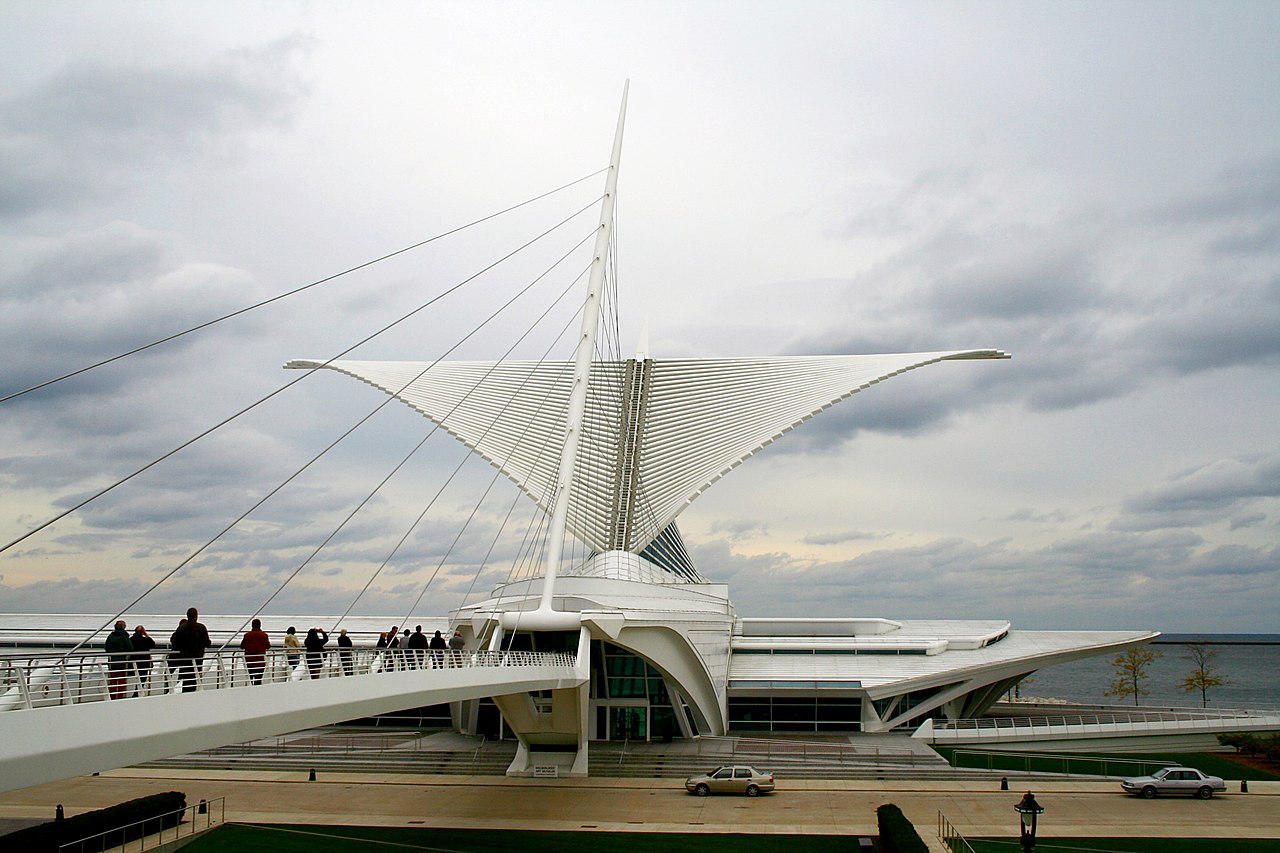

Located at the heart of Milwaukee’s vibrant cultural scene, the Milwaukee Art Museum’s Quadracci Pavilion stands as a stunning testament to the harmonious blend of artistic vision and engineering innovation. Designed by the Spanish architect Santiago Calatrava, the Pavilion is not only a gateway to the world of visual arts but also a beacon of architectural science, showcasing how form can meet function in breathtaking ways.
The most striking feature of the Quadracci Pavilion is its movable, wing-like brise-soleil that unfurls from the building’s spine, creating a dynamic sculpture that responds to the environment. This structure is not merely an aesthetic marvel; it represents a significant engineering feat. The brise-soleil consists of 72 steel fins, spanning up to 217 feet, that open and close like the wings of a great bird. This mechanism is designed to regulate sunlight and temperature within the pavilion, demonstrating an elegant solution to environmental control in building design.
Calatrava’s design was inspired by the natural beauty of Lake Michigan and the surrounding cityscape. The use of white, post-tensioned concrete combined with a soaring glass-enclosed reception hall creates an airy, light-filled space that speaks to the pavilion’s theme of transparency and openness. The architect’s choice of materials and design elements reflect a deep understanding of structural dynamics, a field of science that studies the behavior of structures under various forces.
From a scientific viewpoint, the Pavilion is a case study in mechanical and civil engineering. The operational mechanism of the brise-soleil involves precise calculations to ensure balance and stability, all while maintaining the aesthetic integrity of the structure. The integration of automated systems to control these massive wings required innovative approaches to hydraulic engineering and material science, ensuring durability against the varying climatic conditions of Milwaukee.
Furthermore, the building’s foundation and structural support system are tailored to its lakeside location, addressing challenges posed by the soft soil and the need for a structure that can withstand the natural elements. This involved geotechnical engineering to assess soil properties and hydrodynamics to understand the impact of the lake on the construction.
The Quadracci Pavilion serves as an educational tool by itself, illustrating the potential of integrating scientific principles with creative architectural design. It provides a practical demonstration of physics and engineering concepts in action, such as hydraulics, kinetics, and material properties. For students and visitors, the pavilion offers a live case study on the application of STEM (Science, Technology, Engineering, and Math) in real-world scenarios, making it a valuable educational resource.




Leave a Reply