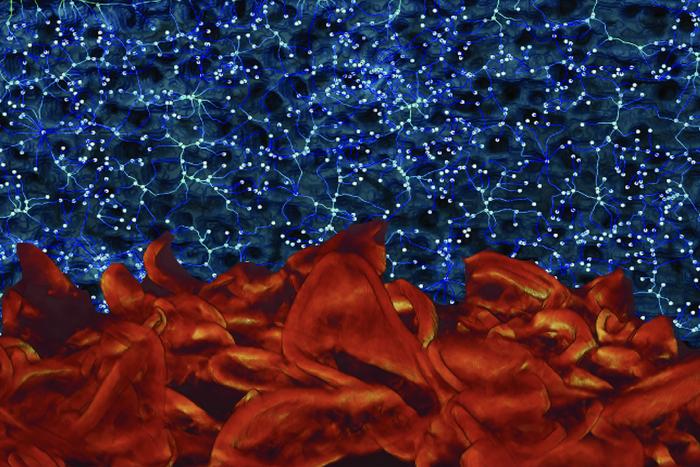
Voids, or empty spaces, exist within matter at all scales, from the astronomical to the microscopic. In a new study, researchers used high-powered microscopy and mathematical theory to unveil nanoscale voids in three dimensions. This advancement is poised to improve the performance of many materials used in the home and in the chemical, energy and medical industries — particularly in the area of filtration.
Magnification of common filters used in the home shows that, while they look like a solid piece of material with uniform holes, they are actually composed of millions of randomly oriented tiny voids that allow small particles to pass through. In some industrial applications, like water and solvent filtration, paper-thin membranes make up the barriers that separate fluids and particles.

“The materials science community has been aware of these randomly oriented nanoscale voids within filter membranes for a while,” said Falon Kalutantirige, a University of Illinois Urbana-Champaign graduate student. “The problem was that the complex structure of the membrane as a whole — which looks like nanoscale mountain ranges when magnified — was blocking our view of the void spaces. Because we could not see them, we couldn’t fully understand how they affected filtration properties. We knew that if we could find a way to see them, we could then figure out how they work and ultimately improve filter membrane performance.”
The study, directed by Illinois materials science and engineering professor Qian Chen and University of Wisconsin-Madison professor Ying Li, is the first to integrate materials science and a mathematical concept called graph theory to help image and map out the random placement of these voids within filtration materials. The findings are published in the journal Nature Communications.
Sign up for the Daily Dose Newsletter and get every morning’s best science news from around the web delivered straight to your inbox? It’s easy like Sunday morning.
Building on a previous study that used laboratory models, the researchers said the new study focuses on far more complex membranes used in industrial applications.
“The surfaces of the membranes we studied in this work look flat to the naked eye, but when we zoomed in using transmission electron microscopy, electron tomography and atomic force microscopy, we could observe these voids nestled within these nanoscale mountainous landscapes that we call crumples,” said Kalutantirige, the study’s first author.
However, the team needed a means to measure and map these features to build a quantitative predictive model and gain a more holistic picture of the membrane surfaces.
“Mapping and measuring alone will work for materials with a regular or periodic structure, making it mathematically simple to scale up our models and predict how structural properties will influence the material’s performance,” Chen said. “But the irregularity we observed in our study pushed us to use graph theory, which gives us a mathematical way to describe this heterogeneous and messy — but practical — material.”
Graph theory helped the team finally gain a more holistic understanding of the filter membrane structure, which led them to discover a strong correlation between the unique physical and mechanical properties of random empty space and improved filtration performance.
“Our method is a very universal technique for describing materials,” Kalutantirige said. “Many things we use in everyday life and science are not made of materials composed of repetitive uniform structures. So, the beauty of the method, I think, is that we can capture the ‘regularness’ of irregular structures.”
The team said that this advancement will improve the effectiveness of many next-generation porous materials, such as polymers used in drug delivery.
“The title of this study hints at the concept of ‘beyond nothingness,’ and by that, we mean that these empty, void spaces are really important when it comes to developing the best filtration membranes,” Chen said. “This work is only possible with our wonderful team of collaborators. Xiao Su helped us with the membrane performance testing. Emad Tajkhorshid, Charles Schroeder and Jeffrey Moore worked with us on the synthesis and analysis of the polymer systems.”
IMAGE CREDIT: Falon Kalutantirige
If you enjoy the content we create and would like to support us, please consider becoming a patron on Patreon! By joining our community, you’ll gain access to exclusive perks such as early access to our latest content, behind-the-scenes updates, and the ability to submit questions and suggest topics for us to cover. Your support will enable us to continue creating high-quality content and reach a wider audience.
Join us on Patreon today and let’s work together to create more amazing content! https://www.patreon.com/ScientificInquirer


Leave a Reply