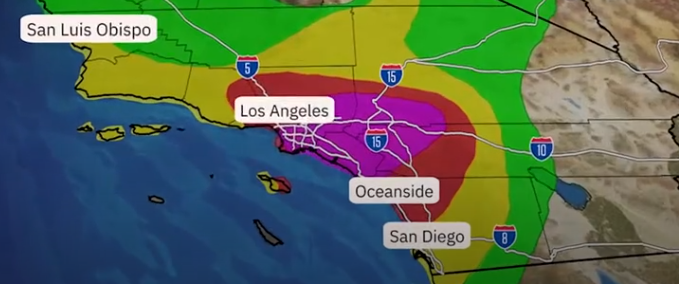
WINTER STORM SHUTS DOWN CALIFORNIA.
A massive winter storm, driven by a powerful atmospheric river, hit California on Sunday, causing extensive disruptions. This storm, affecting 94% of the state’s population, posed severe flood risks. Southern California faced the brunt, with the National Weather Service issuing a rare hurricane-force wind warning for the Central Coast, predicting gusts up to 92 mph. San Francisco dealt with flooding, blocked roads, fallen trees, and landslides. The storm forced the postponement of the AT&T Pebble Beach Pro-Am golf tournament. Expected to move south, it threatened the Los Angeles area with downpours, flash floods, and mountain snow, then onto Orange County and San Diego. Governor Gavin Newsom declared a state of emergency in eight Southern California counties. The storm was part of the “Pineapple Express” system, following a previous storm that brought 1-6 inches of rain. With higher moisture content, this storm intensified the risk in already saturated areas. By Sunday evening, over 856,000 homes and businesses lost power, mainly in coastal areas. Firefighters rescued a man from the rising waters in the Ventura River. The National Weather Service described it as one of the most dramatic weather events in recent memory. (USA Today)
WILDFIRES IN CHILE.
Chile is reeling from catastrophic wildfires along its Pacific Coast, which have claimed at least 112 lives, with many still missing. President Gabriel Boric, foreseeing a rise in the death toll, called it the worst disaster since the 2010 earthquake. The fires, beginning Friday near Viña del Mar, were fueled by high winds and spread rapidly, destroying thousands of homes and prompting a regional emergency and curfew. Many victims, including elderly residents, were unable to flee the fast-moving flames. The devastation, affecting Viña del Mar and neighboring cities, occurred as the region experienced unusually high temperatures. These conditions, worsened by the El Niño climate phenomenon, have led to widespread forest fires across South America. The Chilean government faced criticism for flawed evacuation procedures, with residents receiving late alerts and struggling to escape. The disaster’s magnitude was only fully understood from Saturday, leaving many communities in despair, facing the loss of homes, loved ones, and belongings. The government is now focused on recovery and mourning, with international attention on Chile’s plight. (New York Times)
If you’re enjoying the Daily Dose, sign up for the Daily Dose Newsletter and get the morning’s best science news from around the web delivered straight to your inbox? It’s easy like Sunday morning.
NEW SUPERCOLLIDER PROPOSED.
Researchers at CERN have proposed a new supercollider, the Future Circular Collider (FCC), aiming to uncover new particles and advance our understanding of the universe. If approved, this collider would be three times larger than the current Large Hadron Collider (LHC) but carries a hefty £12bn price tag, sparking debate about its financial viability. The LHC’s significant discovery was the Higgs Boson in 2012, but it hasn’t yet unraveled the mysteries of dark matter and dark energy. The FCC, nearly 91km in circumference, is designed in two phases: the first to study Higgs particles by colliding electrons and the second, starting in the 2070s, to search for new particles using heavier protons and advanced technology not yet available. While some see the FCC as a monumental step in physics, critics question its cost-effectiveness and the prioritization of funds, suggesting alternative research paths and more immediate global challenges needing attention. (BBC)
QUESTIONS ABOUT NEURALINK.
Neuralink, led by Elon Musk, has implanted a brain-reading device in a human for the first time, aiming to enable people with severe paralysis to control devices through thought. This marks a significant step in brain-computer interface (BCI) technology, yet details about the trial are scarce. Concerns revolve around the lack of information on trial specifics, including locations and outcomes. The trial isn’t registered on ClinicalTrials.gov, a standard practice for ensuring ethical standards and transparency. Neuralink’s device, featuring 1,024 recording sites on 64 threads, potentially offers greater bandwidth for brain-machine communication compared to existing BCIs. Its wireless, fully implanted system distinguishes it from other neuron-recording BCIs requiring physical computer connections. Experts anticipate the trial will prioritize safety, examining immediate impacts and long-term effects like signal degradation. The lack of public protocol details raises questions about volunteer safety and trial transparency. Despite regulatory approval, the absence of trial registration on ClinicalTrials.gov and limited public information has led to calls for greater openness, especially important for potential BCI users eagerly awaiting such life-altering technology. (Nature)

IRON AGE BLACKSMITH’S WORKSHOP DISCOVERED INTACT.
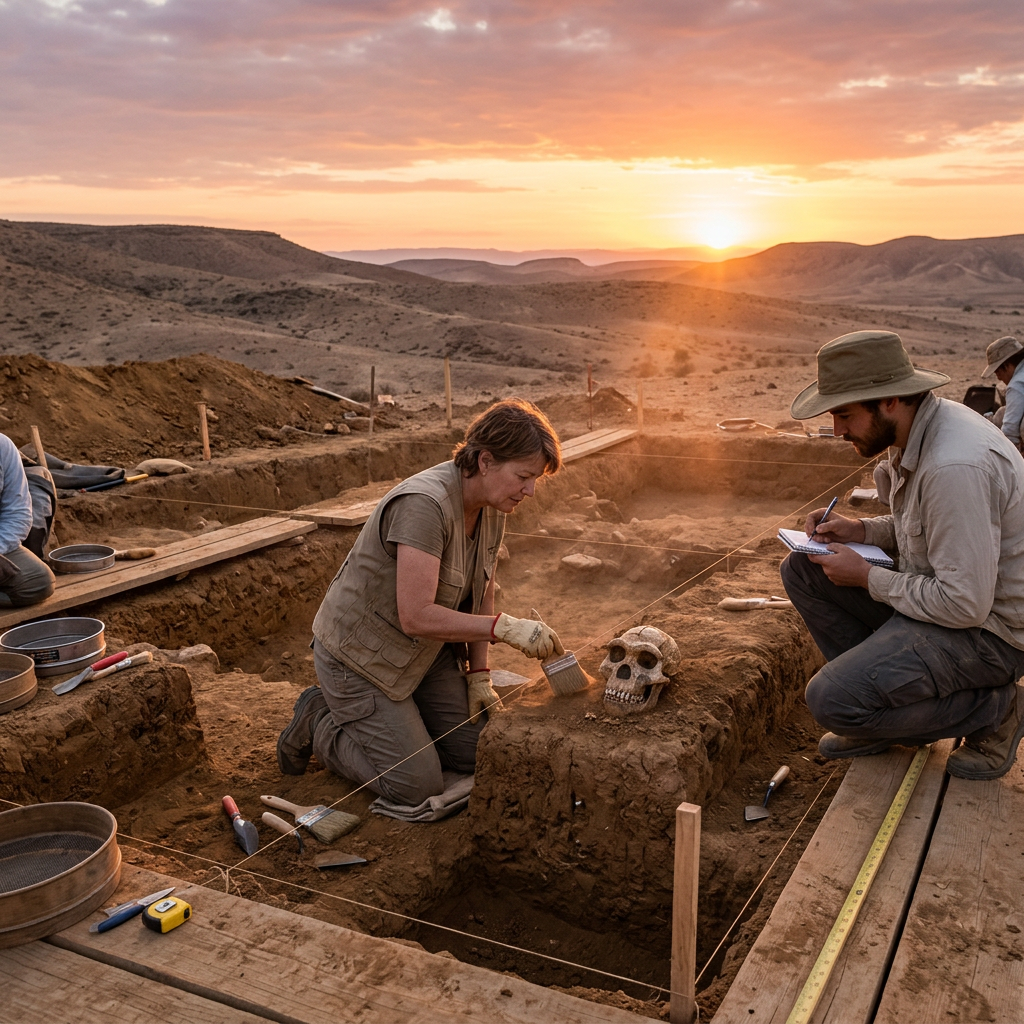
A groundbreaking discovery in Oxfordshire, England, has unveiled a 2,700-year-old Iron Age blacksmith’s workshop, providing new insights into Britain’s early metalworking history. The find, excavated by DigVentures, dates back to between 770 and 515 B.C.E., signifying the dawn of the Iron Age in Britain. The site, located near Wittenham Clumps, was active when ironworking techniques, stronger and more abundant than bronze, were introduced from southern Europe, revolutionizing aspects like agriculture. The excavation, conducted from 2018 to 2020, revealed not just an average blacksmith’s operation, but the workspace of a highly skilled ‘master blacksmith’. Artifacts found include forgery equipment, metal fragments, and an intact tuyere—a rare find used for blowing air into the hearth, indicating a large-scale operation likely producing significant items like swords and cart wheels. The site, rich in Iron Age history, had previously yielded other significant finds such as roundhouses, a pantry, and even a Roman villa. The artifacts from this blacksmith’s workshop will be exhibited at Earth Trust’s visitor center in Abingdon. This discovery offers a unique glimpse into what may have been one of Britain’s earliest master blacksmiths at work. (Smithsonian)
MYSTERIOUS MAGNETIC FIELD.
New detailed maps have unveiled a concealed hydrothermal system under New Zealand’s Lake Rotorua, a site of significant Māori cultural heritage. Situated in an ancient volcanic crater on the North Island, Lake Rotorua is famous for its Māori legend of a chief’s daughter swimming across it for love. Researchers from GNS Science have mapped about 68% of the lake’s floor, revealing features like eruption craters and an ancient river. The study also discovered a large magnetic anomaly in the lake’s southern part, contrasting typical volcanic rock behavior. This anomaly is attributed to hydrothermal fluids converting magnetic magnetite into non-magnetic pyrite (fool’s gold), thus diminishing the lake’s magnetic signal. The hydrothermal activity, which is also visible through a heat flow map, indicates hot water rising to the lake’s floor. However, due to the lake’s size, water temperatures remain cool at about 57 degrees Fahrenheit (14 degrees Celsius), with only minor fluctuations. These findings provide a clearer understanding of the hydrothermal processes beneath Lake Rotorua and add to its cultural and geological significance. (space.com)
COSMONAUT SETS RECORD FOR ISS STAY.
Russian cosmonaut Oleg Kononenko recently set a new world record for the longest cumulative time spent in space, surpassing 878 days aboard the International Space Station (ISS), as announced by Roscosmos. He beat the previous record held by Gennady Padalka, another Russian. Kononenko, 59, who first journeyed to the ISS in 2008, achieved this milestone at 8:30 a.m. on a Sunday and is expected to reach 1,000 days in space by June 5th, with his current mission extending until September 23rd. Despite setting this record, Kononenko emphasized his passion for space exploration over record-setting. He’s part of a long-term expedition, orbiting about 423 kilometers from Earth. Proud of his achievement, he remains more gratified that a Russian cosmonaut still holds this record, continuing Russia’s significant history in space exploration, which includes launching the first satellite, Sputnik 1, in 1957, and sending Yuri Gagarin as the first human into space in 1961. Despite facing challenges like funding shortages and corruption post-1991 Soviet Union collapse, Russia vows to revitalize its space program. Kononenko, while adapting to the physical effects of weightlessness and complex systems and experiments in space, also reflects on personal sacrifices like time away from family. However, advancements now allow cosmonauts to stay connected with their families through video calls and messaging. The ISS remains a vital cooperative venture between the United States and Russia, with a joint mission extended until 2025. (Der Spiegel)
Thanks for reading. Let’s be careful out there.
WORDS: The Biology Guy.
IMAGE CREDIT: Screenshot.
Leave a Reply