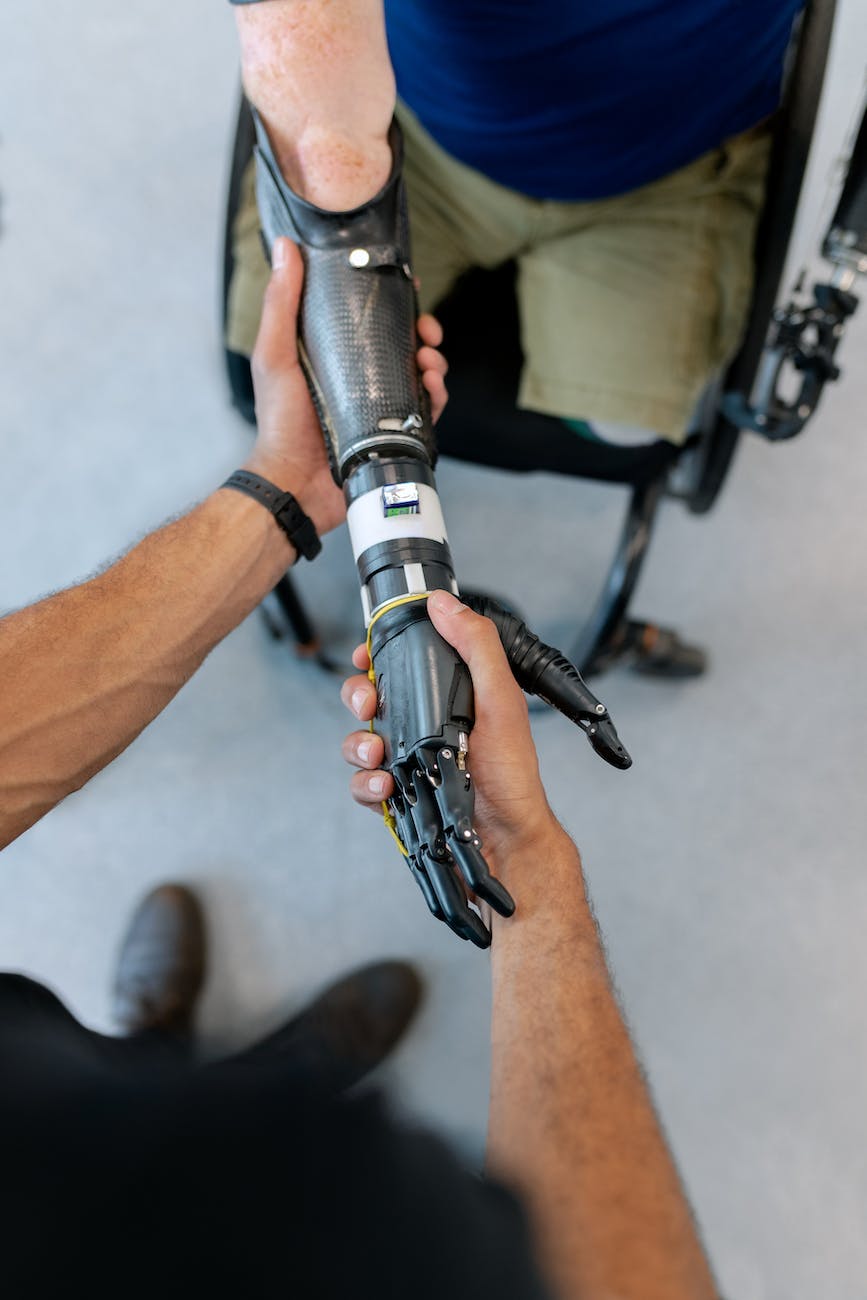
Neuroengineer Silvestro Micera develops advanced technological solutions to help people regain sensory and motor functions that have been lost due to traumatic events or neurological disorders. Until now, he had never before worked on enhancing the human body and cognition with the help of technology.
Now in a study published in Science Robotics, Micera and his team report on how diaphragm movement can be monitored for successful control of an extra arm, essentially augmenting a healthy individual with a third – robotic – arm.
“This study opens up new and exciting opportunities, showing that extra arms can be extensively controlled and that simultaneous control with both natural arms is possible,” says Micera, Bertarelli Foundation Chair in Translational Neuroengineering at EPFL, and professor of Bioelectronics at Scuola Superiore Sant’Anna.

The study is part of the Third-Arm project, previously funded by the Swiss National Science Foundation (NCCR Robotics), that aims to provide a wearable robotic arm to assist in daily tasks or to help in search and rescue. Micera believes that exploring the cognitive limitations of third-arm control may actually provide gateways towards better understanding of the human brain.
Micera continues, “The main motivation of this third arm control is to understand the nervous system. If you challenge the brain to do something that is completely new, you can learn if the brain has the capacity to do it and if it’s possible to facilitate this learning. We can then transfer this knowledge to develop, for example, assistive devices for people with disabilities, or rehabilitation protocols after stroke.”
“We want to understand if our brains are hardwired to control what nature has given us, and we’ve shown that the human brain can adapt to coordinate new limbs in tandem with our biological ones,” explains Solaiman Shokur, co-PI of the study and EPFL Senior Scientist at the Neuro-X Institute. “It’s about acquiring new motor functions, enhancement beyond the existing functions of a given user, be it a healthy individual or a disabled one. From a nervous system perspective, it’s a continuum between rehabilitation and augmentation.”
To explore the cognitive constraints of augmentation, the researchers first built a virtual environment to test a healthy user’s capacity to control a virtual arm using movement of his or her diaphragm. They found that diaphragm control does not interfere with actions like controlling one’s physiological arms, one’s speech or gaze.
In this virtual reality setup, the user is equipped with a belt that measures diaphragm movement. Wearing a virtual reality headset, the user sees three arms: the right arm and hand, the left arm and hand, and a third arm between the two with a symmetric, six-fingered hand.
“We made this hand symmetric to avoid any bias towards either the left or the right hand,” explains Giulia Dominijanni, PhD student at EPFL’s Neuro-X Institute.
In the virtual environment, the user is then prompted to reach out with either the left hand, the right hand, or in the middle with the symmetric hand. In the real environment, the user holds onto an exoskeleton with both arms, which allows for control of the virtual left and right arms. Movement detected by the belt around the diaphragm is used for controlling the virtual middle, symmetric arm. The setup was tested on 61 healthy subjects in over 150 sessions.
“Diaphragm control of the third arm is actually very intuitive, with participants learning to control the extra limb very quickly,” explains Dominijanni. “Moreover, our control strategy is inherently independent from the biological limbs and we show that diaphragm control does not impact a user’s ability to speak coherently.”
The researchers also successfully tested diaphragm control with an actual robotic arm, a simplified one that consists of a rod that can be extended out, and back in. When the user contracts the diaphragm, the rod is extended out. In an experiment similar to the VR environment, the user is asked to reach and hover over target circles with her left or right hand, or with the robotic rod.
Besides the diaphragm, but not reported in the study, vestigial ear muscles have also been tested for feasibility in performing new tasks. In this approach, a user is equipped with ear sensors and trained to use fine ear muscle movement to control the displacement of a computer mouse.
“Users could potentially use these ear muscles to control an extra limb,” says Shokur, emphasizing that these alternative control strategies may help one day for the development of rehabilitation protocols for people with motor deficiencies.
Part of the third arm project, previous studies regarding the control of robotic arms have been focused on helping amputees. The latest Science Robotics study is a step beyond repairing the human body towards augmentation.
“Our next step is to explore the use of more complex robotic devices using our various control strategies, to perform real-life tasks, both inside and outside of the laboratory. Only then will we be able to grasp the real potential of this approach,” concludes Micera.
Neuroengineer Silvestro Micera develops advanced technological solutions to help people regain sensory and motor functions that have been lost due to traumatic events or neurological disorders. Until now, he had never before worked on enhancing the human body and cognition with the help of technology.
Now in a study published in Science Robotics, Micera and his team report on how diaphragm movement can be monitored for successful control of an extra arm, essentially augmenting a healthy individual with a third – robotic – arm.
“This study opens up new and exciting opportunities, showing that extra arms can be extensively controlled and that simultaneous control with both natural arms is possible,” says Micera, Bertarelli Foundation Chair in Translational Neuroengineering at EPFL, and professor of Bioelectronics at Scuola Superiore Sant’Anna.
The study is part of the Third-Arm project, previously funded by the Swiss National Science Foundation (NCCR Robotics), that aims to provide a wearable robotic arm to assist in daily tasks or to help in search and rescue. Micera believes that exploring the cognitive limitations of third-arm control may actually provide gateways towards better understanding of the human brain.
Micera continues, “The main motivation of this third arm control is to understand the nervous system. If you challenge the brain to do something that is completely new, you can learn if the brain has the capacity to do it and if it’s possible to facilitate this learning. We can then transfer this knowledge to develop, for example, assistive devices for people with disabilities, or rehabilitation protocols after stroke.”
“We want to understand if our brains are hardwired to control what nature has given us, and we’ve shown that the human brain can adapt to coordinate new limbs in tandem with our biological ones,” explains Solaiman Shokur, co-PI of the study and EPFL Senior Scientist at the Neuro-X Institute. “It’s about acquiring new motor functions, enhancement beyond the existing functions of a given user, be it a healthy individual or a disabled one. From a nervous system perspective, it’s a continuum between rehabilitation and augmentation.”
To explore the cognitive constraints of augmentation, the researchers first built a virtual environment to test a healthy user’s capacity to control a virtual arm using movement of his or her diaphragm. They found that diaphragm control does not interfere with actions like controlling one’s physiological arms, one’s speech or gaze.
In this virtual reality setup, the user is equipped with a belt that measures diaphragm movement. Wearing a virtual reality headset, the user sees three arms: the right arm and hand, the left arm and hand, and a third arm between the two with a symmetric, six-fingered hand.
“We made this hand symmetric to avoid any bias towards either the left or the right hand,” explains Giulia Dominijanni, PhD student at EPFL’s Neuro-X Institute.
In the virtual environment, the user is then prompted to reach out with either the left hand, the right hand, or in the middle with the symmetric hand. In the real environment, the user holds onto an exoskeleton with both arms, which allows for control of the virtual left and right arms. Movement detected by the belt around the diaphragm is used for controlling the virtual middle, symmetric arm. The setup was tested on 61 healthy subjects in over 150 sessions.
“Diaphragm control of the third arm is actually very intuitive, with participants learning to control the extra limb very quickly,” explains Dominijanni. “Moreover, our control strategy is inherently independent from the biological limbs and we show that diaphragm control does not impact a user’s ability to speak coherently.”
The researchers also successfully tested diaphragm control with an actual robotic arm, a simplified one that consists of a rod that can be extended out, and back in. When the user contracts the diaphragm, the rod is extended out. In an experiment similar to the VR environment, the user is asked to reach and hover over target circles with her left or right hand, or with the robotic rod.
Besides the diaphragm, but not reported in the study, vestigial ear muscles have also been tested for feasibility in performing new tasks. In this approach, a user is equipped with ear sensors and trained to use fine ear muscle movement to control the displacement of a computer mouse.
“Users could potentially use these ear muscles to control an extra limb,” says Shokur, emphasizing that these alternative control strategies may help one day for the development of rehabilitation protocols for people with motor deficiencies.
Part of the third arm project, previous studies regarding the control of robotic arms have been focused on helping amputees. The latest Science Robotics study is a step beyond repairing the human body towards augmentation.
“Our next step is to explore the use of more complex robotic devices using our various control strategies, to perform real-life tasks, both inside and outside of the laboratory. Only then will we be able to grasp the real potential of this approach,” concludes Micera.
Sign up for the Daily Dose Newsletter and get the morning’s best science news from around the web delivered straight to your inbox? It’s easy like Sunday morning.



Leave a Reply