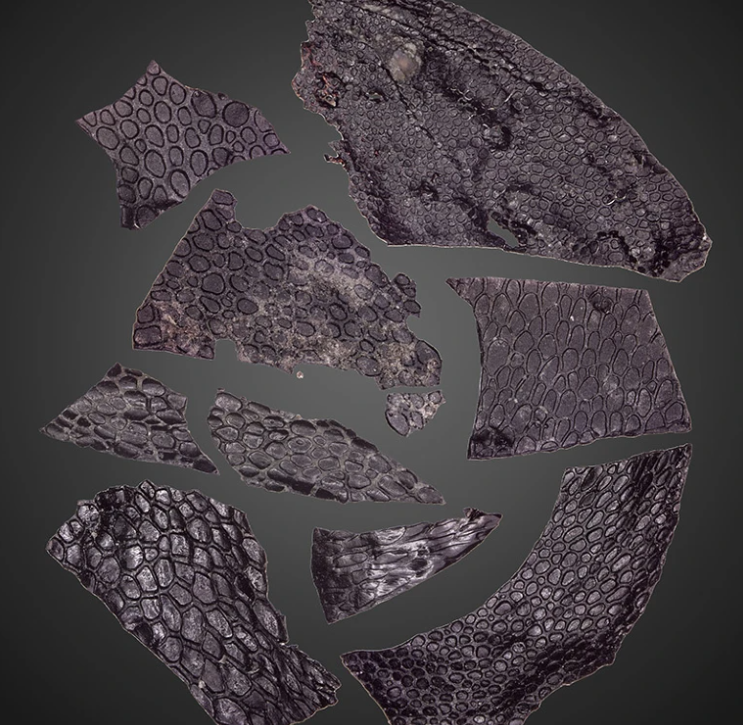
OLDEST LAYER OF SKIN DISCOVERED.
A tiny, dark shred of fossilized skin, only a few millimeters in size, has astounded paleontologists with its significance. Sent in a glass vial by Oklahoma fossil collectors to the University of Toronto Mississauga, this specimen is the oldest known skin of amniotes, a group that includes reptiles, birds, mammals, and excludes amphibians. Dated at approximately 289 million years old, it’s 21 million years older than the previous record holder. The skin likely belonged to Captorhinus aguti, a small lizard-like animal. Remarkably, this isn’t just a skin impression but an actual 3D fossilized layer. Researchers, including paleontologist Robert Reisz and students Ethan Mooney and Tea Maho, examined its cross-section revealing distinct layers of epidermis and dermis. The epidermis contains corneous tissue, crucial for protection in terrestrial environments. The skin was discovered in a cave system in Oklahoma, known for C. aguti fossils, by collectors Bill and Julie May. The dark, almost black coloration is due to oil seepage during fossilization, enriching it with hydrocarbons. This find offers insights into early terrestrial adaptations, highlighting the importance of tough, watertight skin for life on land. It’s rare to find such well-preserved soft tissue, providing a unique window into the evolution of these groups. (Nature)
SENSITIVE INFO EXPOSED MISTAKENLY.
Hundreds of millions of files are accidentally exposed online annually, including a recent leak involving U.S. school emergency planning documents. Security researcher Jeremiah Fowler discovered over 4 million records from Raptor Technologies, used by more than 5,300 U.S. school districts. The leak included sensitive information like evacuation plans, details of students posing threats, medical records, and personal information of students, staff, and their families. These documents, dating from 2022 and 2023, were found in three unsecured web buckets, not due to hacking. They detail schools’ emergency responses and test event results, with specific plans for scenarios like active shooter situations and natural disasters. The leak raises concerns about the potential exploitation of this information by individuals planning attacks on schools. Raptor Technologies was informed in December and quickly secured the data. There’s no evidence of malicious access, but the breach could have significant physical and cybersecurity implications. The incident highlights the vulnerability of sensitive educational data and the broader privacy concerns for individuals affected by such breaches. Raptor Technologies regrets the incident and has assured that there’s no misuse of the information, while their investigation continues. (Wired)
If you’re enjoying the Daily Dose, sign up for the Daily Dose Newsletter and get the morning’s best science news from around the web delivered straight to your inbox? It’s easy like Sunday morning.
HISTORICAL CORONAVIRUS EPIDEMICS.
In November 1889, the “Russian influenza” affected many in St. Petersburg, later spreading worldwide. British officer H. Franklin Parsons detailed this epidemic, noting symptoms like a dry cough and changes in taste and smell. In 2005, Belgian scientists proposed this was caused by a coronavirus, similar to the 2002 SARS outbreak. They suggested the common cold-causing coronavirus OC43 originated from this pandemic, but evidence is still being sought. This research contributes to understanding common cold coronaviruses (NL63, 229E, HKU1) and their animal origins, especially post-COVID-19. These viruses, once possibly more severe, have evolved. The first human coronavirus was identified in 1960, but research was limited until the 2003 SARS outbreak sparked renewed interest. Current studies focus on how immunity to these viruses affects COVID-19 responses. The evolution of SARS-CoV-2 remains debated; whether it will become milder like common cold viruses is uncertain, as seen with evolving variants like Delta and Omicron. (Science)
AMAZONIAN CIVILIZATIONS OLDER AND MORE COMPLEX THAN THOUGHT.
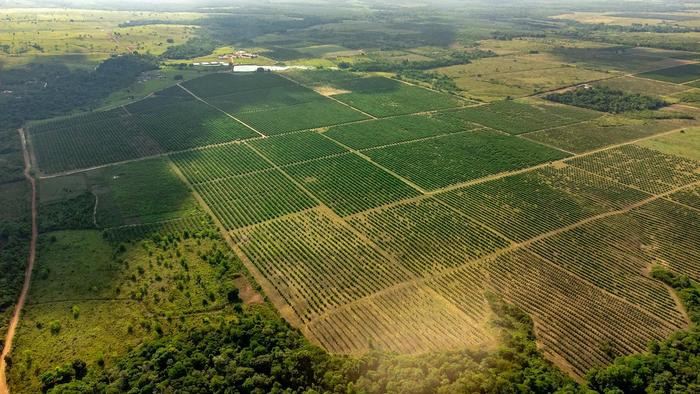
Archaeologists have discovered that the Amazon rainforest, once thought to be sparsely populated, was actually home to large and complex societies. Using lidar technology, which penetrates forest cover to reveal ground structures, they found a network of interconnected ancient cities in Ecuador’s Upano Valley. These settlements, dating back to at least 2500 years ago, are over a millennium older than any other known complex Amazonian society. This discovery, described in Science, highlights the previously unrecognized diversity of ancient Amazonian cultures. Excavations in two major sites, Sangay and Kilamope, revealed mounds, plazas, pottery, and large jugs used for traditional maize beer. The lidar survey revealed dense urban areas with residential and ceremonial structures, agricultural fields, terraces for crops, and extensive road networks connecting cities. These findings challenge previous views of Amazonia, indicating a rich cultural diversity and advanced urbanism in ancient societies. However, further research is needed to fully understand these societies, including their population sizes, governance, and trade networks. This discovery opens a new chapter in understanding the ancient cultures of the Amazon rainforest. (Science)

SELF-DRIVING LABORATORY SUCCESS STORY.
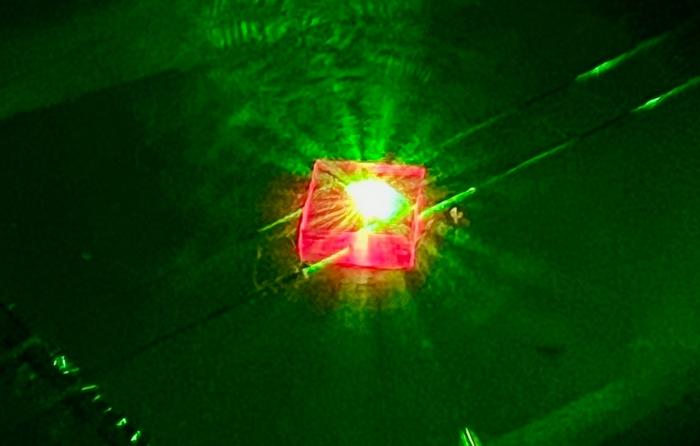
A self-driving laboratory, using robotic equipment and a simple AI model, successfully reengineered enzymes autonomously, only requiring occasional human intervention for hardware maintenance. This innovative approach fully automates protein engineering, making it an ideal application for autonomous labs. These labs, integrating robotics with machine-learning models, aim to accelerate scientific research and discover solutions beyond human conception. In a study published in Nature Chemical Engineering, the team led by Philip Romero at the University of Wisconsin–Madison demonstrated this concept. Their system linked protein sequences to their functions, proposing modifications to enhance performance. The lab autonomously produced proteins, measured their activity, and used the results to refine experiments. Tasked with increasing the heat tolerance of glycoside hydrolases, the lab produced enzyme versions functioning at temperatures 12°C higher than the originals. This method, which took about 6 months and cost approximately $5,200 per 20-round experiment, could replace a year’s work by a human. However, advancing self-driving biology labs might need new hardware and approaches to generate machine-interpretable knowledge. The team is exploring broader applications and incorporating advanced deep-learning tools, aiming to replace mundane tasks in scientific research rather than the scientists themselves. (Nature)
FEMINIZATION OF GREEN TURTLES IS A PROBLEM.
Anne Meylan’s long-term study of green turtles in Bermuda, recently published in Marine Biology, reveals a concerning trend: an increasing number of female turtles. This shift in sex ratios is attributed to climate change raising nest temperatures, which affects sex determination in these egg-laying reptiles. Meylan’s research involved analyzing sex-ratio data from over 2,700 immature green turtles captured around Bermuda from 1975 to 2018. The sex was determined using testosterone levels and confirmed by examining the turtles’ gonads. The turtles, originating from various nesting sites across the Atlantic, including Florida, Cuba, Brazil, and Guinea-Bissau, showed a significant increase in female percentage over four decades, reaching as high as 68.1% in recent years. This widespread feminization trend raises concerns for the future of sea turtle populations. Despite successful conservation efforts since the 1950s, such as establishing protected areas and reducing harvesting and bycatch, skewed sex ratios present a new challenge in species recovery. Meylan emphasizes the urgency of addressing this issue to ensure successful reproduction and long-term survival of sea turtles. (Hakai Magazine)
Thanks for reading. Let’s be careful out there.
WORDS: The Biology Guy.
IMAGE CREDIT: Mooney et al./Current Biology.

Leave a Reply