When the Supreme Court of the United States struck down Roe v. Wade, protections to a woman’s right to an abortion in the first 24 weeks disappeared. For anti-abortion activists, the ruling represented the culmination of nearly a half century of agitation; for pro-choice advocates, it represented a traumatic return to much darker era where desperate women took their chances seeking out procedures that only existed underground. By stripping a woman’s ability to decide what happens within the confines of her own body, Dobbs v Jackson Women’s Health Organization implied that all women were mere wards of the State. It was a traumatic event that shook many women down to their core and, in its immediate aftermath, people speculated on the many scenarios that might play out in the future.
The recent case of Kate Cox, a Texas mother who was forced to flee the state in order to terminate a pregnancy that had sent her to the emergency numerous times crystallized the new reality. Even though Cox’s doctor had diagnosed her fetus with trisomy 18 – a fatal disorder that would either result in an eventual miscarriage or death of the baby within a year – and instructed her to have the abortion, the Supreme Court of Texas overruled a lower court decision allowing her to have an emergency procedure. Pro-choice advocates could be excused for nodding their heads and mumbling, “I told you so.”
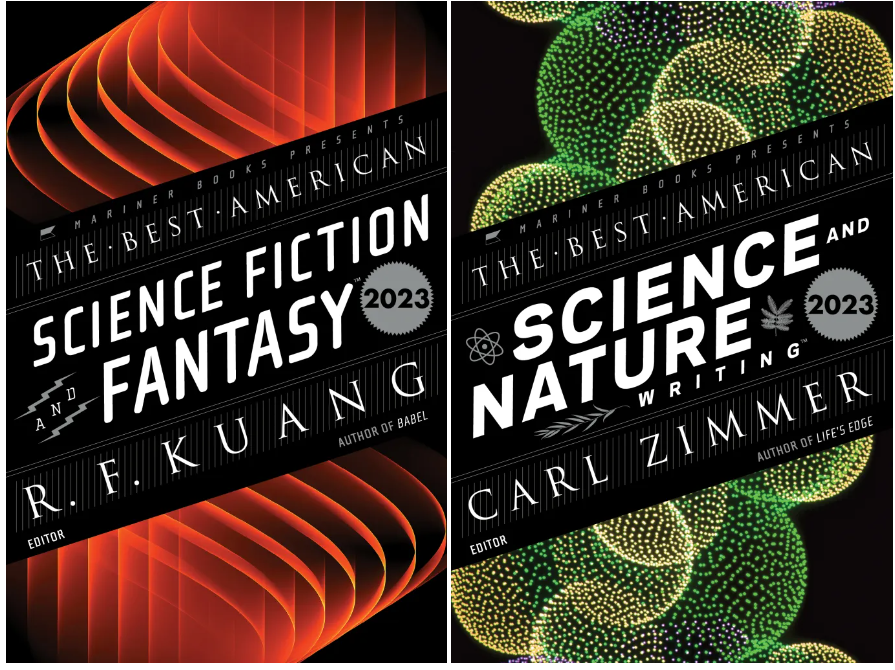
Two entries in the 2023 edition of The Best American Science Fiction and Fantasy Short Stories (ed. R.F. Kuang) and one in The Best American Science and Nature Writing (ed. Carl Zimmer) addresses the implications of the Dobbs decision, each one highlighting a different issue, and in the process elucidating the complexities that have yet to be fully teased out.


In The Best American Science Fiction and Fantasy Short Stories, “Rabbit Test” by Samantha Mills tells the story of a young woman named Grace who learns that she is pregnant during a fictional point in the future when abortions are illegal across the entire United States. Unfortunately, that’s only the beginning of her problems.
When the story opens, the most pressing matter for Grace is to somehow prevent a surveillance system implanted in her body from reporting her pregnancy to the government. She doesn’t have much time to circumvent the automated pregnancy test and enlists the help of a friend who is familiar with ways to trip up the system, albeit temporarily. They find a hack, though nothing more than a band aid.
It’s a glitch they’ve used before. An errant bit of update code that will block their apps for a day or two. Sal uses them to disable her blood alcohol test whenever her parents are out of town. They download patches every time, but she’s a whiz at writing new ones, and that’s all that Grace needs, just a day or two to corrupt the rabbit test. Under cover of the blackout, she can pull up the profile of one of those old ladies who sells pill packs out of their closets, boarded up from before the ban.
Nothing goes to plan for Grace and she ends up bring her baby, Olivia, to term. She does not hold it against her child and genuinely loves her. It proves her undoing because she is willing to do anything to protect her daughter. That includes helping adult-Olivia terminate her pregnancy when she comes home sick from a party.

The multi-generational aspect of Grace and Olivia’s storyline is echoed throughout the short story. What initially seems like random narrative jumps in time become tied together by a common theme – the constant assault on women’s reproductive rights and how the act of knowing (in the form of a pregnancy test) serves as a potential point of contention. It’s a privacy thing and by stripping women of their privacy, the government engages in a damaging act of disenfranchisement second only to denying a woman control over her own body.
The violence done against women in “The Rabbit Test” is symbolic. It is the stripping of a woman’s [sovereignty] over her own body. It is the intrusive surveillance of her bodily functions by the state. It is the hijacking of the reproductive process from the moment of conception that strips women of the own agency. In the future, each and every woman is nothing more than wards of the State.
Another story in The Best American Science Fiction and Fantasy Short Stories addresses the question of women’s rights in a more direct manner. In “The CRISPR Cookbook: A Guide to Biohacking Your Own Abortion in a Post-Roe World”, MKRNYILGLD steps away from the questions of choice and ownership and replaces it with an updated version of the wire-hanger-abortion trope.
Set a quarter of a century after the overturning of Roe v. Wade, “The CRISPR Cookbook” turns to the DIY world that has become so accessible thanks to the internet and, in particular, YouTube. It takes its structure from the step-by-step description of the process of carrying out an abortion without the help of medical professionals. With each set of instructions, the reader is transported to a dark future created when American women “had our rights chipped away” and where “protests get crushed on the streets.”

The steps in the recipe range from the banal – sourcing pipettes, plastics, and reagents – to the technical – Transform your vectors into your chemically competent bacteria; transfer PBMCs to a 3D-printed 10 cm plate; Harvest your lymphocytes and deliver them back into your bloodstream via intravenous infusion. However, what immediately sticks out are not the instructions themselves, but rather the fact that they implore their reader, in most cases someone without medical or scientific background, to move forward with a dangerous procedure, made all the more perilous by the fact that the most important instruments and reagents can only be procured on the black market.
It is the final step in the process and drives home the degree of desperation DIY CRISPR abortion. In order to complete the process, a woman is forced into self-harm.
7. Get yourself sick. Now’s the time to grab yourself a weak version of SARS-CoV, courtesy of your micro-dealer. It’ll help activate your immune system and help you avoid suspicion. Doctors still haven’t figured out the long-term impacts of CoV-19, so pretty much any symptom you want to pin on it works.
The possibility of permanent debilitation or even death is the price a woman pays in order to wrest control of her body and her fate from government overreach.
Rounding out the Dobbs-related writing in the collections is Annie Lowrey’s reflective essay in The Best American Science and Nature Writing about Dobbs v Jackson Women’s Health Organization and how, aside from overturning Roe v. Wade, the ruling creates a harmful ambiguity when it comes to deciding what qualifies as an urgent medical need for a woman. That uncertainty, which did not exist prior to Dobbs, has a chilling effect on doctors diagnosing women with potentially dangerous pregnancies, on judges ruling on the medical need, and on women who petition for exemptions. As an example, she uses her own troubled pregnancies.
Lowrey suffered from preeclampsia during both of her pregnancies, a diagnosis that took some time to play out.
Toward the end of my first trimester, as we were packing boxes and giving away books, the itching showed up.” At first, she dismissed it, chalking it up to an innocent itch and then to a reaction to her laundry detergent. Soon, it became clear that it was something more serious.
Her condition deteriorated so much that:
Soon there was no noticing necessary. I would not notice it. Especially in warm weather and at night, I felt centipedes scuttling over my feet and hot needles poking my shoulder blades.
Diagnosing the problem was not straightforward and she received a number of misdiagnosis from OBY-GYNs to dermatologists. Even when she knew exactly what was wrong, it was no consolation. There was nothing her doctors could do and she would just need to ride things out. Eventually, they told her, it would be necessary to induce labor.
Lowrey’s condition culminated in harrowing fashion,
Two long weeks later, I went in and got a 220 over 100 blood-pressure reading, then 180 over 110. Then time sped up: The chatty sonogram technician going silent – that’s not good. Itching. A meeting with a gray-faced neonatologist, the decision to induce. IV poles. Itching. It was Valentine’s Day, I realized– red hearts, blood-soaked linens. A dozen people rushing into the room. No time to induce, time to move to surgery. “Sign this form.” “Stay Still.” “Your husband has to wait outside.” Cutting, tugging, pulling on my insides, as if I were a prey animal being eaten alive. The discovery that my placenta was shearing away from my uterus, a complication that could have killed me and the baby.
She survived. Only just. When she became pregnant a second time, the symptoms returned immediately and with interest.
As the pregnancy wore on, the aperture of my life drew smaller and smaller I struggled to think. My hair fell out. I developed gestational diabetes, snatching any the routine of a sandwich, the delight of a good banana. Injecting insulin into the tight drum of my abdomen made me itch every time I did it; i took to stabbing my things with my finger-sick lancet after I was done, because pain inhibits itching. I became so foggy-headed that I drove the family car into a concrete pylon.
She began to hallucinate and her immune system attacked her bile ducts, a condition known as primary biliary cholangitis. And while she did manage to bring the baby to term, once again it was only just. She needed a C-section.
According to Lowry, though she wants to have another child, she knows that she might not escape disaster next time around. What’s more, with Dobbs muddying the water, there is a decent chance that she may not even be allowed to have a life-saving abortion.
In the shadow of Dobbs v. Jackson Women’s Health Organization, the narratives in The Best American Science Fiction and Fantasy Short Stories and The Best American Science and Nature Writing poignantly illuminate the profound implications of a post-Roe world. The diverse storytelling, from the speculative fiction of Samantha Mills’ “Rabbit Test” to the chilling prognostications of “The CRISPR Cookbook,” and Annie Lowrey’s intimate recounting of her harrowing pregnancies, collectively underscore a disturbing reality: the erosion of women’s autonomy over their own bodies. These works serve not merely as cautionary tales but as mirrors reflecting a society grappling with the ramifications of denying women the fundamental right to make decisions about their own health and futures.
The narratives, with their interweaving of personal strife, futuristic dystopias, and the stark reality of current medical challenges, amplify a central theme: the inextricable link between bodily autonomy and human dignity. This theme resonates deeply in a time when legal rulings and political agendas threaten to override personal choice and medical necessity. The stories, in their exploration of the consequences of such overreach, reveal a world where women, deprived of their agency, are reduced to being perpetual wards of the state. This is a world where the personal becomes political, and the political becomes painfully personal.
As these works poignantly illustrate, the struggle for reproductive rights is not a relic of the past but a continuing battle in the present and future. They remind us that the fight for women’s rights is far from over and that the cost of complacency is too high. The overturning of Roe v. Wade is not just a legal setback; it is a call to action, a reminder that the rights and freedoms we cherish are never guaranteed and must be actively defended. The stories in these collections are not just fiction or essays; they are a rallying cry for vigilance, resistance, and the relentless pursuit of justice in a world that often seems determined to roll back the hard-won gains of women’s rights.
WORDS: Marc Landas.
Sign up for the Daily Dose Newsletter and get every morning’s best science news from around the web delivered straight to your inbox? It’s easy like Sunday morning.



Leave a Reply