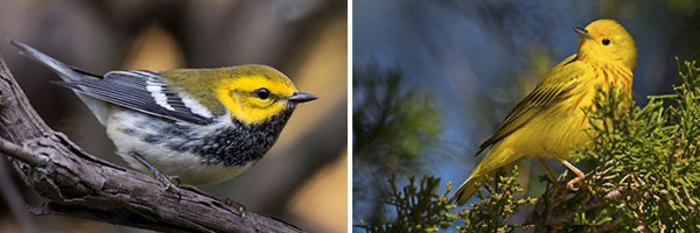
For the first time, big data and artificial intelligence (AI) are being used to model hidden patterns in nature, not just for one bird species, but for entire ecological communities across continents. And the models follow each species’ full annual life cycle, from breeding to fall migration to nonbreeding grounds, and back north again during spring migration. It begins with the more than 900,000 birders who report their sightings to the Cornell Lab of Ornithology’s eBird program, one of the world’s largest biodiversity science projects. When combined with innovations in technology and artificial intelligence–the same innovations that power self-driving cars and real-time language translation–these sightings are revealing more than ever about patterns of bird biodiversity, and the processes that underlie them.
The development and application of this revolutionary computational tool is the result of a collaboration between the Cornell Lab of Ornithology and the Cornell Institute for Computational Sustainability. This work is now published in the journal Ecology.
“This method uniquely tells us which species occur where, when, with what other species, and under what environmental conditions,” said lead author Courtney Davis, a researcher at the Cornell Lab. “With that type of information, we can identify and prioritize landscapes of high conservation value — vital information in this era of ongoing biodiversity loss.”

“This model is very general and is suitable for various tasks, provided there’s enough data,” Gomes said. “This work on joint bird species distribution modeling is about predicting the presence and absence of species, but we are also developing models to estimate bird abundance—the number of individual birds per species. We’re also aiming to enhance the model by incorporating bird calls alongside visual observations.”
Cross-disciplinary collaborations like this are necessary for the future of biodiversity conservation, according to Daniel Fink, researcher at the Cornell Lab and senior author of the study.
“The task at hand is too big for ecologists to do on their own–we need the expertise of our colleagues in computer science and computational sustainability to develop targeted plans for landscape-scale conservation, restoration, and management around the world.”
IMAGE CREDIT: (L) Black-throated Green Warbler by Ian Davies. (R) Yellow Warbler by Brian E. Kushner.
Sign up for the Daily Dose Newsletter and get the morning’s best science news from around the web delivered straight to your inbox? It’s easy like Sunday morning.


Leave a Reply