Porcupines of the genus Coendou are arboreal, herbivorous, nocturnal rodents distributed in tropical and subtropical regions of the Americas. Most of what we currently know on them is restricted to species that occur near urban areas, and we still have a lot to learn about these fascinating animals.
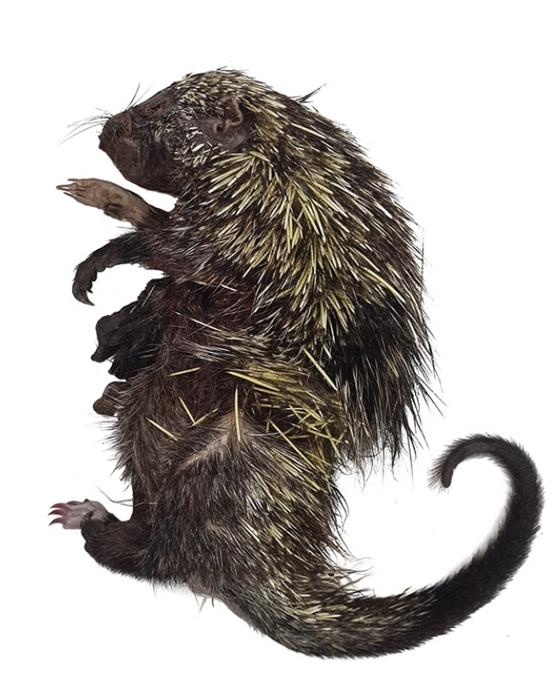
Recently, a new study shed light on a very unknown neotropical porcupine species. Roosmalens’ dwarf porcupine (Coendou roosmalenorum) is the smallest porcupine species we know, with blackish monocolored bristles on the tail which confers a blackish color to it, but apart from its appearance, we didn’t know much about it until recently.
“This species was described in 2001 and our paper is the first scientific report after this date, which means nothing was discovered about Roosmalen’s porcupine in a 22-year period,” says Fernando Heberson Menezes, the lead author of a study that was just published in the open-access journal ZooKeys.

“Before our research, we had only a morphological description of the species, with a little information about its distribution and natural history, and nothing about population ecology or conservation threats.”
Using DNA sequencing and exploring data on its occurrences, Fernando and his team were able to uncover new facts about the enigmatic animal.
Thanks to their study, we now know more about its distribution in the Madeira biogeographical province in the Amazon Forest. “With this information, we raised the hypothesis this species is endemic to Madeira Province, which is important for predicting where we can find this species and the possible threats affecting its population or its distribution,” says Fernando.
At the same time, they found Roosmalens’ dwarf porcupine at new locations in the Amazon rainforest, which suggests that its distribution in southern Amazonia is wider than suspected.
Their phylogenetic analysis – the study of the species’ evolutionary history and relationships with other species – confirmed that the species is a member of the subgenus Caaporamys . This is important, the researchers say, because the classification of the genus Coendou had been “historically chaotic” until the last few years.
The information in this study opens up numerous opportunities for further researching this species. “We can think of ways to answer very basic scientific questions such as ‘how does Roosmalen’s porcupine use space?’ or ‘what does it eat?’, some more advanced questions such as ‘how did it evolve?,’ or applied questions such as ‘what are the major threats for its conservation?,’ or ‘how can we use it as a model to know more about the health of the Amazon forest?’, says Fernando in conclusion.
IMAGE CREDIT: Menezes et al.
Sign up for the Daily Dose Newsletter and get the morning’s best science news from around the web delivered straight to your inbox? It’s easy like Sunday morning.




Leave a Reply