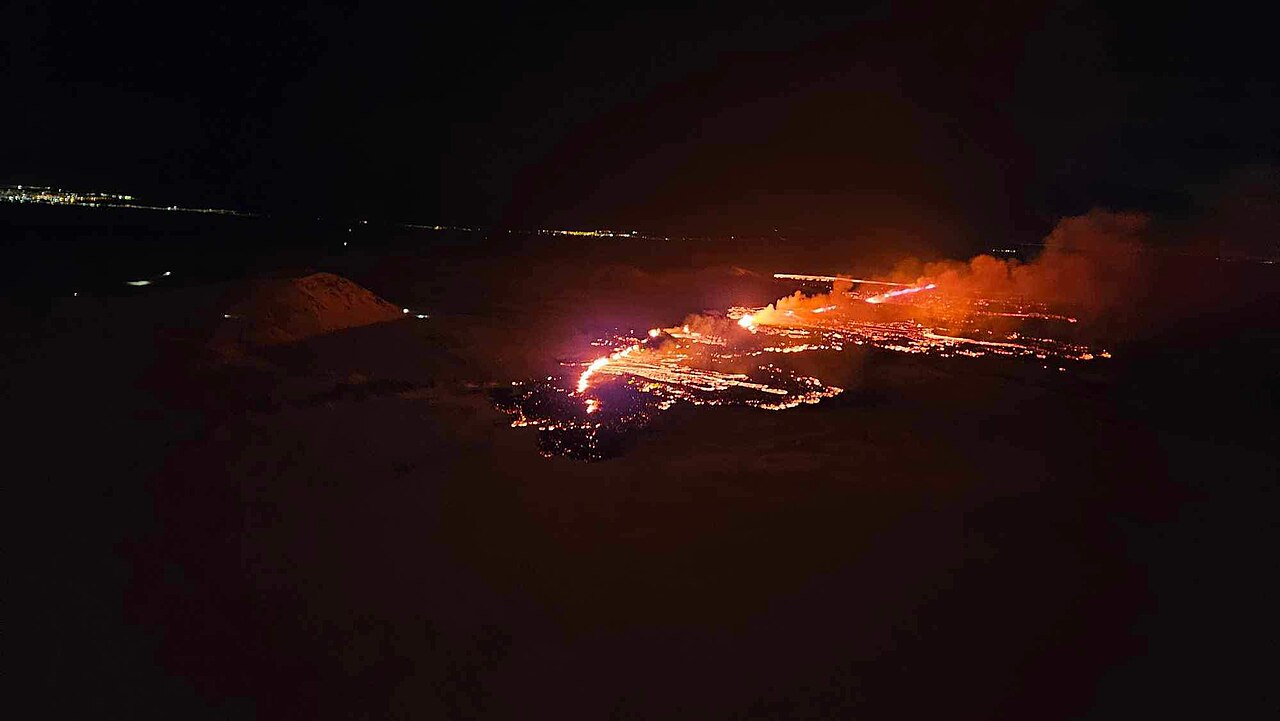
MAJOR VOLCANIC ERUPTION.
A recent volcanic eruption in southwestern Iceland, near the town of Grindavik and about 50 kilometers from Reykjavik, showcased a stunning display of semi-molten rock and light. This eruption, occurring in a region known for its volatile geology, was notable for its visual spectacle but not expected to emit significant ash. Grindavik had been evacuated previously in November due to seismic activities, minimizing the number of people near the eruption site. Despite the dramatic nature of the event, Iceland’s foreign minister confirmed that air travel remained unaffected. Iceland, located over a volcanic hotspot, averages an eruption every four to five years. The recent eruption’s style, characterized by a fire curtain of lava, poses risks, prompting warnings for tourists to exercise caution. The residents of Grindavik, still in temporary housing since their evacuation, face uncertainty about returning home. Scientists monitoring the eruption note its decreasing intensity but are uncertain about its duration. This natural spectacle has drawn awe and attention, emphasizing the dynamic and unpredictable nature of Iceland’s volcanic landscape. (Associated Press)
CHEMO DRUG SHORTAGE.
Stephanie Scanlan’s struggle with rare bone cancer in Tallahassee, Florida, exemplifies the frightening impact of chemotherapy drug shortages in the U.S. At 56, Scanlan couldn’t access two essential drugs for her treatment, leading to the amputation of her left wrist and hand. This incident is a stark representation of a broader issue affecting the healthcare system, where shortages in key chemotherapy and generic drugs are prevalent. These shortages stem from economic factors beyond the FDA’s control, primarily due to the consolidation of generic drug purchasing among a few powerful intermediaries. These group-purchasing organizations drive drug prices down, often to unsustainable levels for manufacturers, leading to supply issues. This situation is compounded by quality control problems in major manufacturing sites like Intas Pharmaceuticals in India, causing nationwide supply shocks. The scarcity of these drugs, crucial in cancer treatment for decades, has significantly impacted patient care across major U.S. cancer centers. Ms. Scanlan’s case, where she couldn’t receive standard chemotherapy even at elite medical facilities, highlights the severity of this crisis. It underscores the complex balance between maintaining affordable drug prices for consumers and ensuring reliable access to essential medications. (New York Times)
If you’re enjoying the Daily Dose, sign up for the Daily Dose Newsletter and get the morning’s best science news from around the web delivered straight to your inbox? It’s easy like Sunday morning.
DEADLY EARTHQUAKE IN CHINA.
A powerful earthquake struck northwest China just before midnight, resulting in the country’s deadliest quake in years, with at least 127 fatalities. The tremor hit impoverished Gansu province, causing at least 113 deaths and injuring over 530 people, with additional casualties in neighboring Qinghai province. The quake, registering a magnitude of 5.9 (USGS) to 6.2 (Xinhua), affected more than 155,000 buildings and sent residents into the freezing streets. Rescue operations commenced in freezing conditions, with a focus on digging through rubble in remote villages. The quake’s epicenter was near Gansu’s provincial capital, Lanzhou, and its impact extended to areas like Xi’an, about 570 kilometers away. President Xi Jinping urged for comprehensive rescue efforts, emphasizing the need for caution against secondary disasters. The quake’s aftermath saw disrupted utilities and significant evacuations, with the government mobilizing resources, including tents and heaters, to aid affected areas. The international community, including Russian President Vladimir Putin, extended condolences and support to China during this crisis. (Channel News Asia)
CRISPR’S POTENTIAL IS VAST.
In 1989, Francis Mojica, a young scientist in Spain, discovered CRISPR in microorganisms while researching at the Santa Pola salt flats. This breakthrough, initially overlooked, later revolutionized medicine. CRISPR, standing for “clustered regularly spaced short palindromic repeats,” was a system microbes used to store virus DNA segments, allowing them to combat returning viruses. This finding laid the groundwork for gene editing. Emmanuelle Charpentier and Jennifer Doudna later realized CRISPR’s potential to rewrite DNA, including human DNA, leading to their Nobel Prize win in 2020. The first CRISPR-based therapy, Casgevy, approved in the UK, treats sickle cell anemia and beta thalassemia by editing and reintroducing modified blood cells into patients. Despite its groundbreaking potential, CRISPR faces challenges like high costs and the risk of unexpected mutations. The therapy’s promise extends to tackling diseases like cancer, Alzheimer’s, and diabetes. Mojica’s early work, once overlooked, now underpins a transformative medical technology, promising to improve millions of lives. (El Pais)

METHANE PERMAFROST DANGERS.
Research in Svalbard has uncovered significant methane migration beneath the permafrost, highlighting potential global warming impacts. Permafrost, ground frozen for at least two years, varies in Svalbard; highlands are more permeable, while lowlands have ice-rich permafrost, effectively sealing methane. This gas, trapped under permafrost from fossil fuel sources, could be released if the permafrost thaws, triggering a cycle of warming and gas release. Dr. Thomas Birchall’s study in Frontiers in Earth Science emphasizes methane’s greenhouse potency and the risk of increased leakage with permafrost thawing. Analysis of historical wellbore data revealed surprising methane accumulations beneath permafrost, more common than expected. This suggests similar conditions across the Arctic. Understanding deep permafrost changes is crucial, as thinning permafrost could facilitate methane escape, accelerating global warming. This research underscores the need for monitoring permafrost to anticipate and mitigate environmental impacts. (Frontiers In)
U.S. KIDS RELYING ON MELATONIN.
Recent research in JAMA Pediatrics highlights a growing trend of melatonin use among U.S. school-age children and preteens for sleep assistance, despite limited FDA regulation. Melatonin, a hormone aiding circadian rhythm, is increasingly used for insomnia, but in the U.S., it’s classified as a dietary supplement, subject to less stringent oversight. A 2023 survey showed significant melatonin usage: 18.5% of children aged 5 to 9 and 19.4% of those aged 10 to 13 had used it in the past month, a sharp increase from 1.3% in 2017-2018. There’s concern about melatonin’s long-term effects on developing brains, and studies have found inconsistencies in supplement content. While it may benefit some children with sleep issues, experts recommend it as a last resort and advise pediatrician consultation. The study, although based on a small sample, suggests widespread melatonin use might indicate deeper sleep problems in children. More research is needed to confirm its long-term safety for pediatric use. (Smithsonian)
DISTURBING FIREARMS NUMBERS AMONG U.S. YOUTH.
In the United States, unintentional injury is the fourth leading cause of death among infants and the primary cause of death for children and adolescents aged 1–17 years, with firearms being a leading method of injury. Data from the National Violent Death Reporting System (NVDRS) covering 2003–2021 from 49 states, the District of Columbia, and Puerto Rico reveals that 1,262 unintentional firearm injury deaths occurred among children aged 0–17 years. The highest percentage of these deaths (33%) was among children aged 11–15 years. Boys comprised 83% of the victims. Most incidents (85%) occurred at a house or apartment, with over half in the child’s own home. About 53% of the fatal injuries were inflicted by others, and 38% were self-inflicted. Two-thirds of the shooters were playing with or showing the firearm when it discharged. Firearms involved were often stored loaded (74%) and unlocked (76%), commonly accessed from sleeping areas. These deaths are preventable, highlighting the need for secured firearm storage practices. It’s crucial for policymakers, healthcare professionals, parents, caregivers, and firearm owners to collaborate in promoting secure storage to prevent child firearm injuries and deaths. (CDC)
Thanks for reading. Let’s be careful out there.
WORDS: The Biology Guy.
IMAGE CREDIT: Almannavarnadeild ríkislögreglustjóra.


Leave a Reply