Although the COVID-19 pandemic was the first time most of humanity learned of the now infamous disease, the family of coronaviruses was first identified in the mid-1960s. In a new study, molecular biologist Steven Van Doren, a scientist in the University of Missouri College of Agriculture, Food and Natural Resources, has uncovered unexpected actions of a key player in how the coronavirus infects its target — a discovery that could guide further vaccine development.
Funded by a National Science Foundation (NSF) grant, Van Doren and his team studied the fusion peptide, an important feature of the spike protein that serves to bind the virus with the human cell, an essential step in the course of infection. In this study, they found that the fusion peptide plays a more invasive role in fusing the virus to the cell than previously thought, which is significant in understanding how infection occurs.
“The fusion peptide is the most preserved part of the whole viral spike,” said Van Doren, a professor of biochemistry. “Throughout the evolution of this virus, the fusion peptide endured despite all the mutations and variants that we kept on hearing about in the news. The fusion peptide never changed much and stayed a constant feature on the virus spike because it’s too critically important for infection for it to be modified.”

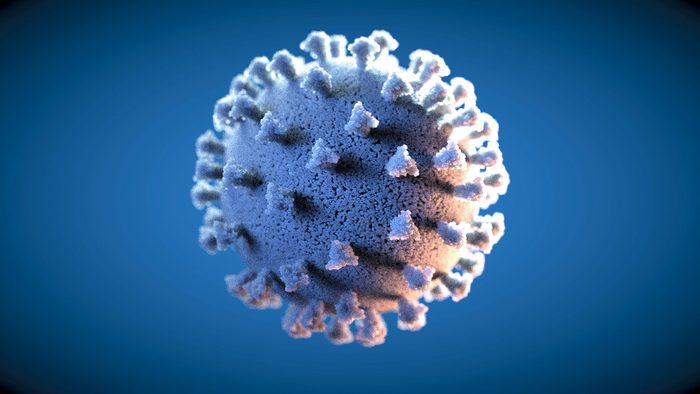
The fusion peptide on the SARS-CoV-2 spike (pictured here) plays a key role in virus/cell attachment.
This research is interesting to compare to a recent study that surveyed asymptomatic patients who were infected by the coronavirus because they had developed a defense mechanism known as broadly neutralizing antibodies. Van Doren’s research on the functionality of the fusion peptide’s ability to puncture a cell membrane could further inform why the fusion peptide may be an important target for vaccine development capable of fighting all types of coronavirus infections.
Another potential application of this research could be to create a novel strategy to penetrate cells.
“There may be many strategies for crossing membranes, but it’s conceivable that the fusion peptide work could help further development of more ways to cross cellular membranes, which could be useful to deliver therapeutics through cell membranes,” Van Doren said.
Further, this research broadens understanding of protein insertion in membranes, which has broader relevance to the scientific community.
“I love what protein molecules look like and what they can do,” Van Doren said. “I got fascinated by the science when I was still a teenager, and it’s intriguing to me the things they can do, so studying how proteins work has been something that has stuck with me for decades now — I’d say going on almost 40 years.”
Sign up for the Daily Dose Newsletter and get the morning’s best science news from around the web delivered straight to your inbox? It’s easy like Sunday morning.


Leave a Reply