HAVE YOUR SAY.
Join us in The Bullpen, where the members of the Scientific Inquirer community get to shape the site’s editorial decision making. We’ll be discussing people and companies to profile on the site. On Wednesday, April 12 at 5:30pm EST, join us on Discord and let’s build the best Scientific Inquirer possible.
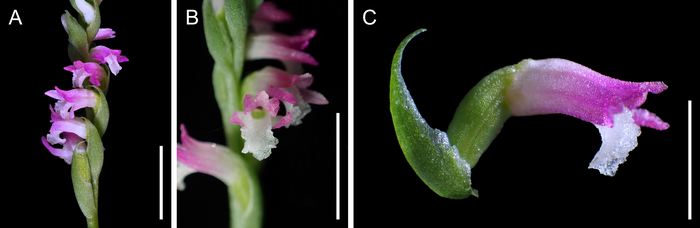
It is extremely rare for a new plant species to be discovered in Japan, a nation where flora has been extensively studied and documented. Nevertheless, Professor SUETSUGU Kenji and his associates recently uncovered a stunning new species of orchid whose rosy pink petals bear a striking resemblance to glasswork (Fig. 1). Since it was initially spotted near Hachijo Island in Tokyo Prefecture, the new species has been given the name Spiranthes hachijoensis. Interestingly, it can be found in familiar environments such as lawns and parks, and even in private gardens and on balconies. This research suggests that other new species may be hiding in common places, eliminating the need to venture into remote tropical rainforests to discover them.
The genus Spiranthes encompasses a captivating and gorgeous variety of orchids, which exhibit an array of distinctive morphological traits. The flowers are typically small and white or pinkish, and arranged in a spiral around a central stalk, hence the moniker “ladies’ tresses.” Spiranthes is the most familiar orchid in Japan and has been cherished for centuries, even appearing in the Manyoshu, Japan’s oldest extant anthology of poetry. For a long time, it was believed that the Spiranthes on the Japanese mainland constituted a single species: Spiranthes australis.
However, while conducting extensive field surveys focused on Japanese Spiranthes specimens, Suetsugu came across several populations of an unknown Spiranthes taxon with hairless flower stems, on the mainland of Japan (Fig. 1). The unknown taxon often grows alongside S. australis but blooms about a month earlier, thus leading to reproductive isolation between the two taxa. Given that S. australis is characterized by a hairy flower stem, the hairless individuals may represent an overlooked species. Consequently, Suetsugu and his colleagues embarked on a comprehensive and multifaceted ten-year study to determine precisely how these plants differed. Specimens were collected from various locations in Japan, Taiwan, and Laos.

By integrating results from DNA analysis, morphology, field observations, and reproductive biology, Suetsugu and his associates discovered that it is a cryptic species that exhibits a high level of molecular divergence, albeit with minimal morphological differentiation (Fig. 2). The fact that the “common” Spiranthes is actually divided into two species is likely to pique the curiosity of the general public. The discovery of a new flowering plant species in Japan is considered an extraordinarily rare event since the flora of this region has been extensively researched. However, the new species reported here can even be found growing in commonplace environments such as parks and lawns. Some specimens used to describe this new species were collected from private gardens and balconies. This discovery of new species concealed in common locales underscores the necessity of persistent exploration, even in seemingly unremarkable settings!
IMAGE CREDIT: Masayuki Ishibashi (A & C) and Kenji Suetsugu (B).




Leave a Reply