HAVE YOUR SAY.
Join us in The Bullpen, where the members of the Scientific Inquirer community get to shape the site’s editorial decision making. We’ll be discussing people and companies to profile on the site. On Wednesday, March 8 at 5:30pm EST, join us on Discord and let’s build the best Scientific Inquirer possible.
A common ingredient – salt – could have a big role to play in the energy transition to lower carbon energy sources. That’s according to a new study led by researchers at The University of Texas at Austin’s Bureau of Economic Geology.
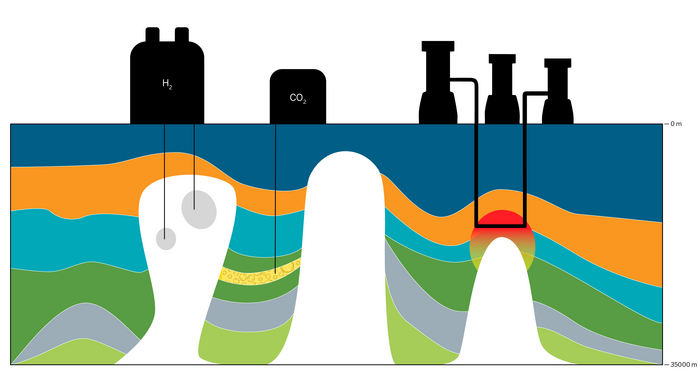
The study describes how large underground salt deposits could serve as hydrogen holding tanks, conduct heat to geothermal plants, and influence CO2 storage. It also highlights how industries with existing salt expertise, such as solution mining, salt mining, and oil and gas exploration, could help.
“We see potential in applying knowledge and data gained from many decades of research, hydrocarbon exploration, and mining in salt basins to energy transition technologies,” said lead author Oliver Duffy, a research scientist at the bureau. “Ultimately, a deeper understanding of how salt behaves will help us optimize design, reduce risk, and improve the efficiency of a range of energy transition technologies.”

The study was published in the journal Tektonika.
Salt has an influential role in shaping Earth’s subsurface layers. It is easily squeezed by geologic forces into complex and massive deposits, with some subsurface salt structures taller than Mount Everest. These structures and their surrounding geology offer a number of opportunities for energy development and emissions management, said study co-author Lorena Moscardelli, the director of the bureau’s State of Texas Advanced Resource Recovery (STARR) program.
“The co-location of surface infrastructure, renewable energy potential, favorable subsurface conditions and proximity to markets is key to plan for subsurface hydrogen storage,” she said. “STARR is currently engaged with emerging energy opportunities in West Texas that involve hydrogen and carbon capture, utilization and storage potential for the region.”
Salt domes are proven containers for hydrogen used by oil refineries and the petrochemical industry. According to the paper, these salt formations could also be put to use as holding pens for hydrogen bound for energy production. What’s more, the porous rock surrounding them could be used as a permanent storage spot for CO2 emissions. The study describes the potential benefits of co-locating hydrogen production from natural gas called “blue hydrogen” and CO2 storage. While the hydrogen is sent to salt caverns, the CO2 emissions generated by production could be kept from the atmosphere by diverting them to the surrounding rock for permanent storage.
With its numerous salt domes surrounded by porous sedimentary rock, the Texas Gulf Coast is particularly well suited for this type of combined production and storage, according to the researchers.
The study also touches on how salt can aid in the adoption of next-generation geothermal technology. Although the industry is still in its early stages, the researchers show how it can make use of salt’s ability to easily conduct heat from warmer underlying rocks to produce geothermal power.
Bureau Director Scott Tinker said that because salt has a role to play in developing new energy resources, it’s important that multiple avenues are thoroughly explored. He said that researchers at the bureau are playing a critical role in doing just that.
“Bureau researchers have been studying subsurface salt formations for many decades. For their role in hydrocarbon exploration, as part of the Strategic Petroleum Reserve, for storage of natural gas, and now for their potential to store hydrogen,” he said. “That’s the remarkable thing about great research. It just keeps evolving, improving and finding new applications.”
IMAGE CREDIT: The University of Texas at Austin / Jackson School of Geosciences




Leave a Reply