HAVE YOUR SAY.
Join us in The Bullpen, where the members of the Scientific Inquirer community get to shape the site’s editorial decision making. We’ll be discussing people and companies to profile on the site. On Wednesday, February 22 at 5:30pm EST, join us on Discord and let’s build the best Scientific Inquirer possible.
Reconfigurable antennas — those that can tune properties like frequency or radiation beams in real time, from afar — are integral to future communication network systems, like 6G. But many current reconfigurable antenna designs can fall short: they dysfunction in high or low temperatures, have power limitations or require regular servicing.
To address these limitations, electrical engineers in the Penn State College of Engineering combined electromagnets with a compliant mechanism, which is the same mechanical engineering concept behind binder clips or a bow and arrow. They published their proof-of-concept reconfigurable compliant mechanism-enabled patch antenna today (Feb. 13) in Nature Communications.
“Compliant mechanisms are engineering designs that incorporate elements of the materials themselves to create motion when force is applied, instead of traditional rigid body mechanisms that require hinges for motion,” said corresponding author Galestan Mackertich-Sengerdy, who is both a doctoral student and a full-time researcher in the college’s School of Electrical Engineering and Computer Science (EECS). “Compliant mechanism-enabled objects are engineered to bend repeatedly in a certain direction and to withstand harsh environments.”

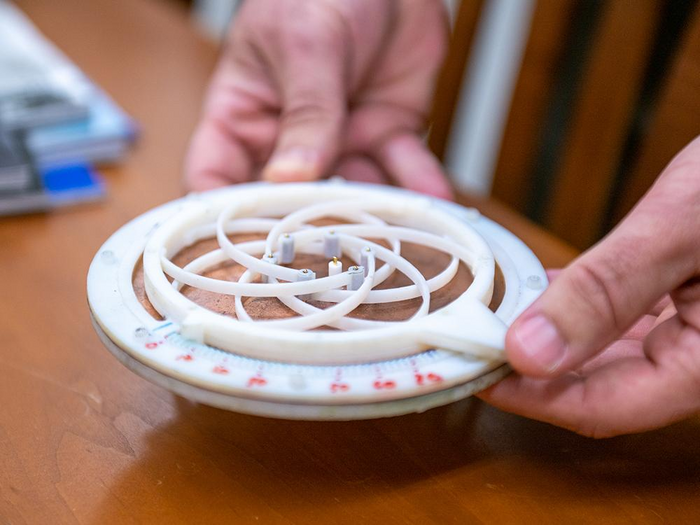
When applied to a reconfigurable antenna, its complaint mechanism-enabled arms bend in a predictable way, which in turn changes its operating frequencies — without the use of hinges or bearings.
“Just like a chameleon triggers the tiny bumps on its skin to move, which changes its color, a reconfigurable antenna can change its frequency from low to high and back, just by configuring its mechanical properties, enabled by the compliant mechanism,” said co-author Sawyer Campbell, associate research professor in EECS.
The compliant mechanism-enabled designs supersede existing origami design technologies, named after the Japanese art of paper folding, which are reconfigurable but do not have the same advantages in robustness, long term reliability and high-power handling capability.
“Origami antenna designs are known for their compact folding and storage capabilities that can then be deployed later on in the application,” Mackertich-Sengerdy said. “But once these origami folded structures are deployed, they usually need a complex stiffening structure, so that they don’t warp or bend. If not carefully designed, these types of devices would suffer environmental and operational lifetime limitations in the field.”
The team illustrated and designed a circular, iris-shaped patch antenna prototype using commercial electromagnetic simulation software. They then 3D printed it and tested it for fatigue failures as well as frequency and radiation pattern fidelity in Penn State’s anechoic chamber, a room insulated with electromagnetic wave-absorbing material that prevents signals from interfering with antenna testing.
Though the prototype — designed to target a specific frequency for demonstration — is only slightly larger than a human palm, the technology can be scaled to the integrated circuit level for higher frequencies or increased in size for lower frequency applications, according to researchers.
Compliant mechanism research has increased in popularity due to the rise of 3D printing, according to the researchers, which enables endless design variations. It was Mackertich-Sengerdy’s background in mechanical engineering that gave him the idea to apply this specific class of compliant mechanisms to electromagnetics.
“The paper introduces compliant mechanisms as a new design paradigm for the entire electromagnetics community, and we anticipate it growing,” said co-author Douglas Werner, John L. and Genevieve H. McCain Chair Professor of EECS. “It could be the branching off point for an entirely new field of designs with exciting applications we haven’t dreamed of yet.”
IMAGE CREDIT: Jeff Xu/Penn State




Leave a Reply