HAVE YOUR SAY.
Join us in The Bullpen, where the members of the Scientific Inquirer community get to shape the site’s editorial decision making. We’ll be discussing people and companies to profile on the site. On Wednesday, January 25 at 5:30pm EST, join us on Discord and let’s build the best Scientific Inquirer possible.
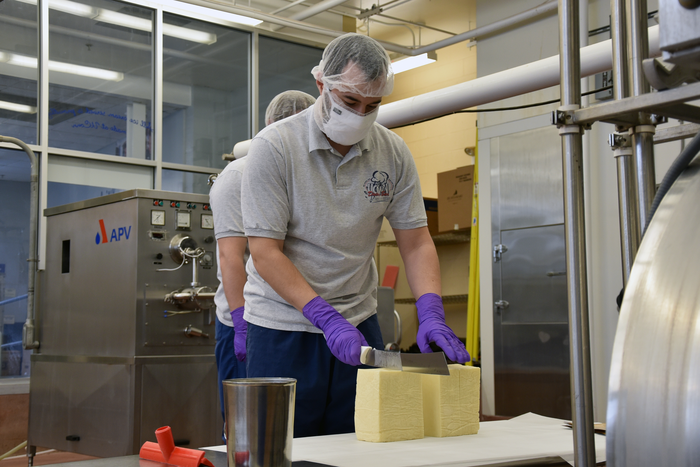
Dennis D’Amico, associate professor of dairy foods in UConn’s College of Agriculture, Health and Natural Resources has continued to advance his work using protective bacterial cultures to prevent illness from food-borne pathogens.
In a new publication in Food Microbiology, D’Amico and his team looked at the ability of a protective culture called Hafnia alvei B16 to prevent infection by two Salmonella serovars, a grouping within the Salmonella enterica species. The serovars D’Amico studied are common culprits in food-borne illness outbreaks and are resistant to multiple antibiotics.
Almost immediately after the introduction of antibiotics like ampicillin, scientists began observing bacterial resistance to the drugs. By the mid-1990s, scientists were identifying multi-drug antibiotic resistance in the Salmonella serovars D’Amico studied.

“One of the biggest challenges in food safety, just like in human medicine is this emergence of superbugs,” D’Amico says. “And these particular strains, as with a lot of Salmonella, have developed resistance to most of the antibiotics we use in food production and human medicine, so we wanted to focus on them as a target.”
This new publication is an expansion of D’Amico’s ongoing work studying the use of protective bacterial cultures to control the growth of pathogens in food products and impede their ability to cause sickness.
Protective cultures work because when bacteria are in the presence of other, similar bacteria, they produce antimicrobial metabolites. When a pathogenic bacterium detects the presence of these protective cultures and their metabolites, it can enter a kind of “fight or flight” mode. The pathogen can turn its focus to expressing genes important to surviving the competitor and turn off many of the nonessential functions that allow it to cause illness such as those needed to attach to and invade human intestinal cells.
Most of the protective cultures on the market target “Gram-positive” bacteria rather than “Gram-negative” ones. This distinction refers to differences in the structure of bacterial cell walls. Gram-positive protective cultures are generally most effective against Gram-positive pathogens, meaning there is a need for effective protective cultures against Gram-negative pathogens, like Escherichia coli and Salmonella, as well.
D’Amico’s lab previously identified Hafnia alvei B16 as effective in inhibiting the growth of both E. coli and Salmonella in milk. Hafnia alvei also effectively stopped the growth of another pathogen, Staphylococcus aureus, and prevented it from producing toxins – critical steps in the bacterium’s ability to cause illness.
“What we learned from our previous work is that not only can these protective cultures stop the growth of pathogens in different situations, in our case it was in milk and dairy products, but they also had these impacts on the virulence of those pathogens when they were able to grow,” D’Amico says.
Hafnia alvei works differently than other protective cultures. Most cultures produce antimicrobial metabolites that stop the growth of competing bacteria. But when Hafnia alvei’s metabolites were added to a pathogenic culture, it didn’t stop their growth as expected. But when the entire Hafnia alvei bacterium was in the presence of E. coli or Salmonella, it did. This told the team it was inhibiting the pathogen’s growth through some other mechanism.
D’Amico’s lab found that growth in the presence of Hafnia alvei decreased the expression of virulence genes in Salmonella and reduced the pathogen’s ability to subsequently invade human intestinal cells by nearly 90%. They also found that when Hafnia alvei attaches to intestinal cells, it does not stop Salmonella from adhering to the cells, but protects them from invasion.
“Because the Salmonella could still adhere to, but not invade intestinal cells, this culture could potentially have stimulated those cells to protect themselves against the invading pathogen, so that could be another mechanism by which these protective cultures exert an effect,” says D’Amico.
D’Amico’s study did find differences in gene expression and how the two serovars, S. Typhimurium and S. Newport, responded to the protective culture in milk.
For example, coculture with Hafnia alvei in milk prevented S. Typhimurium from adhering to intestinal cells but not the Newport serovar.
“We did find some difference between the two serovars, so it does look like these effects are not necessarily universal across Salmonella,” D’Amico says. “Even though they’re very similar, they do differ ever so slightly. And some of those differences may have an impact on the ability of this culture and other cultures to have an effect more globally.”
IMAGE CREDIT: Jason Sheldon/UConn Photo


Leave a Reply