HAVE YOUR SAY.
Join us in The Bullpen, where the members of the Scientific Inquirer community get to shape the site’s editorial decision making. We’ll be discussing people and companies to profile on the site. On Wednesday, August 31 at 5:30pm EST, join us on Discord and let’s build the best Scientific Inquirer possible.
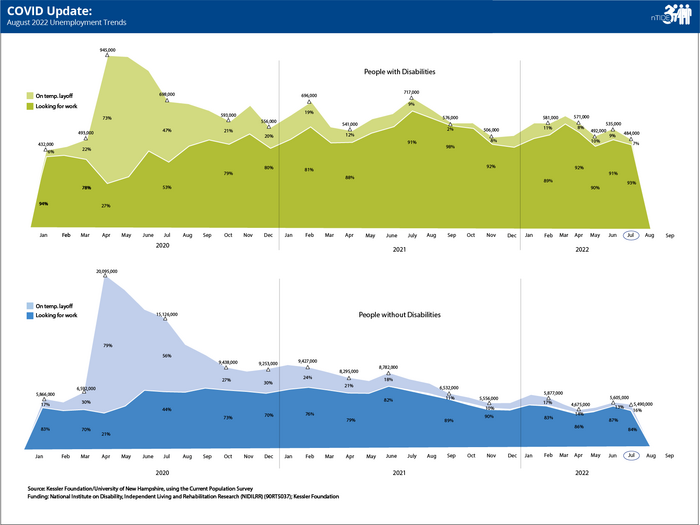
Employment continues to remain solid and steady in July for people with disabilities, according to today’s National Trends in Disability Employment (nTIDE) COVID Update. July numbers showed a slight decrease in unemployment for people with disabilities and people without disabilities.
“Over the past three months with unemployment hovering slightly above pre-pandemic levels, we seem to be stabilizing around a better picture for people with disabilities,” noted Andrew Houtenville, PhD, professor of economics at the University of Hampshire (UNH) and research director of the UNH Institute on Disability. “The level of unemployed people with disabilities is returning to baseline, pre-pandemic levels,” Dr. Houtenville said. “Our COVID Update data is consistent with what we saw in employment and labor force participation statistics detailed in this month’s prior nTIDE report,” he added.
“We’re waiting to see how world events and U.S. inflation-fighting policies will influence the job market. Supply chain bottlenecks and rising interest rates will likely affect economic growth and eventually the Iabor market,” said Dr. Houtenville. “Meanwhile, staffing issues continue to be a problem around the country. In many areas it is difficult to fill jobs, even with wages rising and initial salary offers increasing,” he added.

Monitoring the National Trends in Disability Employment will help us track the impact of these economic shifts on people with disabilities. Register now for upcoming nTIDE webinars scheduled for September 2 and September 23, 2022: nTIDE Lunch & Learn Webinar Series | Center for Research on Disability.
Field Notes
For the most part, people with disabilities who were impacted by the pandemic are now back to work, according to Job Path NYC, a nonprofit that provides customized employment services for people with intellectual and developmental disabilities. “But for some individuals with more intense support needs, returning to work has been slower,” said nTIDE co-author John O’Neill, PhD, director of the Center for Employment and Disability Employment Research at Kessler Foundation and board member of Job Path NYC.
According to Job Path NYC, New York schools and the theater district are two job sectors that are struggling organizationally to a degree to return to a place where they can rehire Job Path participants, explained Dr. O’Neill. “Staffing shortages and undetermined sources of funding have caused organizational challenges in New York’s public schools, hindering job placement,” he added. “Because of these factors, jobs that people with disabilities filled often don’t exist anymore. The pandemic caused long-term and intermittent closures of venues in the theater district, which also led to job losses,” said Dr. O’Neill. “Many staff members and supervisors who liaison with Job Path NYC have left their positions, so the job placement team must start over to make connections, Dr. O’Neill concluded.
For in-depth analysis of the impact of the COVID-19 pandemic on employment trends, see our recent nTIDE Special Edition: Workers with disabilities overcome pandemic setbacks, outpacing people without disabilities to set new records for employment.
IMAGE CREDIT: Kessler Foundation




Leave a Reply