HAVE YOUR SAY.
Join us in The Bullpen, where the members of the Scientific Inquirer community get to shape the site’s editorial decision making. We’ll be discussing people and companies to profile on the site. On Wednesday, August 17 at 5:30pm EST, join us on Discord and let’s build the best Scientific Inquirer possible.
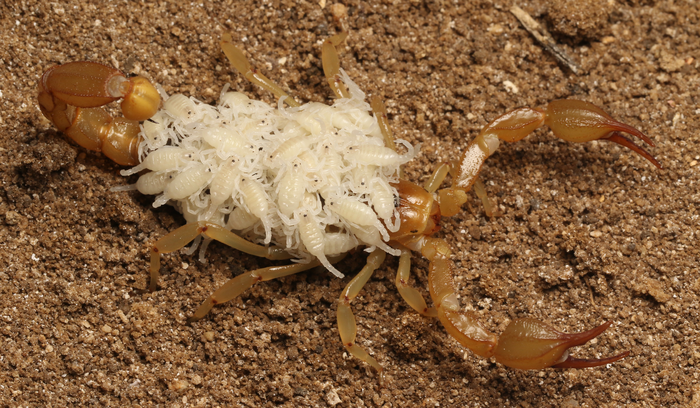
California now has two new scorpions on its list of species, thanks to the efforts of two keen-eyed high school students from the Bay Area and the California Academy of Sciences. Harper Forbes and Prakrit Jain, avid users on the community science platform iNaturalist, discovered the new-to-science scorpions while trawling the thousands of observations uploaded by other users in the state. New species Paruroctonus soda and Paruroctonus conclusus are playa scorpions, meaning they can only be found around dry lake beds, or playas, from the deserts of Central and Southern California. For scientists, conservation managers, and the growing communities of wildlife observers on platforms like iNaturalist, these newly described species provide a better understanding of California’s biodiversity and the places most in need of protection—a cornerstone of the Academy’s Thriving California initiative. The budding naturalists collaborated with Curator of Arachnology Lauren Esposito, PhD, to formally describe the species in a study published today in ZooKeys.
In 2019, Forbes and Jain came across an unknown scorpion species on iNaturalist observed near Koehn Lake—an ephemeral lake in the Mojave Desert—that had remained unidentified since it was uploaded six years earlier.
“We weren’t entirely sure what we were looking at,” Jain says. “Over the next couple years, we studied scorpions in the genus Paruroctonus and learned they frequently evolve to live in alkali playas like Koehn Lake. When we returned to that initial observation, we realized we were looking at an undescribed Paruroctonus species.”

Serendipitously, another unknown scorpion observed in San Luis Obispo County was uploaded to iNaturalist shortly after their discovery in May of 2021. With a few years of arachnid research under their belts, Forbes and Jain knew right away that it was a new species in the same genus. They immediately contacted Esposito to assist, resulting in two new-to-science scorpions—P. soda and P. conclusus—and a published paper in which Forbes and Jain are first authors.
“Harper and Prakrit went through all the steps to formally describe a species, sampling the populations and comparing them with existing specimens in our collection,” Esposito says. “There’s a lot of work involved, but they are incredibly passionate about this research. It’s inspiring to see that their hobby is one that advances biodiversity science.”
P. soda and P. conclusus are both alkali sink specialists, meaning they have adapted to the alkaline basins—dry, salty playas with high pH soils—in which they evolved. Each species has a very limited range and can only be found in the playas where they were discovered: Soda Lake (the former’s namesake) and Koehn Lake. During their summer break, Forbes and Jain visited the lakes to collect specimens of each new species. After scouting the alkali flats during the daytime for habitats most suited for playa scorpions, they set out with their vials and forceps at dusk, as these desert dwellers are primarily active at night. Luckily, most scorpions fluoresce under ultraviolet light, so the researchers used blacklights to scour the open playas while keeping an eye out for their glowing subjects. They also searched the scorpions’ typical hiding places, peering into cracks in the hard clay soil and combing through common alkali sink plants like iodine bush (Allenrolfea occidentalis) and bush seepweed (Suaeda nigra). At the end of each trip, they successfully collected a sample size of both males and females sufficient for the study.
While the species range for P. soda is small (just a few square miles), it is entirely located within Carrizo Plain National Monument—federally protected land that renders this species safe from human-driven threats. Unfortunately, this is not the case for P. conclusus.
“While no official assessment has been carried out for either species, P. conclusus can only be found on a narrow strip of unprotected land, less than two kilometers long and only a few meters wide in some places,” Forbes says. “The entire species could be wiped out with the construction of a single solar farm, mine, or housing development.”
Though P. soda seems to be relatively safe compared to P. conclusus, the constant threat of climate change endangers all wildlife, particularly in delicate desert environments. As part of the Thriving California initiative, Academy scientists hope to collaborate with schools and communities throughout the state to conduct further biodiversity research. By harnessing scientific data—including crowd-sourced data from iNaturalist—and providing access to environmental and science learning, the initiative hopes to halt biodiversity loss in the Golden State.
Now high school graduates, this fall Forbes will study evolutionary biology at the University of Arizona and Jain will study integrative biology at the University of California, Berkeley. They will continue their work with Esposito and are currently collaborating on their next major project: a holistic book of California’s scorpions. In addition to their research and academic endeavors, they are excited to get back out in the field to find, collect, and identify more scorpions.
“I will never get tired of going out at night to find a certain scorpion for the first time,” Jain says. “Whether it be solving the mystery of a long-lost scorpion or discovering something new in an unexpected place, a trip to the desert is always a challenge and an adventure.”
IMAGE CREDIT: Gayle Laird © California Academy of Sciences



Leave a Reply