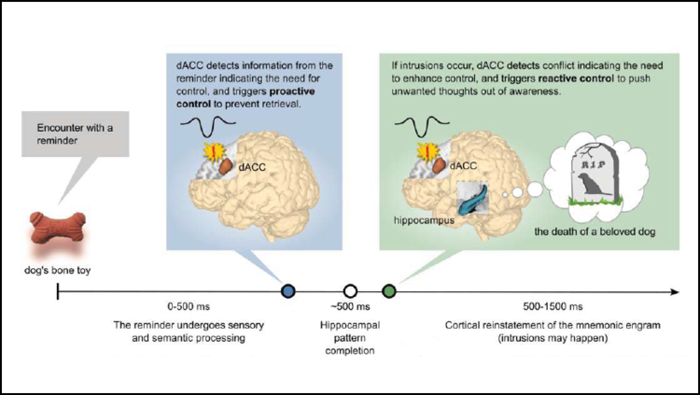
Forget what you saw: a brain region detects when you are about to think of an unwanted memory and alerts other regions to suppress it, according to research recently published in JNeurosci.
Crespo García et al. measured participants’ brain activity with both EEG and fMRI while they completed a memory task. The participants memorized sets of words (i.e., gate and train) and were asked to either recall a cue word’s pair (see gate, think about train) or only focus on the cue word (see gate, only think about gate).
During proactive memory suppression, activity increased in the anterior cingulate cortex (ACC), a brain region involved in cognitive control, within the first 500 milliseconds of the task. The ACC relayed information to the dorsolateral prefrontal cortex (DLPFC), which then inhibited activity in the hippocampus, a key region for memory recall.
The activity levels in the ACC and DLPFC remained low for the rest of the trial, a sign of success — the memory was stopped early enough so no more suppression was needed. If the memory was not suppressed in time, the ACC generated a reactive alarm, increasing its activity to signal to the DLPFC to stop the intrusion.
IMAGE CREDIT: Crespo García et al., JNeurosci 2022




Leave a Reply