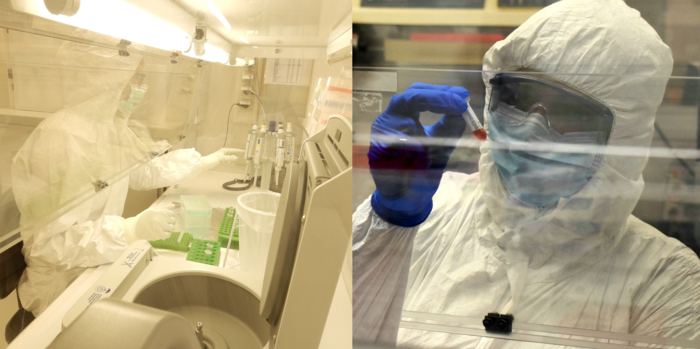
Tuberculosis is the second most common cause of death worldwide by an infectious pathogen, COVID-19 being the first. However, many aspects of TB’s long history remain controversial. Scientists studying ancient TB genomes are assembling pieces of this complex evolutionary puzzle, now suggesting that not only does TB pre-date the arrival of European settlers in the Americas, but also that early TB variants traveled long distances on land.

Building on the 2014 discovery that the emergence of TB in Peru likely came from marine mammals like seals and sea lions, a recent study published in the journal Nature Communications confirmed those findings and discovered cases in people who lived nowhere near the coast, suggesting these infections were not the result of direct transmission from seals, but rather caused by one, or more, spillover events – where a pathogen moves from one species to another.
The research team, co-led by Tanvi Honap, a research assistant professor of anthropology, Dodge Family College of Arts and Sciences at the University of Oklahoma, and Åshild Vågene with the Section for Evolutionary Genomics, GLOBE Institute at the University of Copenhagen, recovered three new ancient TB genomes.
“These three new cases of pre-contact-era South American TB are from human remains that come from inland archaeological sites, two of which are situated in the highlands of the Colombian Andes, Honap said. “All of these new three ancient TB genomes resemble M. pinnipedii – the same TB variant found in the ancient coastal Peruvian individuals and in modern-day seals and sea lions.”
The research team, which includes scientists from the Max Planck Institute for Evolutionary Anthropology and Arizona State University, used archaeological evidence and stable isotope data to show that the inland individuals did not have contact with marine mammals. Thus, the TB transmission was most likely from the bacterium “jumping” to other species.
Vågene said, “The TB bacterium can infect numerous mammalian species, so there are many candidates for its terrestrial dispersal, including humans themselves.”
“Colombia has a wide variety of terrestrial mammals, so M. pinnipedii could have been brought inland via the animal life,” Honap added. “Or in a more likely scenario, it could have been brought inland via human-to-human transmission facilitated by trade routes, or a combination of both!”
Anne Stone, one of the study’s contributors and a specialist in the evolutionary history of TB, sees their findings as an opportunity for deeper exploration into the ecology of the disease in the Americas before the colonial period.
“It’s an exciting time in ancient DNA research, as we can now look at genome-level differences in these ancient pathogens and track their movements across continents and beyond,” she said.
IMAGE CREDIT: Elizabeth Nelson. Right image provided by Sarah Johnson.



Leave a Reply