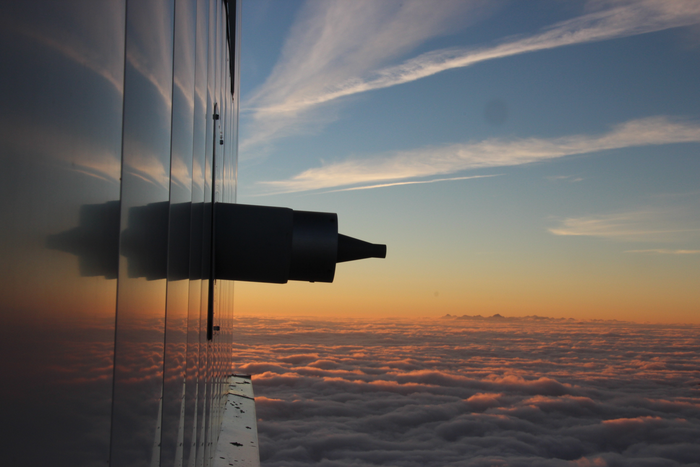
Previously detected in rivers, oceans, and snow,1 microplastic has now been found in the high-altitude air surrounding the Pic du Midi (2,877 m)—by an international research team including scientists from the CNRS, Université Grenoble Alpes,2 and the University of Strathclyde (Scotland).

After analysing the composition of 10,000 m3 of air captured weekly by a pump installed at the Pic du Midi Observatory,3 the researchers report a microplastic concentration of approximately one particle per 4 m3.
This plastic (e.g., polystyrene or polyethylene polymers) comes predominantly from packaging. While posing no direct threat, its presence far from sources of pollution is nonetheless surprising. Mathematical models of air mass trajectories used by the scientists indicate that the particles originated in Africa, North America, or the Atlantic Ocean, which indicates intercontinental atmospheric transport of microplastic.
The team’s findings, published in Nature Communications (21 December 2021), describe a new stage in the microplastic life cycle and offer an explanation for their presence at the poles, on Mount Everest, or in other remote regions of our planet.
IMAGE CREDIT: Jeroen Sonke

Leave a Reply