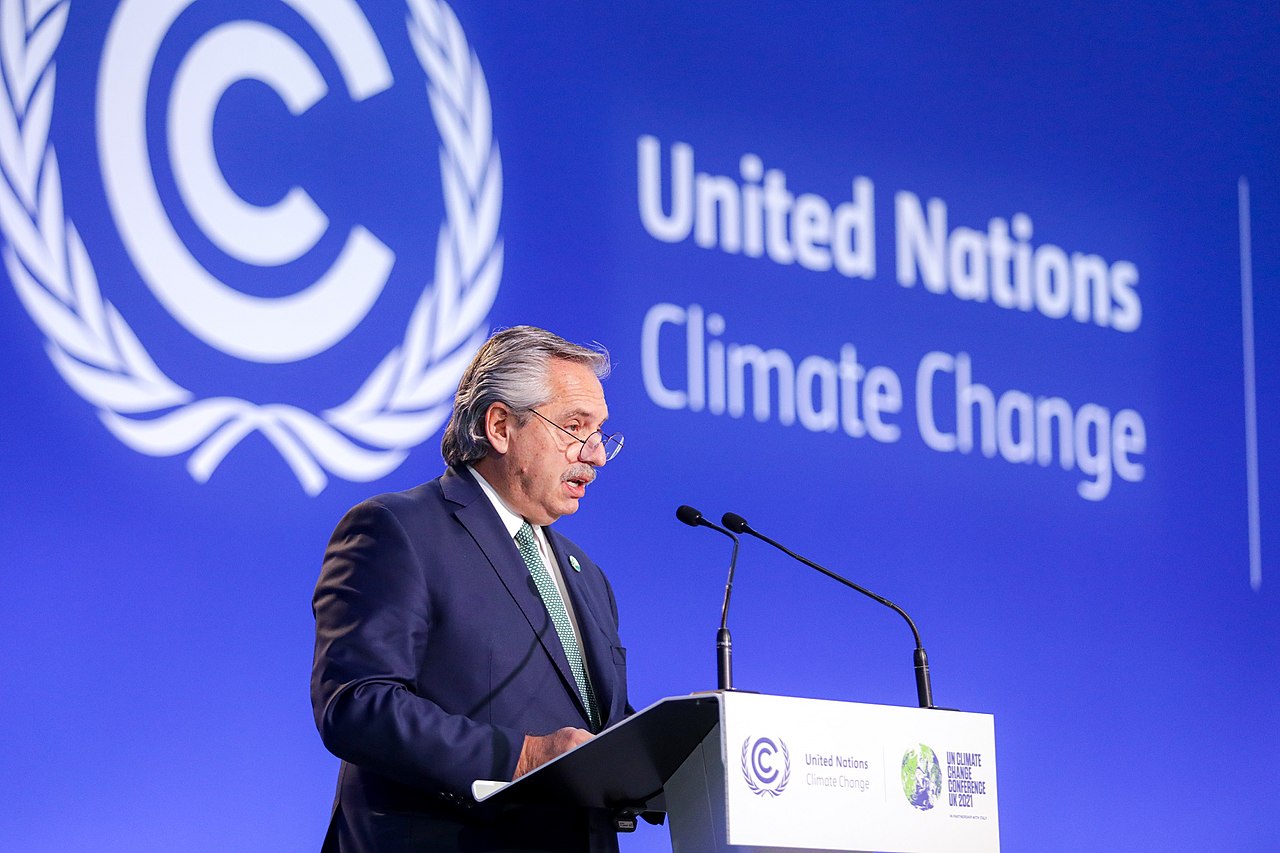
Faced with the prospect of world leaders assuming cautious approaches to just how much they are willing to promise in terms of fighting climate change, the head of the United Nations is doing some public jaw-boning as COP26 draws to a conclusion. Per the Associated Press, “United Nations Secretary-General Antonio Guterres says the goal of limiting global warming to 1.5 degrees Celsius (2.7 F) is ‘on life support’ with climate talks in Glasgow so far not reaching any of the U.N.’s three goals, but he added that ‘until the last moment, hope should be maintained.’ In an exclusive interview Thursday with The Associated Press, Guterres said the U.N. climate talks in Glasgow, Scotland “are in a crucial moment” and need to accomplish more than securing a weak deal that participating nations agree to support. ‘The worst thing would be to reach an agreement at all costs by a minimum common denominator that would not respond to the huge challenges we face,’ Guterres said.” In other words, he’d like some more aspirational pledges. As we all know, actual commitments are far and very few between. https://bit.ly/3oCaBCP
It’s great when two openly hostile countries can find common ground. Now, the two largest polluters in the world have joined hands in what is most likely a commitment to share the responsibility of gas lighting the world in terms of fighting climate change. Per the Associated Press, “China and the United States have pledged to increase cooperation on climate action at U.N. talks in Glasgow, China’s climate envoy said Wednesday. As the talks approached a Friday deadline, Xie Zhenhua told reporters that the two biggest carbon polluters would outline their efforts in a joint statement based on the guidelines of the 2015 Paris Agreement on climate change. The agreement calls for ‘concrete and pragmatic’ regulations in decarbonization, reducing methane emissions and fighting deforestation, Xie said. ‘Both sides recognize that there is a gap between the current effort and the Paris agreement,’ he said. ‘So we will jointly strengthen climate action and cooperation with respect to our respective national situations.’” It’s interesting that when it comes to agreeing on something, it’s about doing the least possible effort in fighting climate change. https://bit.ly/30fYMJW
An interesting article in Nature takes a look at Caltech’s problematic racist past and its attempts at addressing it. The whole thing started when a student was doing some research at the university. According to the article, “After a few hours leafing through documents in the basement of a research building, Jane Panangaden was shaking with rage. It was 2017 and she was reading case records for hundreds of people who had been sterilized, usually without their consent, in the 1920s and 1930s. The physician reports had been collected to support the eugenics movement, a racist, pseudoscientific ideology with a history, Panangaden now realized, that was deeply entwined with that of her university, the California Institute of Technology — or Caltech — in Pasadena.” She had stumbled upon documents regarding the Human Betterment Foundation (HBF), one of the most prominent eugenics groups of its time. The organization began in Pasadena at about the same time that Caltech transformed from a technical school into a science and engineering powerhouse. https://go.nature.com/3wAvq4S
It’s becoming increasingly common to discover instances where the genetic code is expanded to include other bases. An article in The Scientist puts the spotlight on a study that has discovered that the phenomenon is far more common than believed. According to The Scientist, “The genetic code that dictates how genetic information is translated into specific proteins is less rigid than scientists have long assumed, according to research published today (November 9) in eLife. In the paper, scientists report screening the genomes of more than 250,000 species of bacteria and archaea and finding five organisms that rely on an alternate genetic code, signifying branches in evolutionary history that haven’t been fully explained.” Coupled with epigenetics, this really challenges the established view about how our genetic material functions. https://bit.ly/3oqm9Jg
Dogs may be man’s best friend, but we sure don’t always treat them that way. That is particularly true when it comes to little things that we may not perceive but which really distress canines. Sounds are a perfect example. Per Futurity, “While it’s well established that sudden loud noises, such as fireworks or thunderstorms, commonly trigger a dog’s anxiety, the new study finds even common noises, such as a vacuum or microwave, can be a trigger. The research in Frontiers in Veterinary Science shows that high-frequency, intermittent noises such as the battery warning of a smoke detector are more likely to cause a dog anxiety, rather than low-frequency, continuous noise. ‘We know that there are a lot of dogs that have noise sensitivities, but we underestimate their fearfulness to noise we consider normal because many dog owners can’t read body language,’ says lead author Emma Grigg, a research associate and lecturer at the University of California, Davis School of Veterinary Medicine. https://bit.ly/3qpMERD
Thanks for reading. Let’s be carefully out there.
IMAGE SOURCE: Casa Rosada.



Leave a Reply