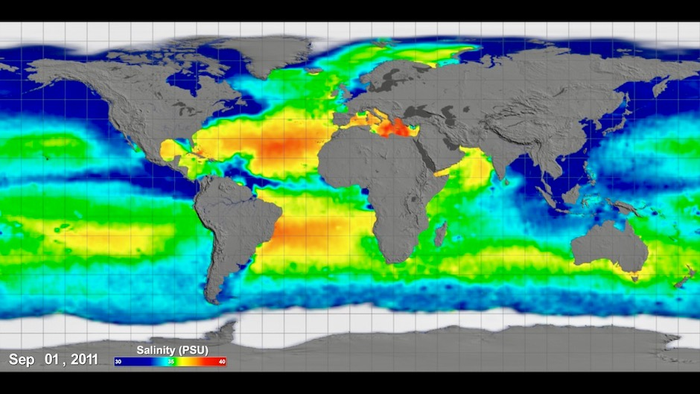
MIAMI—A new study led by scientists at the University of Miami (UM) Rosenstiel School of Marine and Atmospheric Science, in collaboration with scientists at Princeton University, shows that the intensification of global hydrological cycle drives more ocean heat uptake into the deep ocean and moderates the pace of global warming.

As a result of a warming climate, the global water cycle becomes more intensified and as a result wet regions are getting wetter and dry regions are getting drier. The researchers found that this intensification is also reflected in ocean salinity. The increase in ocean surface salinity in salty regions, such as the subtropical oceans, leads to denser seawater and more heat uptake in to the deep ocean. The increase in the rate of ocean heat uptake would reduce the rate of surface warming.
“We discovered a new mechanism that influences the rate of global warming through a suite of climate model experiments,” said Maofeng Liu, a postdoctoral researcher at the UM Rosenstiel School, Department of Atmospheric Sciences. “The good match between climate model simulations and observations in the past few decades suggest that the salinity changes due to human-induced warming are likely working to enhance the ocean heat uptake.”
To conduct the study, the researchers used a global climate model to conduct two sets of experiments. In the first set of experiments conducted as a baseline, they increased the atmospheric carbon dioxide concentration one percent per year until it doubled. In the second set of experiments, they repeated the first experiment but do not allow the surface salinity to respond to the CO2-induced global hydrological cycle changes. The different outcome from the two sets of experiments highlights the impact of the water cycle changes in the ocean heat uptake and transient climate change.
Global warming from emission of greenhouse gas into the atmosphere is increasing sea levels and resulting in more frequent and intense storms, drought, and wildfires.
“Predicting the rate of global warming is still a challenge,” said Liu. “This study found a new impact to the rate of global warming.”
The study, titled “Enhanced hydrological cycle increases ocean heat uptake and moderates transient climate change,” was published on Sep 23, 2021 in the journal Nature Climate Change. The study’s authors include: Maofeng Liu, Brian Soden and Bosong Zhang from the UM Rosenstiel School; and Gabriel Vecchi and Wenchang Yang from Princeton University.
Funding for the study was provided by National Aeronautics and Space Administration (NASA) and the U.S. Department of Energy (DOE)
IMAGE CREDIT: NASA, Scientific Visualization Studio

Leave a Reply