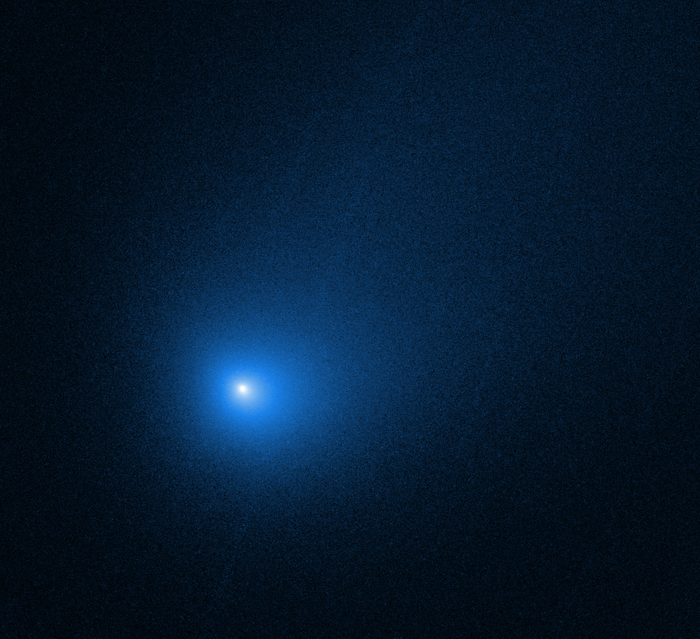
Cambridge, MASS. – In 2019, astronomers spotted something incredible in our backyard: a rogue comet from another star system. Named Borisov, the icy snowball traveled 110,000 miles per hour and marked the first and only interstellar comet ever detected by humans.
But what if these interstellar visitors—comets, meteors, asteroids and other debris from beyond our solar system—are more common than we think?
In a new study published Monday in the Monthly Notices of the Royal Astronomical Society, astronomers Amir Siraj and Avi Loeb at the Center for Astrophysics | Harvard & Smithsonian (CfA) present new calculations showing that in the Oort Cloud—a shell of debris in the farthest reaches of our solar system—interstellar objects outnumber objects belonging to our solar system.
“Before the detection of the first interstellar comet, we had no idea how many interstellar objects there were in our solar system, but theory on the formation of planetary systems suggests that there should be fewer visitors than permanent residents,” says Siraj, a concurrent undergraduate and graduate student in Harvard’s Department of Astronomy and lead author of the study. “Now we’re finding that there could be substantially more visitors.”
The calculations, made using conclusions drawn from Borisov, include significant uncertainties, Siraj points out. But even after taking these into consideration, interstellar visitors prevail over objects that are native to the solar system.
“Let’s say I watch a mile-long stretch of railroad for a day and observe one car cross it. I can say that, on that day, the observed rate of cars crossing the section of railroad was one per day per mile,” Siraj explains. “But if I have a reason to believe that the observation was not a one-off event—say, by noticing a pair of crossing gates built for cars—then I can take it a step further and begin to make statistical conclusions about the overall rate of cars crossing that stretch of railroad.”
But if there are so many interstellar visitors, why have we only ever seen one?
We just don’t have the technology to see them yet, Siraj says.
Consider, he says, that the Oort Cloud spans a region some 200 billion to 100 trillion miles away from our Sun—and unlike stars, objects in the Oort Cloud don’t produce their own light. Those two factors make debris in the outer solar system incredibly hard to see.
Senior astrophysicist Matthew Holman, who was not involved in the research, says the study results are exciting because they have implications for objects even closer than the Oort Cloud.
“These results suggest that the abundances of interstellar and Oort cloud objects are comparable closer to the Sun than Saturn. This can be tested with current and future solar system surveys,” says Holman, who is the former director of the CfA’s Minor Planet Center, which tracks comets, asteroids and other debris in the solar system.
“When looking at the asteroid data in that region, the question is: are there asteroids that really are interstellar that we just didn’t recognize before?” he asks.
Holman explains that there are some asteroids that get detected but aren’t observed or followed up on year after year. “We think they are asteroids, then we lose them without doing a detailed look.”
Loeb, study co-author and Harvard astronomy professor, adds that “interstellar objects in the planetary region of the solar system would be rare, but our results clearly show they are more common than solar system material in the dark reaches of the Oort cloud.”
Observations with next-generation technology may help confirm the team’s results.
The launch of the Vera C. Rubin Observatory, slated for 2022, will “blow previous searches for interstellar objects out of the water,” Siraj says, and hopefully help detect many more visitors like Borisov.
The Transneptunian Automated Occultation Survey (TAOS II), which is specifically designed to detect comets in the far reaches of our solar system, may also be able to detect one of these passersby. TAOS II may come online as early as this year.
The abundance of interstellar objects in the Oort Cloud suggests that much more debris is left over from the formation of planetary systems than previously thought, Siraj says.
“Our findings show that interstellar objects can place interesting constraints on planetary system formation processes, since their implied abundance requires a significant mass of material to be ejected in the form of planetesimals,” Siraj says. “Together with observational studies of protoplanetary disks and computational approaches to planet formation, the study of interstellar objects could help us unlock the secrets of how our planetary system — and others — formed.”
IMAGE CREDIT: NASA, ESA and D. Jewitt (UCLA)




Leave a Reply